

Start here
What Is an Electrical Panel and What Does It Do?
Next
Circuit Breakers vs. Fuses: Key Differences
Then
How to Read Your Panel's Layout
Stay safe
Warning Signs That Demand Attention
Know your limits
What Homeowners Can Do - and What Requires a Licensed Electrician
What Is an Electrical Panel and What Does It Do?
Your electrical panel - also called a breaker box, load center, or service panel - is the metal cabinet, typically in a basement, garage, or utility closet, where utility power enters your home and gets divided into individual circuits. Think of it as a traffic hub: electricity arrives at high capacity from your utility, and the panel routes it in manageable portions to your lights, outlets, appliances, and HVAC system.
Every circuit in the panel is protected by either a circuit breaker or a fuse. When too much current flows through a circuit - from a short, a fault, or too many devices running at once - the protection device interrupts the flow before the wiring overheats. This protective function is the panel's most critical job, and understanding it helps you respond calmly when something goes wrong.
Circuit
A closed loop of wiring that carries electricity from the panel to outlets, lights, or appliances and back. Each circuit is protected by its own breaker or fuse.
Circuit breaker
A resettable switch inside your panel that automatically shuts off a circuit when it detects too much current, protecting your wiring from overheating.
Amperage (amps)
The measure of how much electrical current a circuit or wire can carry safely. Each breaker is rated for a maximum amperage that must not be exceeded.
GFCI
Ground-fault circuit interrupter - a safety device that cuts power in milliseconds when it detects current leaking outside the normal path, reducing shock risk near water.
AFCI
Arc-fault circuit interrupter - a type of breaker that detects dangerous electrical arcing in wiring or connections and shuts the circuit off to prevent fires.
Main breaker
The large double breaker at the top of most panels that controls power to every circuit in the home simultaneously. It does not cut power to the service entrance wires above it.
For a broader look at home systems every owner should know, see our first-time homeowner maintenance primer.
Circuit Breakers vs. Fuses: Key Differences
Homes built before roughly the 1960s often used fuse boxes, which contain screw-in or cartridge fuses made of thin wire. When a circuit overloads, the wire melts - breaking the circuit. Fuses work, but they are single-use: once blown, they must be replaced with a fuse of the correct amperage rating.
Most homes built or rewired since then use circuit breakers - resettable switches that trip to an off position when overloaded. Breakers come in several types: standard single-pole breakers for 120-volt circuits, double-pole breakers for 240-volt appliances like dryers and ranges, and specialty breakers such as AFCI (arc-fault circuit interrupter) and GFCI (ground-fault circuit interrupter) types, which offer additional protection in bedrooms, kitchens, and bathrooms.
Match the Fuse Amperage Exactly
When replacing a blown fuse, always use a replacement with the identical amperage rating printed on the old fuse. Installing a higher-rated fuse to stop nuisance blowing is a common but dangerous mistake - it allows more current than the wiring is designed to handle, increasing fire risk. If a circuit fuse blows repeatedly, call an electrician to find the underlying cause.
Knowing which system your home has matters. If you're unsure, a quick look inside the panel will reveal either rows of toggle-style breakers or a cluster of round, screw-in fuses.
How to Read Your Panel's Layout
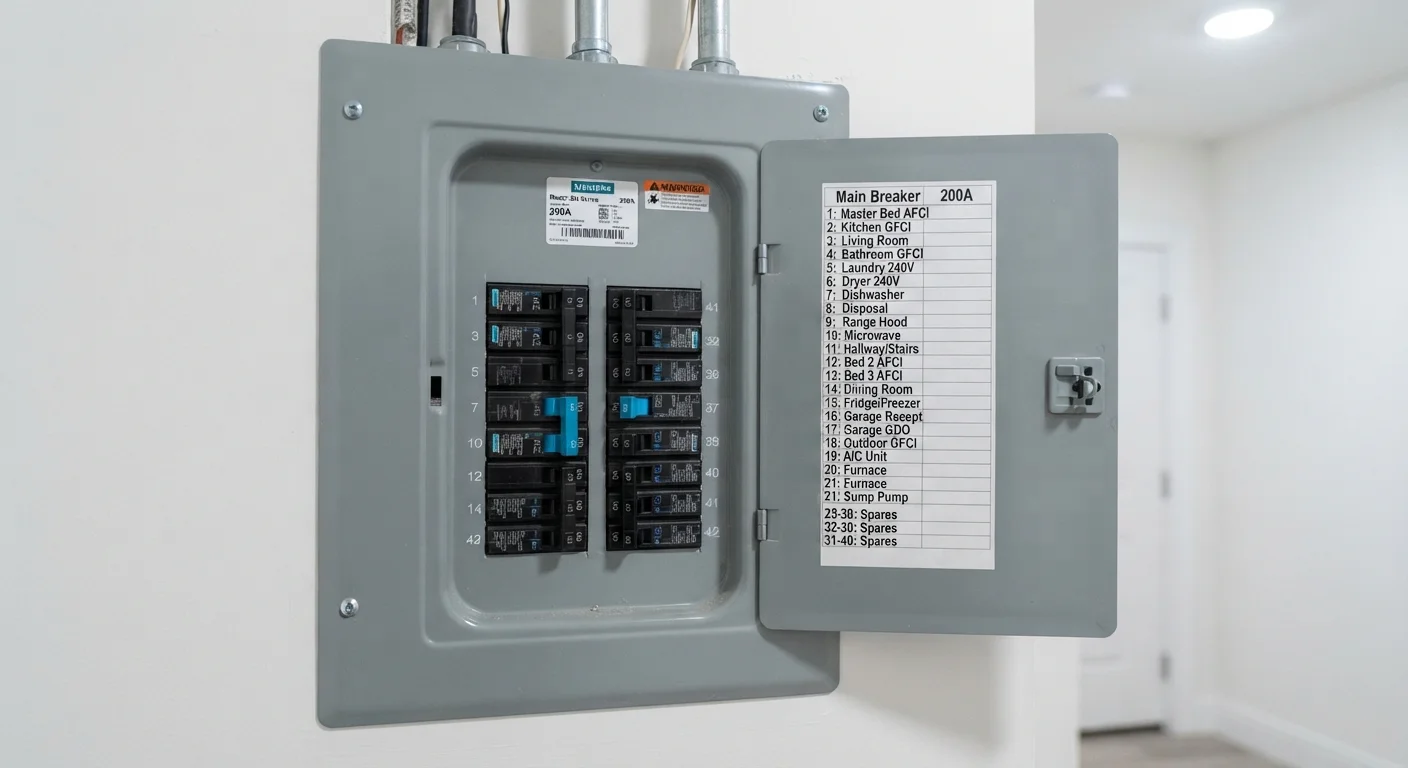
Open your panel door and you should see a directory - a labeled index identifying which breaker controls which area of your home. If the directory is blank, incomplete, or illegible, filling it in is one of the most practical maintenance tasks a homeowner can do. A circuit finder tool (available at hardware stores) makes this much easier than trial and error.
The large double breaker at the top of most panels is the main breaker - it controls all power to the panel at once. Numbered or arranged below it are the branch circuit breakers. Dedicated circuits (those serving a single appliance) are typically 20 or 30 amps. General lighting and outlet circuits are commonly 15 amps.
Keep the panel directory current, especially after any renovation. A well-labeled panel helps you isolate circuits during a repair and respond faster in an emergency. Our annual home maintenance reference includes electrical checks in its seasonal task list.
Warning Signs That Demand Attention
Your panel communicates problems in several observable ways. Take any of the following seriously and contact a licensed electrician promptly:
- Burning smell or scorch marks near or inside the panel - these suggest overheating wiring and require immediate professional attention.
- Breakers that feel warm or hot to the touch, which may indicate a sustained overload or a failing breaker.
- Frequently tripping breakers that reset but trip again quickly, pointing to an overloaded or faulted circuit.
- Flickering or dimming lights, especially when an appliance switches on - can signal loose connections or inadequate capacity.
- Rust, moisture, or corrosion on or inside the panel, which compromises the integrity of connections.
- Buzzing or crackling sounds from the panel, which can indicate arcing - a fire hazard.
These symptoms parallel other home warning signs covered in our guide to reading your home's warning signs.
Never Ignore a Burning Smell from Your Panel
A burning odor coming from your electrical panel is not a minor inconvenience - it is a potential fire emergency. Do not wait to see if the smell goes away. Turn off the main breaker if you can do so safely from outside the panel, evacuate the home if you have any doubt about safety, and contact a licensed electrician immediately. Electrical fires can smolder inside walls before becoming visible.
What Homeowners Can Do - and What Requires a Licensed Electrician
There is a clear and important line between what is safe for homeowners and what requires a licensed professional.
Homeowners can safely:
- Reset a tripped circuit breaker (push to full off, then back to on).
- Replace a blown fuse with one of the identical amperage rating.
- Label the circuit directory and keep it updated.
- Visually inspect the exterior of the panel for corrosion, damage, or signs of heat.
Always hire a licensed electrician for:
- Adding, moving, or replacing breakers or fuses inside the panel.
- Upgrading panel amperage or replacing an outdated panel.
- Any wiring work inside the panel enclosure.
- Investigating persistent tripping, burning smells, or arcing sounds.
- Work that requires a permit - which most panel modifications do under U.S. building codes.
Working inside a live panel exposes you to voltages that can cause fatal injury. The main breaker does not de-energize the service entrance wires at the top of the panel - those remain live at all times. This is not a space for amateur experimentation. When in doubt, err firmly on the side of calling a professional. For peace of mind when buying or evaluating a home, an electrician's assessment complements what you would learn from a home inspection report.
Frequently Asked Questions
Locate the breaker that has moved to the middle or 'off' position. First unplug devices on that circuit to reduce load. Then firmly push the breaker to the full 'off' position before switching it back to 'on.' If it trips again immediately, stop and call an electrician - there may be a wiring fault.
Most electricians recommend a professional inspection every 10 years for panels in good condition, and sooner for homes over 25 years old or after significant renovations. Annual visual checks by the homeowner - looking for corrosion, labeling accuracy, and signs of heat - are also a good practice.
Most modern homes use a 200-amp service, which supports high-demand appliances like electric vehicle chargers, heat pumps, and large HVAC systems. Older homes may have 60- or 100-amp panels, which can be inadequate for today's electrical loads. A licensed electrician can evaluate whether an upgrade is warranted.
Fuse boxes are not inherently dangerous, but they are older technology and can become problematic when fuses are replaced with the wrong amperage rating. If your home still has a fuse box, have it evaluated by a licensed electrician to ensure it meets current safety standards.
No - adding circuits involves working inside a live panel with exposed wiring that carries lethal voltage. This work requires a licensed electrician and, in most jurisdictions, a building permit and inspection. Attempting it without proper training and credentials creates serious safety and legal risks.
A repeatedly tripping breaker usually signals a circuit overload, a short circuit, or a ground fault. Redistributing plugged-in devices may help with a simple overload. If the tripping continues with normal loads, or if you smell burning, call a licensed electrician to diagnose the cause.
The content on this site is for informational purposes only and is not a substitute for professional advice. Always consult a qualified professional for guidance specific to your situation.