

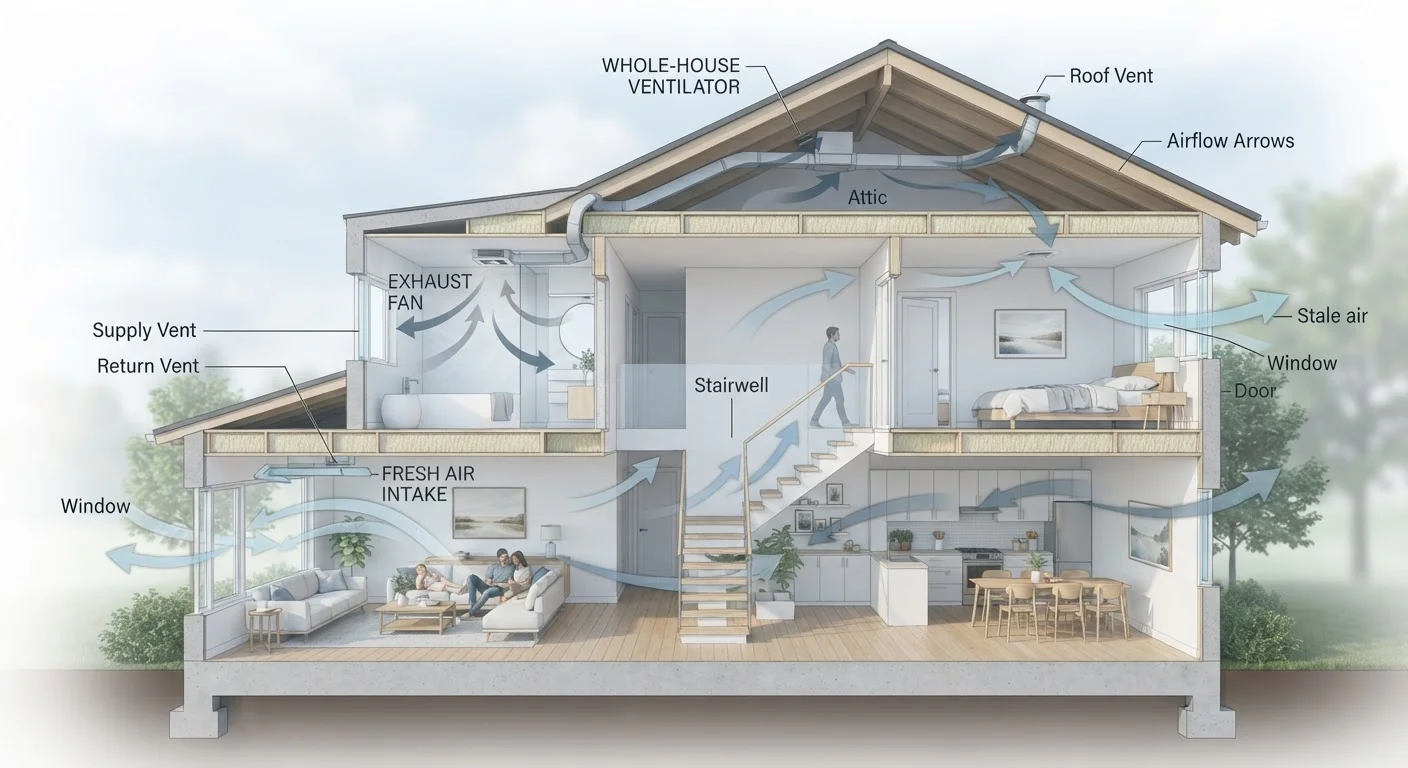
What Ventilation Actually Does in Your Home
Ventilation serves two simultaneous functions: it removes air that has become laden with moisture, cooking fumes, carbon dioxide, and volatile compounds; and it introduces fresh outdoor air to replace it. This exchange happens through a mix of natural ventilation (air moving through gaps, windows, and trickle vents) and mechanical ventilation (extractor fans, whole-house systems, and HVAC equipment).
When this exchange slows or stops - because fans are broken, vents are blocked, or a home has been sealed too tightly during an energy retrofit - moisture has nowhere to go. Water vapor from cooking, showering, breathing, and even houseplants accumulates in the air. When that humid air contacts cooler surfaces like windows, exterior walls, or ceiling corners, it condenses into liquid water. Left unchecked, that moisture becomes the foundation for mould, timber rot, and damaged insulation.
Understanding ventilation as a maintenance system - not a fixed feature - is the first step toward preventing these problems. See our guide to damp, mould, and condensation to understand how inadequate airflow connects to each of these distinct issues.
50%
Indoor air pollutant concentration vs. outdoors
The U.S. Environmental Protection Agency notes that indoor air can be two to five times more polluted than outdoor air, partly due to insufficient ventilation in tightly constructed homes.
90%
Of time Americans spend indoors
According to EPA estimates, Americans spend approximately 90% of their time indoors, making indoor air quality and ventilation a significant factor in daily health conditions.
30%
Of homes with inadequate bathroom extraction
Industry surveys of home inspectors consistently find exhaust fans that are undersized, disconnected, or venting into attic spaces rather than to the exterior - a widespread and underreported issue.
Where Ventilation Problems Most Commonly Occur
Three areas of the home account for the majority of ventilation failures:
- Bathrooms: High steam output from showers and baths demands reliable mechanical extraction. A fan that vents into the attic space rather than all the way outside - a surprisingly common installation error - deposits moisture where it causes structural damage rather than expelling it.
- Kitchens: Recirculating range hoods filter grease but do not remove humidity. Only ducted hoods that vent to the exterior actually address moisture from cooking. Stovetops without any extraction are a consistent source of indoor humidity buildup.
- Attics and crawl spaces: These enclosed areas require their own dedicated airflow to prevent condensation on structural timbers and roof decking. Blocked soffit vents - often caused by insulation installed too close to the eaves - are a frequent and easily overlooked problem.
Rooms without windows or with windows that are permanently sealed present a related challenge in the main living areas. Trickle vents built into window frames are designed to provide a low-level continuous supply of fresh air even when the window is closed; painting or blocking these vents eliminates this passive ventilation pathway.
Quick Check: Is Your Bathroom Fan Working?
Hold a single sheet of toilet paper near the running exhaust fan grille. If it is drawn firmly against the grille and holds there, airflow is adequate. If it falls away or barely moves, the fan needs cleaning, repair, or replacement. Do this simple test every six months as part of your routine maintenance.
The Maintenance Tasks That Keep Ventilation Working
Ventilation systems require routine upkeep just like any other home system. These are the tasks that make the greatest practical difference:
- Clean exhaust fan grilles every three to six months. Dust and lint accumulation reduces airflow volume significantly. Remove the cover, wash it, and wipe the visible blades before reinstalling.
- Verify fans vent outside. Hold a piece of tissue near a running bathroom fan - it should draw toward the grille. If not, the fan motor may have failed, or the duct may be disconnected or blocked in the attic.
- Check soffit and ridge vents annually. Look from inside the attic with a flashlight to confirm soffit vents are not blocked by insulation batts. Outdoors, check that ridge and gable vents are free of bird nests, debris, and deteriorated mesh.
- Inspect trickle vents. These small slots in window frames are easily painted over during redecoration. If yours are sealed, a professional window installer can assess whether they can be cleared or need replacement.
- Service whole-house systems. Heat recovery ventilation (HRV) and energy recovery ventilation (ERV) units have filters that require cleaning or replacement on a schedule set by the manufacturer - typically every six to twelve months.
A common misconception is that airtight draft-proofing and good ventilation are in conflict. In practice, the goal is controlled airflow - sealing unintended gaps while maintaining deliberate ventilation pathways. Our article on caulking and weatherstripping explains how to seal a home without inadvertently cutting off needed airflow.
When to Investigate Further or Call a Professional
Routine maintenance addresses most ventilation problems, but some situations call for a closer look or professional assessment:
- Persistent mould that returns after cleaning suggests the underlying moisture source has not been resolved. This warrants a ventilation audit rather than repeated surface treatment. See common maintenance myths for why surface-only fixes often fail.
- Condensation forming on interior walls rather than just windows indicates higher humidity levels than surface ventilation can manage alone. A whole-house ventilation strategy may be needed.
- Attic spaces showing staining, rot, or black discolouration on timbers require prompt assessment by a qualified contractor - these are signs of sustained moisture intrusion, not a routine maintenance fix.
- Gas appliances in enclosed spaces require adequate combustion air as specified by the appliance manufacturer and local codes. Do not seal rooms containing boilers, water heaters, or furnaces without consulting a licensed HVAC technician or qualified heating engineer.
When in doubt, a certified home inspector or HVAC professional can conduct a ventilation assessment, including airflow measurement and identification of disconnected or undersized ductwork. Addressing ventilation early is consistently less costly than repairing the structural damage that follows from ignoring it.
“Ventilation is not optional - it is the mechanism by which a building breathes. Treat it as infrastructure, not an afterthought, and most moisture problems simply do not develop.”
— Building Science Corporation, Research and consulting organization specializing in building enclosure performance
Frequently Asked Questions
Recurring condensation on windows, musty odours, visible mould spots, and persistent humidity are common indicators. Peeling wallpaper or paint near ceilings can also signal trapped moisture. If these appear regularly despite cleaning, ventilation is likely the underlying cause.
In mild weather, opening windows can provide adequate background ventilation for most rooms. However, in winter or in wet climates, windows stay closed for long periods, making mechanical ventilation in bathrooms and kitchens essential. Relying on windows alone is rarely sufficient for high-moisture spaces.
Yes. Modern energy-efficiency upgrades like additional insulation and draft-proofing can reduce natural air infiltration to the point where moisture and pollutants build up indoors. In tightly sealed homes, mechanical ventilation systems or trickle vents become especially important.
Exhaust fan grilles and covers should be cleaned every three to six months. Dust buildup reduces airflow efficiency significantly. The fan motor and blades can be cleaned annually - check the manufacturer's instructions for safe access.
Yes, and it is especially critical in cold climates. Without adequate attic airflow, warm interior air rises into the attic, meets the cold roof deck, and condenses - causing rot and mould. Proper soffit and ridge venting keeps the attic temperature closer to the outside air, preventing this cycle.
The content on this site is for informational purposes only and is not a substitute for professional advice. Always consult a qualified professional for guidance specific to your situation.