

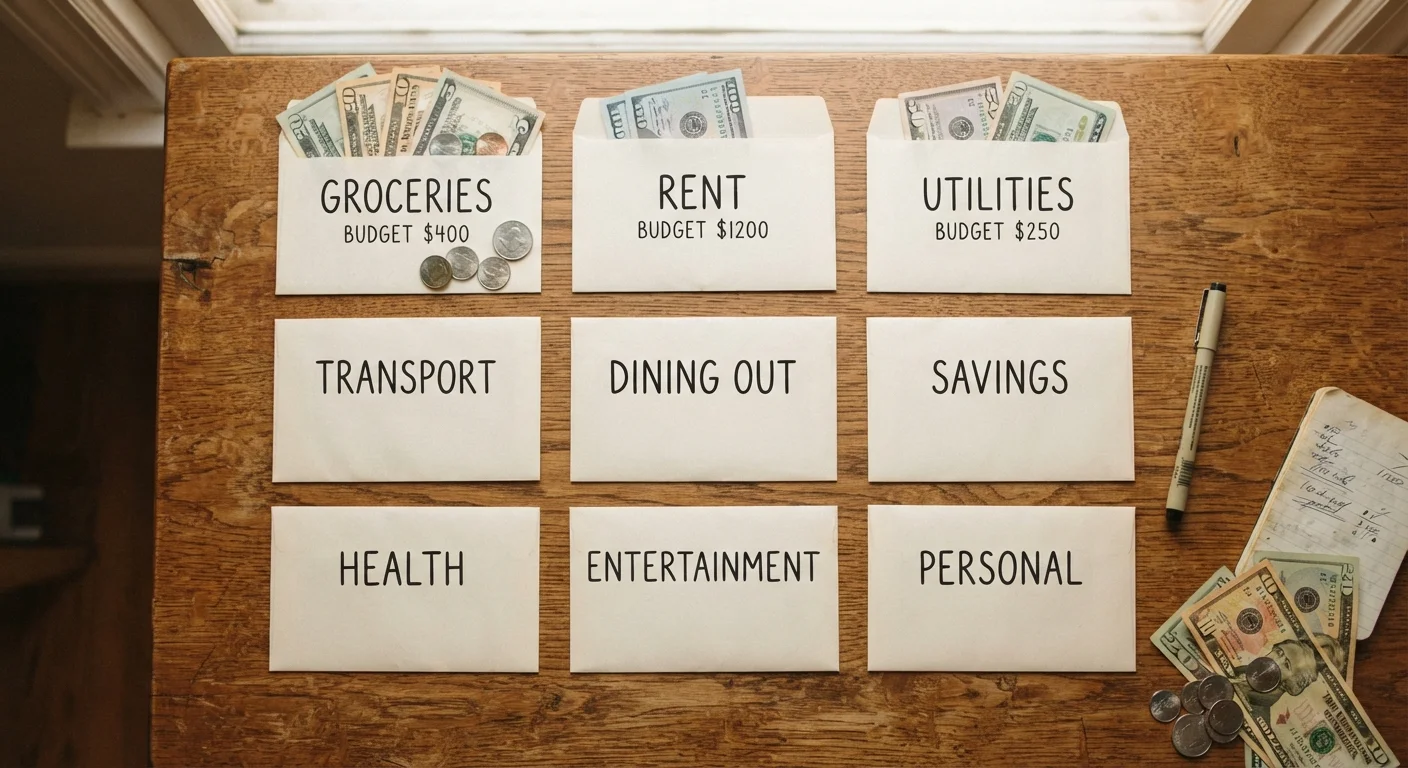
Where the Envelope System Came From
The envelope method predates personal finance apps, spreadsheets, and even credit cards. For much of the twentieth century, cash was how most American households managed daily expenses-and keeping spending in check meant physically controlling how much cash was available for any given purpose. Dividing a paycheck into envelopes gave families a tangible boundary: when the grocery envelope was empty, grocery shopping waited.
The approach gained wider recognition through financial educators who emphasized that behavior, not math, is the hardest part of budgeting. The envelope system works not because it's complicated, but because it removes ambiguity. There's no mental calculation required to know whether you've overspent on dining out-you look in the envelope.
For a broader overview of how budgeting methods have evolved and what makes each one effective, see the complete personal budgeting resource.
How the System Works in Practice
Setting up envelope budgeting involves three steps. First, list every income source and calculate your total monthly take-home pay. Second, identify your fixed expenses-rent, utilities, loan payments-and subtract them. Third, divide the remaining balance among discretionary categories, placing the cash equivalent in a labeled envelope for each.
Start With Just Three or Four Envelopes
New envelope budgeters often overcomplicate their first month by creating a dozen categories. Start with the three or four areas where you know you overspend-typically groceries, dining, and entertainment. Once those feel natural, add more categories gradually. Simpler systems are more likely to stick.
The envelope method is most powerful for variable categories. Fixed bills don't need envelopes because their amounts don't change. Direct your attention to the spending areas where behavior is the variable-food, entertainment, clothing, and personal care.
At the start of each month, you refill the envelopes. If an envelope empties before month's end, spending in that category pauses. If money remains at month's end, you can roll it forward, apply it to savings, or redirect it to a higher-priority envelope next cycle. This built-in feedback loop is what makes the system self-correcting over time.
33%
Americans with no monthly budget
According to a Gallup survey, roughly one in three Americans report they do not follow a budget of any kind, leaving discretionary spending largely unchecked.
$1,000+
Average monthly discretionary overspend
Consumer spending data from the Bureau of Labor Statistics suggests households frequently underestimate variable category spending, particularly on food away from home and entertainment.
Adapting the Method for Digital Spending
Most Americans today use debit cards, mobile payments, and online accounts-not physical cash. The envelope concept translates directly to digital life through a few practical adaptations.
Bank sub-accounts: Many banks allow customers to open multiple checking or savings accounts at no cost. Labeling each account for a spending category-"Groceries," "Gas," "Entertainment"-replicates the envelope structure. Transfer the budgeted amount at the start of the month and spend only from the corresponding account.
Budgeting apps: Several apps are built specifically around the envelope framework, allowing users to create digital envelopes, link their bank accounts, and receive alerts when a category approaches its limit. These tools automate the tracking that would otherwise be manual.
Prepaid debit cards: Some households assign a specific prepaid card to a spending category and load it with the monthly allocation. This works especially well for groceries or household supplies.
For a deeper look at applying this logic to debit and digital accounts, envelope budgeting in the digital age walks through the process step by step.
Strengths, Limitations, and Who It Suits Best
The envelope method's greatest strength is its psychological clarity. It converts an abstract budget line into a physical or visual boundary, which research in behavioral economics consistently shows is more effective at moderating spending than mental accounting alone.
“A budget is telling your money where to go instead of wondering where it went.”
— John C. Maxwell, Author and speaker on personal development and leadership
The method does have real limitations. It requires consistent monthly setup, which can feel tedious. It works less naturally for subscription services and automatic payments, since those transactions bypass manual envelope logic. And for households with highly irregular income, setting accurate envelope amounts takes additional care.
Envelope budgeting suits people who struggle with discretionary overspending, who find abstract category limits easy to rationalize past, or who are working to build a savings habit from scratch. If you're comparing this approach against other structured frameworks, a side-by-side comparison of the 50/30/20 rule, zero-based budgeting, and the envelope method can help you decide which fits your habits. You may also find that a budget designed around real-life behavior offers useful context about why rigid systems sometimes fail-and what to do instead.
For those focused on building savings alongside spending control, budgeting methods that support long-term saving covers how the envelope approach fits into a broader savings strategy.
This article provides general financial education and is not personalized financial advice. For guidance tailored to your individual circumstances, consult a licensed financial professional.
Frequently Asked Questions
No. While the original method uses physical cash and paper envelopes, many people today replicate the logic using bank sub-accounts, labeled digital wallets, or budgeting apps. The core principle-spending only what you've pre-allocated to a category-works the same way regardless of format.
Focus envelopes on variable, discretionary categories where overspending is common: groceries, dining out, gas, clothing, and entertainment. Fixed costs like rent and insurance don't benefit as much from the envelope method since those amounts don't change month to month.
You have two options: stop spending in that category until the next month, or transfer money from a lower-priority envelope to cover the gap. Most financial educators recommend the first option during the learning phase, because running short reveals where your estimates were off and helps you calibrate future allocations more accurately.
It can work, but requires an adjustment. People with variable income often base their envelopes on their lowest expected monthly earnings, treating any extra income as a bonus directed to savings or debt repayment. This conservative baseline protects against shortfalls.
The 50/30/20 rule divides income into broad buckets-needs, wants, and savings-without controlling how you spend within each bucket. Envelope budgeting sets hard limits on granular categories and stops spending automatically when limits are reached. See <a href="/money-finance/budgeting-basics/the-503020-rule-zero-based-budgeting-and-the-envelope-method-which-fits-your-life">a side-by-side comparison of both methods</a> for more detail.
Yes. By capping discretionary spending, the method frees up predictable amounts each month that can be directed toward debt repayment. Many people create a dedicated "debt payoff" envelope or sub-account to make that allocation explicit and consistent.
The content on this site is for informational purposes only and is not a substitute for professional advice. Always consult a qualified professional for guidance specific to your situation.