

Our Verdict
Each of these three budgeting frameworks is effective when matched to the right person. The 50/30/20 rule suits those who want simplicity and flexibility. Zero-based budgeting rewards detail-oriented planners who want maximum accountability. The envelope method works best for people who overspend in specific categories and need firm, tangible limits.
| Best for | Recommended |
|---|---|
| Those who want a low-maintenance starting point | 50/30/20 Rule |
| Those with variable income or aggressive savings goals | Zero-Based Budgeting |
| Those who struggle with impulse or category overspending | Envelope Method |
| Those new to budgeting who want a structured habit | 50/30/20 Rule |
Why Your Budgeting Method Matters
A budget is only useful if you follow it. That means the framework you choose has to fit your income pattern, your spending habits, and your patience for tracking details. The three methods covered here - the 50/30/20 rule, zero-based budgeting, and the envelope method - each take a fundamentally different approach to organizing money. Understanding those differences helps you spend less time fighting your budget and more time benefiting from it.
For a broader foundation, see the complete guide to personal budgeting, which covers how budgets work and how to build lasting habits around them.
| 50/30/20 Rule | Zero-Based Budgeting | Envelope Method | |
|---|---|---|---|
| Core concept | Split income into three broad percentages | Assign every dollar a specific category | Cap spending per category with fixed amounts |
| Time required monthly | Low (minutes) | High (1-2 hours) | Medium (30-60 minutes) |
| Best income type | Steady, salaried income | Variable or irregular income | Any income type |
| Flexibility | High - broad categories allow wiggle room | Low - every dollar pre-assigned | Low - category limits are firm |
| Savings visibility | Built-in 20% savings target | Explicit savings line item | Requires dedicated savings envelope |
| Ideal for | Beginners or busy schedules | Detail-oriented planners | People who overspend in specific areas |
| Main challenge | May be imprecise for complex finances | Time-intensive setup each month | Can feel restrictive mid-month |
The 50/30/20 Rule: Simplicity at Scale
Popularized by Senator Elizabeth Warren in her personal finance writing, the 50/30/20 rule divides your after-tax income into three broad buckets: 50% for needs (housing, utilities, groceries, minimum debt payments), 30% for wants (dining out, subscriptions, entertainment), and 20% for savings and debt repayment beyond minimums.
Its main strength is speed. You do not need to categorize every purchase - you only need to confirm that your big spending groups are roughly on target. This makes it accessible for anyone who is new to budgeting or who finds granular tracking unsustainable.
The trade-off is precision. High earners may find 30% allocated to wants feels excessive, while people in high-cost-of-living cities may struggle to keep needs below 50%. If your situation doesn't map cleanly onto those proportions, you may need to adjust the percentages - which is entirely acceptable. The framework is a guide, not a rule with legal force.
Adjust the Percentages to Your Reality
The 50/30/20 split is a starting point, not a strict formula. If you live in a high-cost city or are aggressively paying down debt, shifting needs to 55-60% and wants to 20-25% is a reasonable adaptation. What matters is that you have a clear, intentional allocation - not that the numbers match a textbook example.
Zero-Based Budgeting: Every Dollar Has a Job
Zero-based budgeting (ZBB) starts from a simple equation: income minus expenses equals zero. That does not mean spending every dollar - it means assigning every dollar a purpose, whether that purpose is a bill, a savings goal, or an investment contribution. If you earn $4,200 in a month, your budget categories must add up to exactly $4,200.
ZBB demands more time upfront. You build a fresh budget each month, which means accounting for irregular expenses like annual insurance premiums or holiday spending before they arrive. This is precisely why it tends to work well for people with variable income - freelancers, gig workers, or commission-based earners - because it forces intentional decisions rather than assuming last month's numbers still apply.
The accountability is its greatest asset. Research from behavioral economics suggests that when people name their spending categories explicitly, they are more likely to follow through. The budgeting methods that support long-term saving explores how structured approaches like ZBB channel money toward financial goals more reliably than informal tracking.
The Envelope Method: Limits You Can Feel
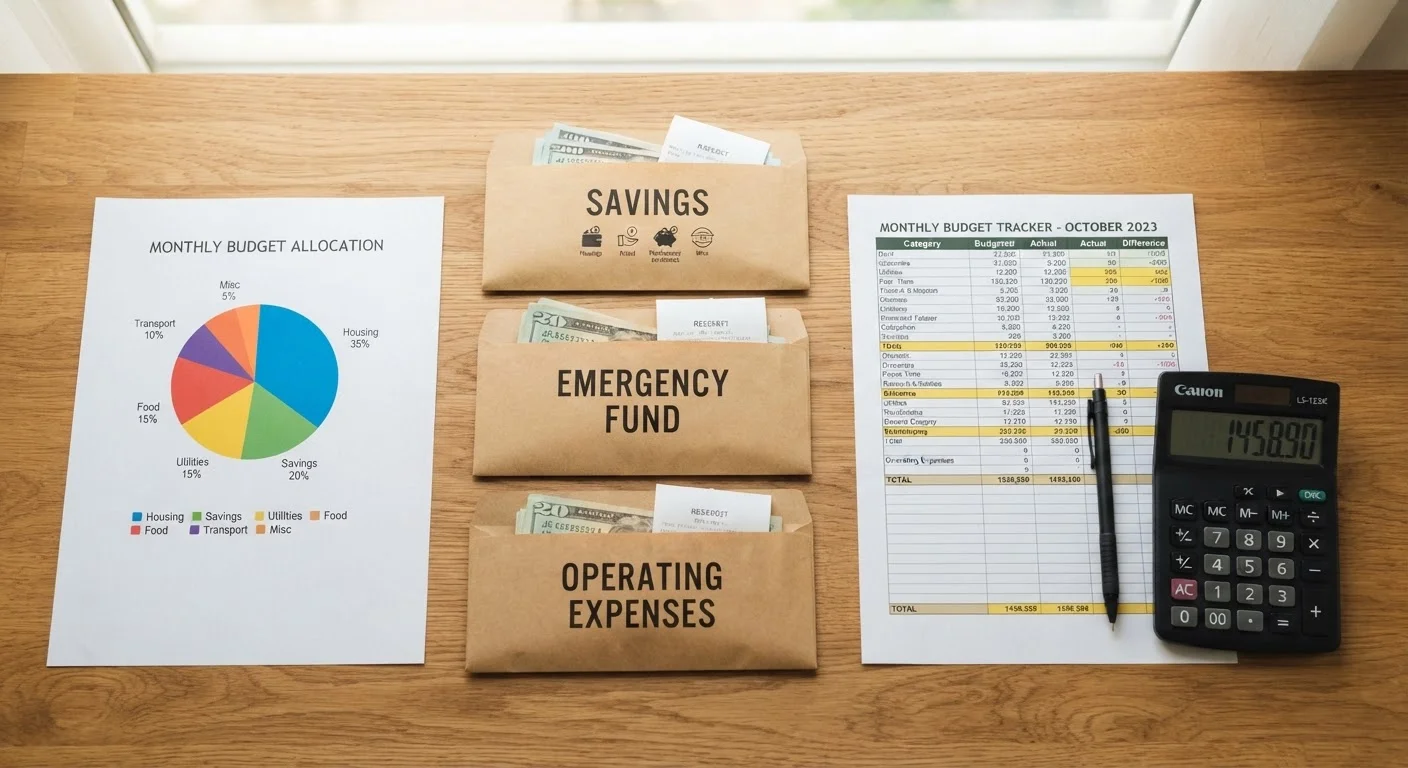
The envelope method works by allocating a fixed amount of cash - or a digital equivalent - to specific spending categories at the start of each month. When the envelope is empty, spending in that category stops until the next month. There is no carrying over, no renegotiating mid-month.
Traditionally this meant literal cash in labeled envelopes. Today, many people replicate the logic using separate bank accounts, prepaid debit cards, or budgeting apps. The psychological mechanism remains the same: a finite, visible limit makes it harder to rationalize overspending.
It is particularly effective for categories where people habitually overspend - groceries, dining, and entertainment being common examples. If seeing the envelope empty triggers a behavior change, the method is working. For a deeper look at how this system adapts to modern life, see how the envelope method translates to modern life and envelope budgeting in the digital age.
Watch for Gaps in Irregular Expenses
The envelope method works well for recurring monthly categories but can break down when large, infrequent expenses arrive - think car registration, medical bills, or annual subscriptions. Without a dedicated 'irregular expenses' envelope funded a little each month, these costs can disrupt your entire system. Build a buffer envelope specifically for planned but non-monthly costs.
Choosing the Right Method for You
The comparison above highlights the structural differences, but choosing comes down to a few personal questions:
- How consistent is your income? Salaried workers can use any method comfortably. Variable earners benefit most from ZBB's monthly reset.
- How much time will you realistically invest? If 15 minutes a month is your limit, start with 50/30/20. If you enjoy spreadsheets, ZBB rewards the effort.
- Where does your money actually go missing? If it disappears in a few specific categories, envelopes - physical or digital - directly address the problem.
You can also combine elements. Many people use the 50/30/20 rule as a high-level structure and apply envelope logic to one or two problem categories. The 50/30/20 rule vs. zero-based budgeting comparison digs deeper into how these two frameworks stack up for different financial situations. For ongoing guidance on saving and managing debt, the Saving & Debt resource hub offers practical next steps.
This article is for general informational and educational purposes only and does not constitute personalized financial advice. Consult a licensed financial professional for guidance tailored to your specific circumstances.
The content on this site is for informational purposes only and is not a substitute for professional advice. Always consult a qualified professional for guidance specific to your situation.