

Our Verdict
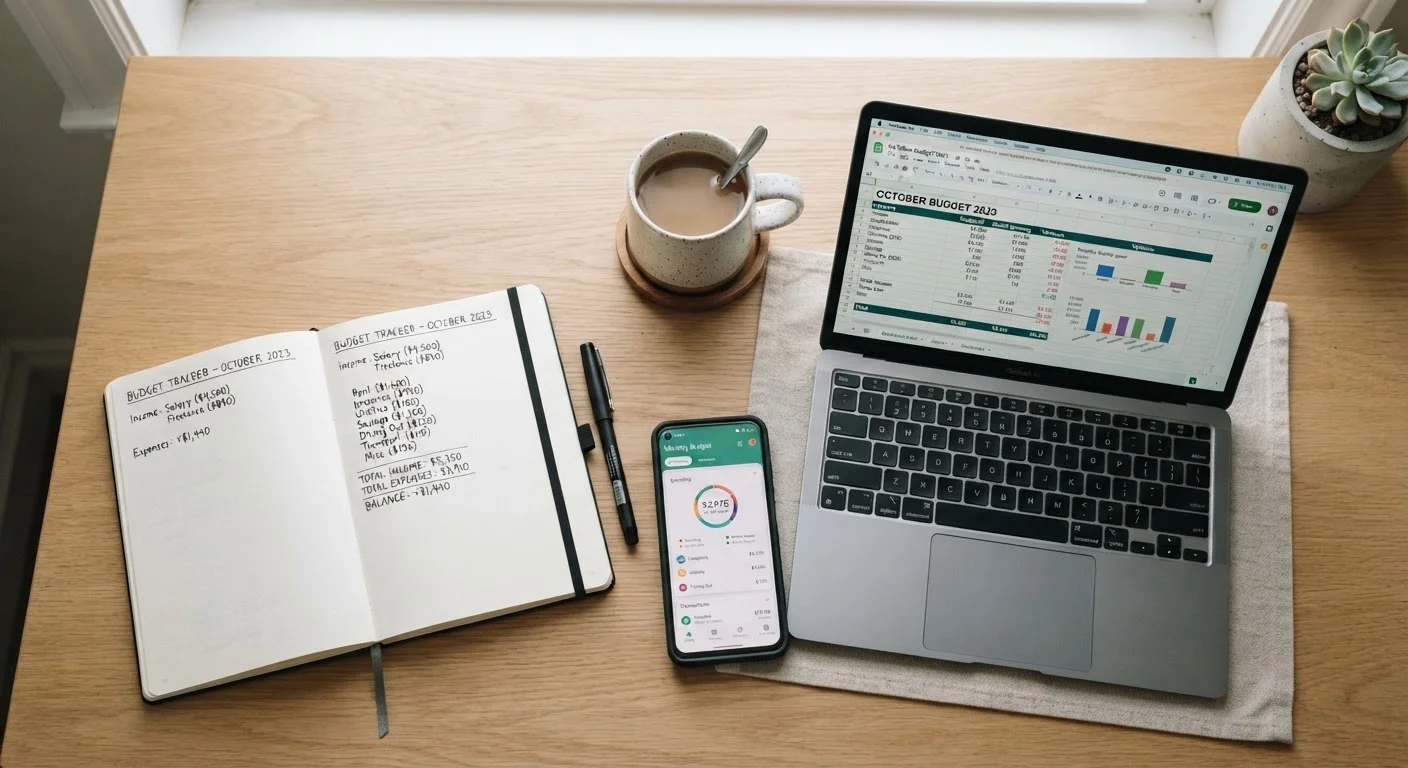
Each method has a legitimate place depending on how your brain processes information and how disciplined your daily habits are. Spreadsheets reward analytical thinkers who want full control. Apps suit busy people who need automation to stay consistent. Pen and paper is surprisingly powerful for those who want to build deep awareness of where money actually goes. There is no universally superior choice - only the one that fits your life.
| Best for | Recommended |
|---|---|
| Detail-oriented people who want total control over their budget structure | Spreadsheet |
| Busy individuals who need low-friction, automated tracking | Budgeting App |
| Those building spending awareness or trying to break impulsive habits | Pen and Paper |
| People who want to experiment before committing to one system | Pen and Paper (start here, then migrate) |
Why Your Tracking Method Shapes Your Results
Knowing you should track spending is the easy part. The harder part is picking a system you'll stick with long enough to see results. The tool you choose influences how often you engage with your budget, how accurately you record transactions, and whether the habit survives a hectic week or a financial surprise.
This isn't a theoretical exercise. According to the Consumer Financial Protection Bureau (CFPB), one of the most common barriers to budgeting success is abandoning a tracking method before it becomes routine. If the tool creates too much friction, it gets dropped. If it's too passive, it provides data without producing insight.
This article compares three widely used approaches - spreadsheets, mobile apps, and pen and paper - across the dimensions that matter most to everyday budgeters. For a broader foundation on how budgeting works before diving into tools, see the complete personal budgeting resource.
This article provides general financial education and is not personalized financial advice. Consider consulting a qualified financial professional for guidance specific to your situation.
How the Three Methods Compare
Before diving into the nuances of each approach, the table below summarizes how spreadsheets, apps, and pen and paper stack up across the criteria most relevant to real-world budgeters.
| Spreadsheet | Budgeting App | Pen and Paper | |
|---|---|---|---|
| Setup effort | Medium to high | Low | Very low |
| Daily time required | 5-10 minutes | 1-3 minutes | 3-5 minutes |
| Data entry method | Manual or imported | Mostly automated | Fully manual |
| Customization | Very high | Limited | Unlimited |
| Spending awareness built | Moderate | Low | High |
| Privacy / security risk | Low | Moderate to higher | None |
| Cost | Free (cloud tools) | Free to paid tiers | Minimal (notebook) |
| Long-term sustainability | High if tech-comfortable | High if low-maintenance | Varies by discipline |
Each method involves real trade-offs. Understanding them upfront prevents the common mistake of choosing a tool based on its reputation rather than its fit with your actual behavior.
Spreadsheets: Power and Flexibility at a Cost
A spreadsheet - whether in a free tool like Google Sheets or a desktop program - gives you a blank canvas. You define the categories, formulas, and layout. That flexibility is its biggest advantage and its biggest obstacle.
What works well: Spreadsheets let you build exactly the budget structure you need. If you want to track spending by paycheck period, split categories into subcategories, or model out what happens if you cut one expense, a spreadsheet handles all of it. There's no subscription fee for the free cloud-based versions, and your data stays under your control.
Where it falls short: Every transaction must be entered manually unless you import bank data - and even then, you'll likely need to clean up the formatting. A missed week of entries can create a backlog that discourages continued use. The setup also has a learning curve; someone unfamiliar with basic formulas may find it frustrating at the start.
Spreadsheets tend to work best for people who are comfortable with numbers, enjoy customizing systems, and can commit to a regular entry routine. If that describes you, compare spreadsheets and apps in more depth before deciding.
Start With a Template
If you're new to spreadsheet budgeting, start with a pre-built template rather than building from scratch. Most cloud-based spreadsheet tools offer free budget templates that cover the basics: income, fixed expenses, variable expenses, and savings. Customize gradually as you get familiar with your spending patterns.
Budgeting Apps: Automation With Trade-offs
Mobile budgeting apps typically connect directly to your bank accounts and credit cards, pulling transactions in automatically and sorting them into spending categories. The appeal is obvious: less manual work means fewer excuses to skip a day.
What works well: Automation lowers the barrier to consistency. You don't have to remember to log a coffee purchase - it appears in your transaction feed. Many apps also generate visual summaries of spending trends, which can make patterns more visible than a column of numbers.
Where it falls short: Automatic categorization is imperfect. Transactions are frequently miscategorized, requiring manual correction. More importantly, connecting financial accounts to a third-party app involves sharing login credentials or account access, which raises legitimate data privacy and security concerns. Passive engagement is also a risk: it's easy to glance at an app without truly processing what the numbers mean.
Review App Permissions Carefully
Before linking a bank account to any budgeting app, review what data the app collects, how it is stored, and whether it is shared with third parties. Look for apps that use read-only access rather than login credential storage, and check whether the service has undergone independent security audits. When in doubt, consult the app's privacy policy and terms of service directly.
App-based tracking suits people with variable, high-volume spending across many categories who need automation to keep up. If you decide to go this route, review your app's privacy policy and understand how your data is stored and shared.
Pen and Paper: Slower, But Surprisingly Effective
Writing down every purchase by hand sounds like a step backward, but research in cognitive psychology consistently shows that the physical act of writing reinforces memory and attention. For budgeting, that translates to a heightened awareness of spending in the moment - exactly when decisions are made.
What works well: There's no software to learn, no account to connect, and no subscription. Writing a purchase down forces a brief pause that can interrupt impulsive spending patterns. Many people who've struggled to stick with digital tools find the tactile routine of a notebook easier to maintain. See a full look at manual expense tracking for a balanced breakdown of this approach.
Where it falls short: Totaling and categorizing entries requires manual math or a calculator. There are no automated alerts, no trend visualizations, and no way to pull a six-month summary without significant effort. Physical notebooks can be lost or damaged, and entries may be skipped during busy periods.
Pen and paper works especially well as a starting point. Tracking manually for one month before migrating to a spreadsheet or app gives you a realistic picture of your spending categories. Once you have that baseline, a monthly audit checklist can help you stay accountable regardless of which tool you continue with.
Choosing What Sticks
The most important criterion isn't accuracy or features - it's sustainability. A method you use imperfectly every day outperforms a perfect system you abandon after three weeks.
Consider these practical questions before choosing:
- How much time can you realistically commit daily? Apps require the least; spreadsheets the most.
- Do you want to understand your spending or just record it? Pen and paper builds understanding; apps record efficiently.
- Are you comfortable sharing financial account access? If not, rule out apps that require bank connectivity.
- Do you have irregular or complicated finances? Freelancers or those with variable income may benefit from a spreadsheet's customizability.
If you're building your first budget from zero, starting with pen and paper for 30 days is a low-risk way to understand your real spending before investing time in a more complex system. Whatever method you choose, commit to a monthly review - that's where the real financial insight happens.
The content on this site is for informational purposes only and is not a substitute for professional advice. Always consult a qualified professional for guidance specific to your situation.