

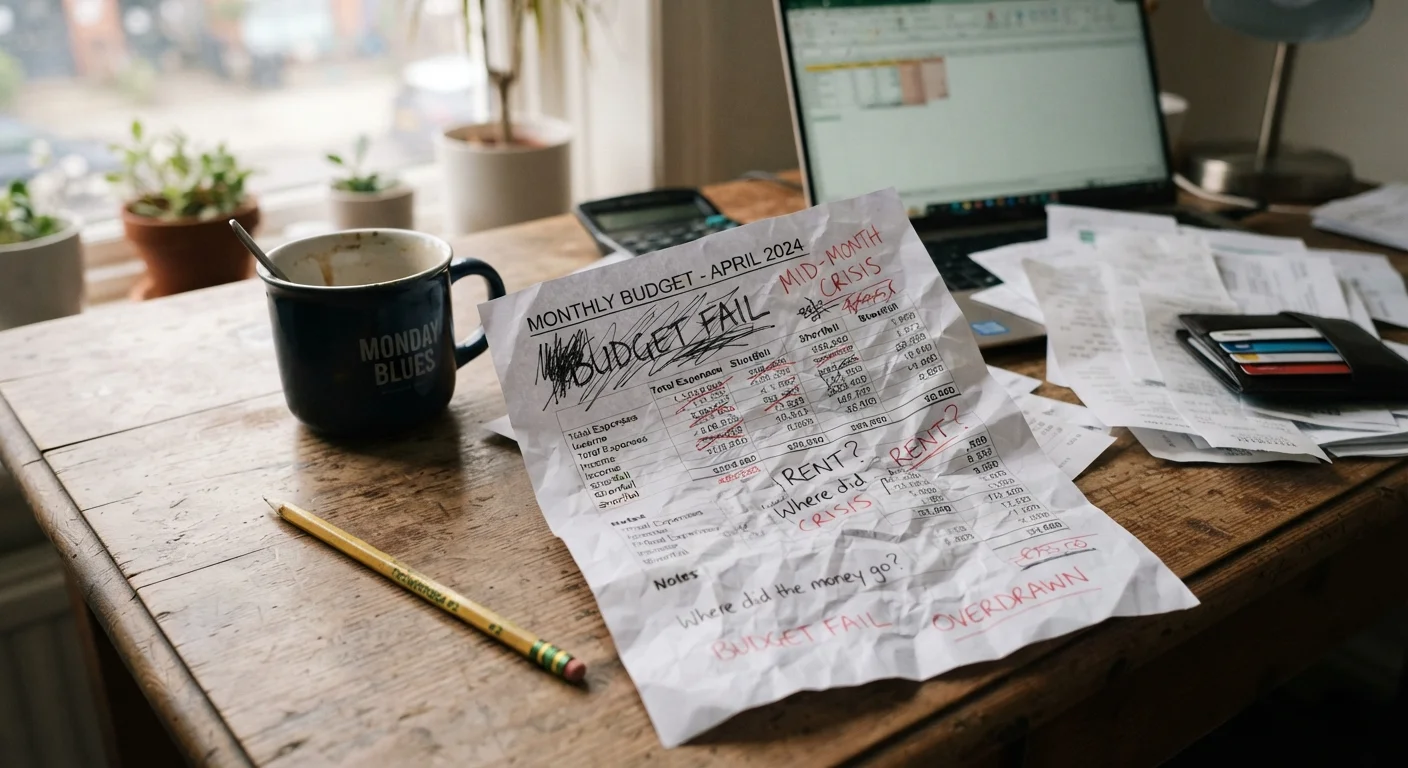
The Real Reason Week Three Feels Like a Disaster
If your budget looks fine on paper but collapses around week two or three, you're not alone - and the problem probably isn't your income. Research in behavioral economics consistently shows that people make financial decisions based on emotion, habit, and mental shortcuts as much as on logic. A budget that ignores this will fail on schedule.
The pattern is recognizable: you start the month with good intentions, track carefully for the first week, then hit an unexpected expense or a stressful day, and suddenly the whole plan feels irrelevant. Understanding why this happens is the first step toward building something that actually holds. For a deeper look at the structural side of this problem, see why budgets fall apart and the patterns behind each breakdown.
Building a budget around monthly averages while ignoring irregular expenses like car registration, annual subscriptions, or medical co-pays.
Why it happens: These costs don't appear every month, so they're easy to overlook during the planning stage. When they arrive, they feel like surprises even though they're entirely predictable.
Setting spending limits that are technically accurate but leave no room for the small, low-cost purchases that make daily life workable.
Why it happens: People often build budgets in an optimistic mindset, underestimating how often they'll grab a coffee, pay for parking, or pick up a household item mid-month.
Treating the budget as a once-a-month document rather than an active, ongoing tracking tool.
Why it happens: Checking in only at month's end creates a false sense of control. By the time you review, you've already overspent - and there's nothing left to course-correct.
Abandoning the entire budget after one category goes over, rather than rebalancing within the same month.
Why it happens: This "all-or-nothing" thinking is common. One overspend feels like a total failure, which makes quitting feel more logical than continuing.
Not accounting for the emotional or social triggers that reliably lead to unplanned spending.
Why it happens: Stress, boredom, social pressure, and celebration are powerful spending triggers. A budget built purely on numbers won't anticipate them.
How to Rebuild After a Budget Breaks Down
A failed budget isn't a character flaw - it's feedback. When a plan stops working, the goal isn't to restart the same approach with more willpower. It's to identify which of the patterns above caused the breakdown and make a targeted fix.
~33%
Americans with a formal monthly budget
Gallup polling has consistently found that fewer than one in three Americans maintain a detailed household budget, suggesting that starting one is already a meaningful step.
2-3 weeks
Typical point of budget abandonment
Behavioral finance research suggests that most people who abandon a budget do so within the first few weeks, often following a single unexpected expense or emotional spending event.
Start by auditing last month's actual spending against what you planned. Look for the categories where the gap is largest - those are your leverage points. Then ask whether the gap came from a forgotten expense, an unrealistic number, or a behavioral trigger like stress spending.
Consider building a budget that anticipates imperfection. A category labeled "miscellaneous" or a small monthly buffer of even $50-$100 can absorb the small surprises that otherwise blow up the whole plan. For a practical framework, building a budget that survives real life walks through how to structure categories and handle the inevitable curveballs. If saving consistently is also a challenge, where savings plans break down before they even start explores the overlapping behavioral patterns that derail both budgets and savings goals.
Avoid the "Fresh Start" Trap
Restarting your budget at the beginning of every month without changing anything is one of the most common cycles people get stuck in. If the same categories blow up every month, the problem isn't discipline - it's the structure of the budget itself. Make at least one concrete structural change before you restart, even a small one.
This article is for general informational and educational purposes only and does not constitute personalized financial advice. Consult a qualified financial professional for guidance specific to your situation.
The content on this site is for informational purposes only and is not a substitute for professional advice. Always consult a qualified professional for guidance specific to your situation.