

Start here
Why a Monthly Budget Matters
Next
Step 1: Add Up Your Take-Home Income
Then
Step 2: List and Categorize Every Expense
Choose your method
Step 3: Choose a Budgeting Framework
Fine-tune
Step 4: Balance Your Budget and Adjust
Make it stick
Keeping Your Budget Working Month After Month
Why a Monthly Budget Matters
A budget is simply a written plan that tells your money where to go before the month begins. Without one, spending tends to fill whatever space it finds - and at the end of the month, many people genuinely can't explain where their paycheck went.
Research from the Consumer Financial Protection Bureau (CFPB) consistently shows that households with a spending plan feel more financially secure and are better prepared for unexpected costs. A budget doesn't restrict your life; it reflects your priorities and helps you fund them on purpose.
For a broader foundation, see the complete personal budgeting resource that covers everything from how budgets work to making them a lasting habit.
Net income
The money you actually receive after taxes and deductions are taken out of your paycheck. This is the number to use when building a budget.
Fixed expense
A recurring cost that stays the same each month, such as rent, a car loan payment, or a set insurance premium.
Variable expense
A cost that changes from month to month based on your choices or usage, like groceries, gas, or dining out.
Zero-based budgeting
A method where you assign every dollar of income to a specific category so that income minus all allocations equals zero - nothing is left unplanned.
Emergency fund
A savings reserve set aside specifically to cover unexpected expenses, like a car repair or medical bill, without disrupting your regular budget.
50/30/20 rule
A budgeting guideline that suggests dividing take-home pay into 50% for needs, 30% for wants, and 20% for savings and debt repayment.
Step 1: Add Up Your Take-Home Income
Start with the money that actually lands in your bank account - your net income after taxes, Social Security, and any other payroll deductions. Using gross income (pre-tax) is one of the most common first-budget mistakes and will cause your plan to fall apart immediately.
List every reliable income source:
- Primary job (use your most recent pay stub)
- Part-time or freelance work
- Regular benefits or support payments
If your income varies month to month, use the lowest amount you've earned in the past three to six months as your planning baseline. This builds a conservative buffer. Once you have a single monthly income figure, you have the ceiling everything else must fit under.
Step 2: List and Categorize Every Expense
Pull up three months of bank and credit card statements. Write down every expense you see, then sort them into two buckets:
- Fixed expenses
- Costs that are the same every month - rent or mortgage, car payment, insurance premiums, loan minimums.
- Variable expenses
- Costs that change - groceries, gas, dining out, entertainment, clothing, personal care.
Don't forget expenses that don't occur monthly, such as car registration, annual subscriptions, or holiday gifts. Divide those annual totals by 12 and include that monthly fraction as a budget line.
Groceries deserve their own line. The factors that shape a realistic grocery budget vary significantly by household size and location, so look at your own past spending rather than national averages.
Use Real Numbers, Not Estimates
It's tempting to guess at what you spend on groceries or gas, but estimates are almost always lower than reality. Use actual bank and card statements for at least two to three months to get accurate category totals. Accurate numbers make a budget you can actually stick to.
Step 3: Choose a Budgeting Framework
Once you know your income and expenses, a framework gives you a structure for assigning your dollars. Three common approaches work well for beginners:
- 50/30/20 rule - Allocate 50% of take-home pay to needs (housing, utilities, groceries, minimum debt payments), 30% to wants (dining out, subscriptions, hobbies), and 20% to savings and extra debt repayment. It's a useful starting template, not a one-size-fits-all prescription.
- Zero-based budgeting - Assign every dollar a specific job until income minus expenses equals zero. Nothing is unaccounted for. This method requires more detail but gives maximum visibility.
- Pay-yourself-first - Move a set savings amount automatically at the start of each month, then budget the rest for spending. This prioritizes saving without requiring perfect discipline on discretionary spending.
Compare these and other methods in more detail with the plain-English budgeting starting point guide.
Step 4: Balance Your Budget and Adjust
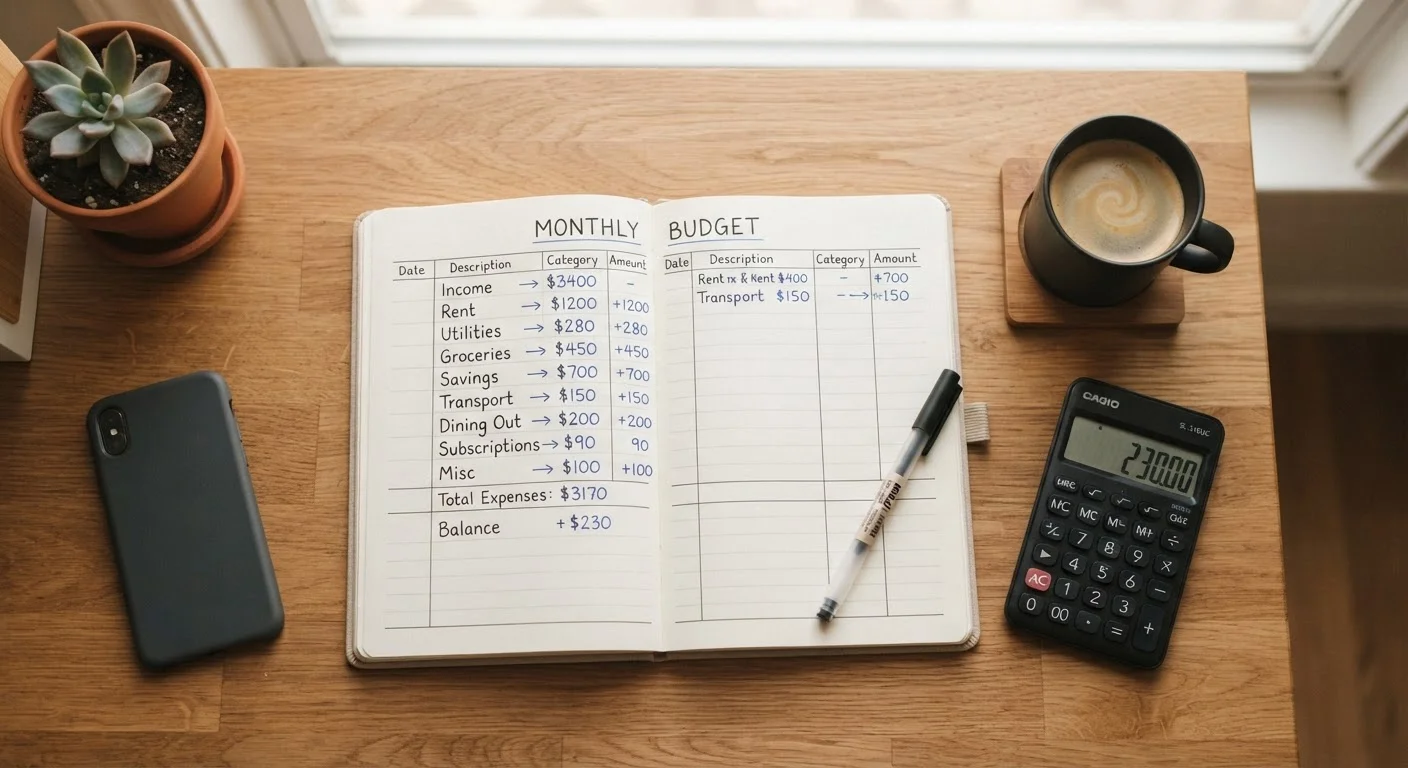
Subtract your total planned expenses from your take-home income. If the result is positive, allocate the surplus to a goal - an emergency fund, debt payoff, or savings. If the result is negative, you have a gap to close.
To close a gap, work through these options in order:
- Cut or reduce variable expenses (subscriptions, dining, discretionary shopping).
- Reduce fixed expenses where possible (renegotiate insurance, find a lower-cost plan).
- Explore whether income can increase, even temporarily.
Don't Cut So Deep You Can't Sustain It
Slashing every discretionary expense to zero might look good on paper but tends to collapse within a few weeks. Leave a realistic, if modest, amount for wants and enjoyment. A budget you can live with long-term is far more valuable than a perfect plan you abandon after one month.
A first budget rarely balances perfectly. That's normal. The point of this exercise is to surface the gap so you can make a conscious decision about it. For a structured walkthrough of the balancing process, the six-step monthly budget guide goes step by step through assigning every dollar a job.
Keeping Your Budget Working Month After Month
A budget made once and never revisited stops being useful quickly. Set a recurring monthly check-in - 20 minutes is usually enough - to compare what you planned to what you actually spent. Adjust next month's plan based on what you learned.
Two habits accelerate progress:
- Automate savings transfers on payday so the money moves before you have a chance to spend it.
- Review before you overspend, not after - check your budget mid-month to catch drift early.
As your budget becomes routine, you'll naturally start planning for larger goals: paying off debt, building an emergency fund, or saving for a significant purchase. The saving and debt hub is a natural next stop for readers ready to take those steps. And if life throws something unexpected at you - job change, medical cost, or a major expense - revisit the guide to building a budget that survives real life for strategies to stay on track.
This article is for general informational and educational purposes only. It is not personalized financial advice. Consider consulting a qualified financial professional for guidance tailored to your individual circumstances.
Frequently Asked Questions
Budgeting is useful at any income level. In fact, the lower your income, the more important it is to know exactly where every dollar goes. A budget helps you make deliberate choices regardless of how much you earn.
Use your lowest reliable monthly income as your baseline when building the budget. When you earn more in a given month, decide in advance where that extra money goes - savings, debt payoff, or a specific goal. This approach prevents overspending in high-earning months.
Monthly budgeting aligns with how most fixed bills are structured - rent, insurance, subscriptions. If you're paid weekly or biweekly, you can still build a monthly plan and divide it into pay-period buckets to manage cash flow more easily.
The 50/30/20 rule suggests directing 50% of take-home income to needs, 30% to wants, and 20% to savings and debt repayment. It's a starting framework, not a rigid law - adjust the percentages to fit your actual situation and goals.
Add up annual costs like car registration or holiday gifts, divide by 12, and set aside that amount each month in a dedicated savings account. When the bill arrives, the money is already there - no scrambling required.
Both work well; the best tool is the one you'll actually use consistently. A simple spreadsheet gives you full visibility and control, while many free apps automate transaction tracking. Start with whichever feels less intimidating and switch later if needed.
The content on this site is for informational purposes only and is not a substitute for professional advice. Always consult a qualified professional for guidance specific to your situation.