

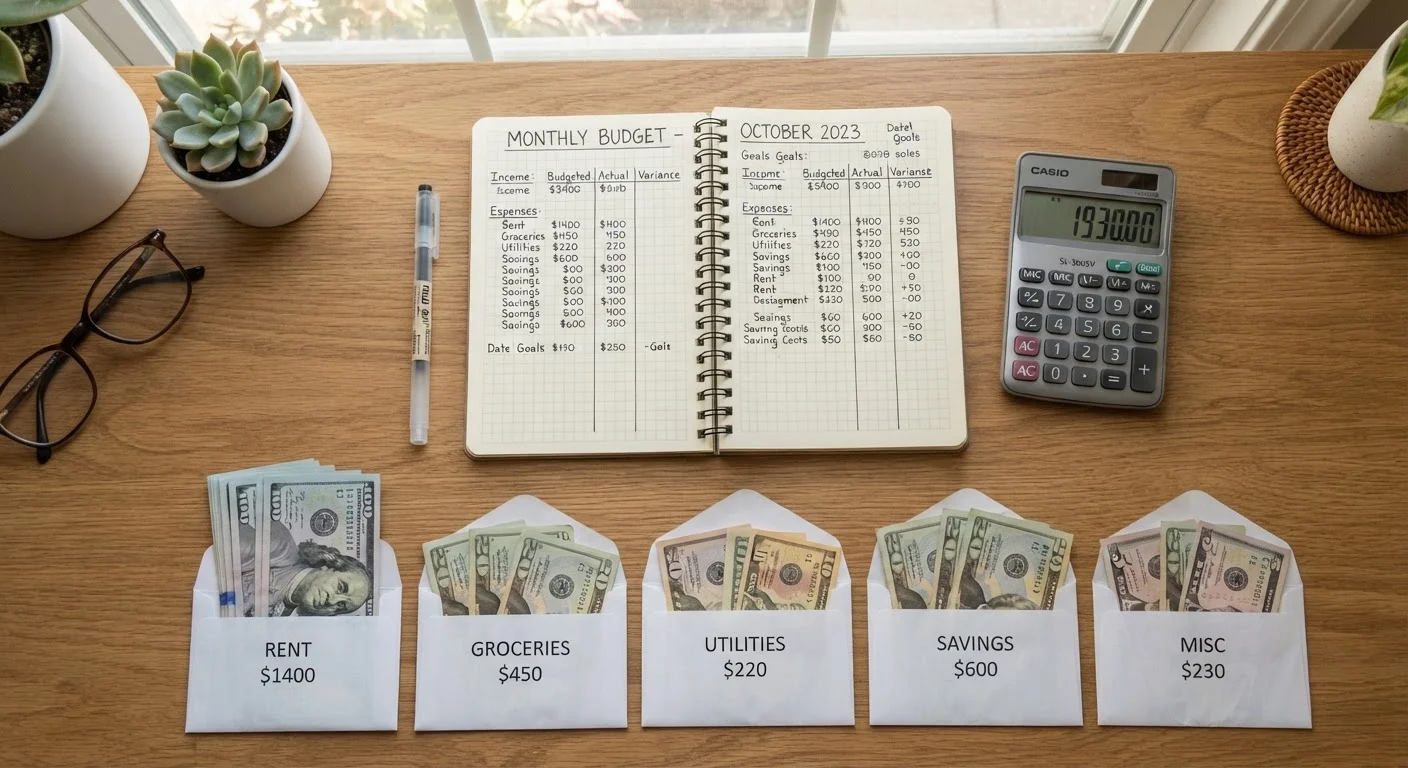
How Zero-Based Budgeting Works
The core mechanic is straightforward: take your total monthly income and subtract allocations for every category until you reach zero. Those categories typically include fixed expenses (rent, insurance, loan payments), variable necessities (groceries, utilities, transportation), discretionary spending (dining out, entertainment), savings goals, and debt repayment.
Each budget is built fresh at the start of every month. Rather than copying last month's numbers and adjusting slightly, you reconsider each category - a discipline that forces conscious spending decisions. If your income was $4,200 last month, every dollar of that $4,200 gets a named destination before the month begins.
If you finish the allocation process and have $150 left over, ZBB requires you to assign that remainder too - perhaps to an emergency fund or a vacation savings category. Leaving it unassigned defeats the purpose of the method.
Start Simple, Then Add Detail
New to ZBB? Begin with just five to seven broad categories rather than 20 narrow ones. Once you've completed two or three monthly cycles and understand your spending patterns, you can break categories into more specific buckets. Overly complex budgets are harder to maintain and more likely to be abandoned.
If you've never made a structured budget before, the plain-English starting point on our site walks through foundational concepts like income, expenses, and balance - a useful primer before diving into ZBB.
Who Benefits Most from This Approach
Zero-based budgeting tends to deliver the most value to people who:
- Have predictable, salaried income - knowing exactly what arrives each month makes it easier to allocate with precision.
- Want to break spending habits - because every category must be re-justified monthly, it's harder for lifestyle inflation to go unnoticed.
- Are working toward a specific financial goal - paying off credit card debt, building an emergency fund, or saving for a down payment all benefit from the intentionality ZBB demands.
- Feel like money disappears without explanation - the granular nature of ZBB surfaces where spending actually goes.
The method asks more of you than simpler frameworks. If you prefer a lighter-touch approach, it's worth understanding how ZBB stacks up against alternatives. Our article on the 50/30/20 rule vs. zero-based budgeting offers a direct comparison to help you decide.
1 in 3
Americans who don't follow any formal budget
A Gallup survey found that fewer than one-third of U.S. households maintain a detailed household budget.
$1,000+
Average monthly discretionary spending per U.S. household
U.S. Bureau of Labor Statistics Consumer Expenditure data shows significant discretionary outflows that often go untracked without a structured method.
20%
Recommended savings allocation as a starting target
Many personal finance frameworks, including guidance aligned with CFPB resources, suggest directing at least 20% of take-home pay toward savings and debt repayment.
Building Your Zero-Based Budget Step by Step
Getting started requires four straightforward actions:
- Calculate your monthly take-home income. Use net pay - what actually lands in your account after taxes and deductions. For variable income, use a conservative estimate.
- List every spending category. Start with fixed obligations, then variable necessities, then discretionary items. Don't forget irregular expenses like annual subscriptions or car maintenance - divide annual costs by 12 and set aside that amount monthly.
- Assign dollar amounts to each category. Work through the list until total allocations equal your income. Savings and debt payments should appear here as deliberate line items, not leftovers.
- Track spending throughout the month. A budget that isn't monitored won't work. Check actual spending against your plan weekly, and adjust within categories as needed without breaking the zero-sum total.
For a detailed walkthrough with examples, see our guide on building a personal budget from zero.
Common Pitfalls and How to Avoid Them
Even well-intentioned ZBB practitioners run into consistent trouble spots:
- Forgetting irregular expenses - Annual costs like car registration or holiday gifts can blow a monthly budget if not pre-planned. Build a miscellaneous or sinking fund category for these.
- Setting unrealistic category amounts - Budgeting $100 for groceries when you consistently spend $350 doesn't change behavior; it just creates failure. Use actual spending data from the prior two to three months as your baseline.
- Giving up after one imperfect month - The first one or two months of ZBB are almost always messy. Categories get misjudged, and unexpected costs appear. Treat early months as calibration, not failure.
ZBB Is a Method, Not a Moral Judgment
Zero-based budgeting is a planning tool - not a test of financial virtue. A category for entertainment, dining out, or hobbies is completely appropriate within a ZBB framework, as long as it's intentional and funded. The goal is awareness and intentionality, not austerity.
Zero-based budgeting is one of several established frameworks. Our broader overview of three popular budgeting methods - including the 50/30/20 rule and the envelope method - can help you determine which structure fits your habits and income type.
This article is for general informational and educational purposes only and does not constitute personalized financial advice. Consider consulting a qualified financial professional for guidance tailored to your individual circumstances.
Frequently Asked Questions
No. Zero-based budgeting means every dollar is assigned a job - that job could be saving, investing, or paying down debt. If your budget reaches zero, it means nothing is unaccounted for, not that your bank account is empty.
The 50/30/20 rule divides income into broad percentage buckets (needs, wants, savings). Zero-based budgeting is more granular - every specific category is planned individually. See a side-by-side comparison in our guide on the two methods.
It can work but requires extra steps. People with variable income often build the budget around their minimum expected earnings and adjust as additional income arrives. It demands more flexibility and monitoring than with a fixed paycheck.
The first month typically takes the longest - often one to two hours - because you're categorizing spending from scratch. After that, monthly resets usually take 30 to 60 minutes as you adjust prior categories rather than rebuild everything.
A simple spreadsheet works well for many people. Dedicated budgeting apps also support ZBB-style planning. The right tool is whichever one you'll actually use consistently each month.
The content on this site is for informational purposes only and is not a substitute for professional advice. Always consult a qualified professional for guidance specific to your situation.