

Our Verdict
The 'good debt vs. bad debt' distinction is a helpful mental model, not a firm rule. Whether a given debt helps or harms your finances depends on its interest rate, its purpose, your ability to repay, and how it fits your overall budget. Understanding where any debt falls - and why - gives you a clearer lens for every borrowing decision.
| Best for | Recommended |
|---|---|
| Those seeking a quick mental framework for evaluating borrowing | Good/Bad Debt Framework |
| Those with complex or mixed-purpose borrowing situations | Grey Area Analysis (asking individual questions) |
| Those focused on eliminating existing debt efficiently | Structured repayment strategies (avalanche or snowball) |
The Basic Framework: What Makes Debt 'Good' or 'Bad'?
The terms good debt and bad debt are shorthand for a more nuanced idea: some borrowing tends to improve your financial position over time, while other borrowing tends to erode it. Understanding which is which starts with two core questions - what does this debt produce, and what does it cost?
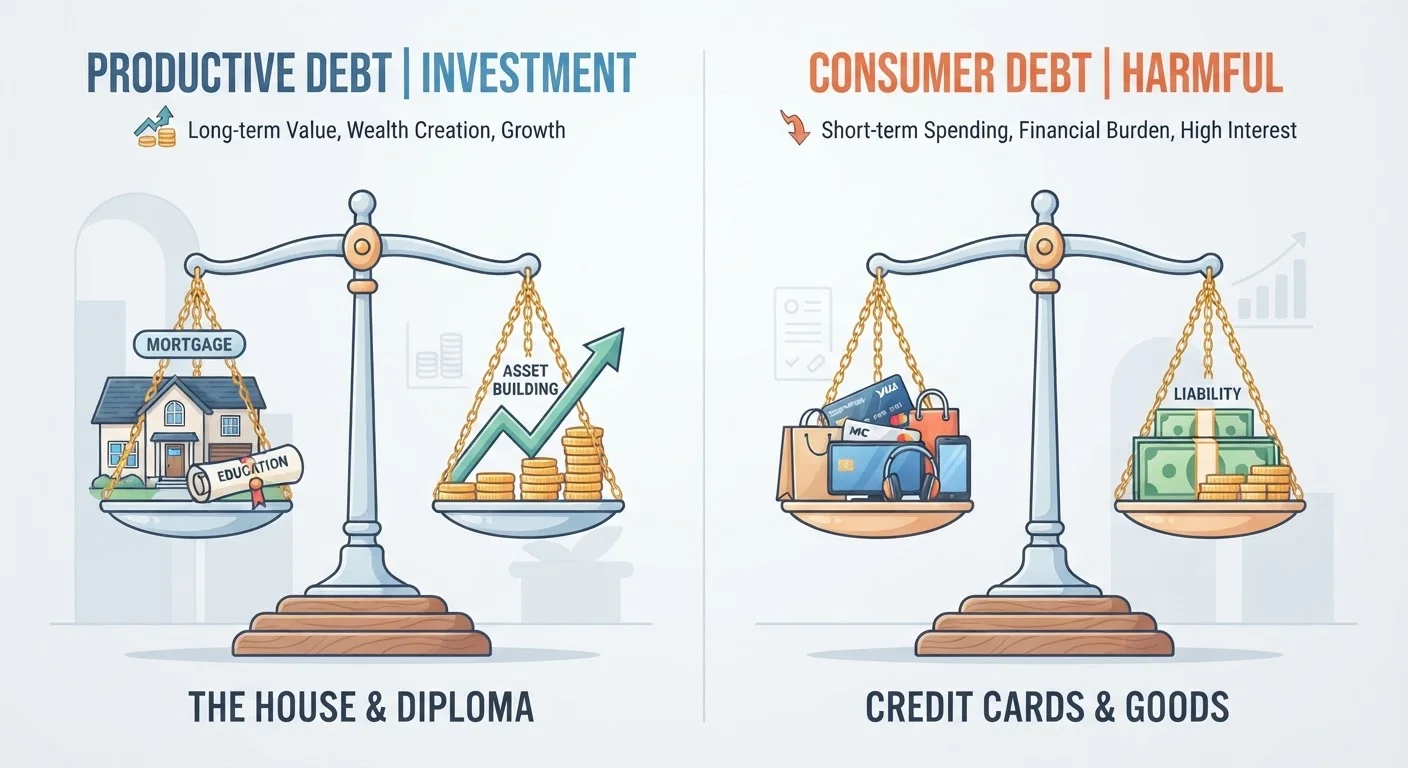
Good debt is generally characterized by a relatively low interest rate and a connection to something that builds lasting value. A home mortgage is the classic example: you're financing an asset that may appreciate, and in many cases, mortgage interest is tax-deductible. Federal student loans, taken to complete a degree that expands earning potential, are another frequently cited example - though as we'll see, this category comes with important caveats.
Bad debt, on the other hand, typically carries a high interest rate and finances things that either depreciate immediately or provide only short-term satisfaction. High-interest credit card balances carried month-to-month are the clearest example. Payday loans - short-term, extremely high-cost borrowing - sit at the most harmful end of the spectrum. For a plain-language breakdown of key debt terms, see our debt glossary.
| Good Debt | Grey Area Debt | Bad Debt | |
|---|---|---|---|
| Typical purpose | Builds value or earning power | Mixed - need and convenience | Finances consumption or impulse |
| Common examples | Mortgage, federal student loan | Auto loan, medical debt | High-interest credit card, payday loan |
| Typical interest rate | Lower (often tax-advantaged) | Moderate to high | High to very high |
| Asset or value created | Often yes | Sometimes (car depreciates) | Rarely or never |
| Risk level | Lower, but not zero | Medium | High |
| Impact on net worth (potential) | Positive over time | Neutral to slightly negative | Negative |
The Grey Area: Where Most Real-Life Debt Lives
The clean good/bad split breaks down quickly when you examine the debt most Americans actually carry. Auto loans illustrate this well. A car is a depreciating asset - it loses value the moment you drive it off the lot. But for most people, a vehicle is a practical necessity for getting to work and generating income. That productive function pushes it toward the 'good' side; its depreciation and often-moderate-to-high interest rates push it back.
Medical debt is another genuinely ambiguous category. It doesn't finance a purchase you chose - it results from a need. It often carries interest, and it can damage credit scores. Yet avoiding necessary medical care to sidestep debt is its own serious risk. The debt isn't a lifestyle choice; it's frequently unavoidable.
Even student loans, often cited as good debt, are more complicated than the label suggests. The value of a degree depends heavily on field of study, institution, completed degree status, and the job market a graduate enters. Borrowing heavily for a credential with uncertain income prospects can produce debt that functions much more like the 'bad' category in practice. Our companion article explores this nuance in more depth.
Ask These Questions Before Borrowing
Before taking on any debt, ask: What is the interest rate and total cost over the life of the loan? Does this debt create lasting value or simply fund immediate consumption? Can I comfortably afford the monthly payment within my budget? Having clear answers helps you move beyond labels and make a grounded decision.
Interest Rates, Affordability, and What the Numbers Actually Tell You
Perhaps more important than the category label is the actual cost of borrowing. Interest rates determine how much a loan truly costs over its life - a distinction that matters far more than whether the debt is nominally 'good' or 'bad.'
~$17.5T
Total U.S. household debt
According to the Federal Reserve Bank of New York's Household Debt and Credit Report, total U.S. household debt reached approximately $17.5 trillion in 2024.
20%+
Average credit card APR
The Federal Reserve tracks average credit card interest rates, which have exceeded 20% APR in recent years - illustrating the cost of high-interest consumer debt.
A mortgage at a reasonable rate may cost meaningfully less over time than a personal loan at double-digit interest - even though both could theoretically finance something lasting. The difference between fixed and variable rate debt also plays a role: variable-rate debt can become significantly more expensive if interest rates rise.
Equally important is affordability within your budget. Even productive debt becomes a problem if the monthly payment strains your cash flow and forces you to carry high-interest balances elsewhere. Lenders use your debt-to-income ratio (DTI) as one measure of this - and it's worth understanding how that ratio reflects your overall financial picture before taking on new obligations. For guidance on keeping debt manageable within monthly spending, see our budgeting basics hub.
Even 'Good' Debt Can Become Harmful
A mortgage or student loan is only as productive as the context it's taken in. Borrowing more than you can reasonably repay, at an unfavorable rate, or for a degree with limited earning prospects can turn so-called good debt into a financial burden. The category is a starting point - your specific numbers and circumstances always take precedence.
Moving Beyond Labels: Applying This Framework to Real Decisions
The good/bad framework is most useful as a starting lens, not a final answer. Once you understand where a debt roughly falls, the next step is asking sharper, more personal questions: Does the rate reflect acceptable cost given your options? Does the borrowed amount fit within a realistic repayment timeline? And does the debt serve a genuine financial purpose, or is it filling an emotional or convenience gap that a stronger savings habit might address instead?
For readers already carrying debt across multiple categories, the next practical question is usually how to pay it down most efficiently. Two structured approaches - the debt avalanche (targeting highest-interest debt first) and the debt snowball (targeting smallest balances first) - each have different strengths depending on your situation. Our comparison of the debt avalanche and snowball methods walks through both. You might also want to review common myths about debt that can derail even well-intentioned repayment efforts.
The central insight is that debt is a tool. Like most tools, its value depends entirely on how it's used, at what cost, and whether the user has a clear plan. Labels help orient thinking - but the details always determine the outcome.
This article provides general financial education and is not personalized financial or legal advice. Consult a qualified financial professional for guidance specific to your situation.
The content on this site is for informational purposes only and is not a substitute for professional advice. Always consult a qualified professional for guidance specific to your situation.