

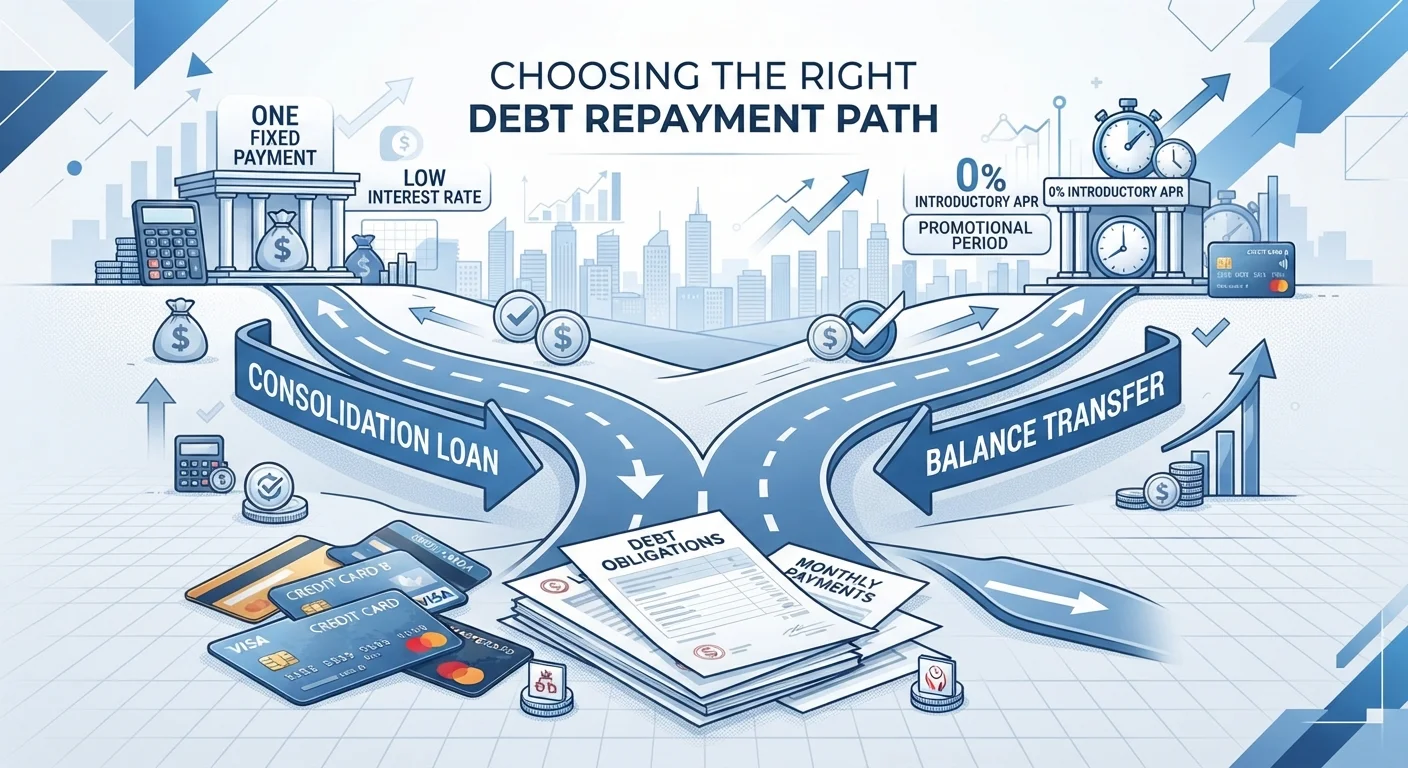
Our Verdict
Debt consolidation loans tend to suit borrowers with larger, mixed debt balances who want a predictable repayment structure. Balance transfers work best for those with good-to-excellent credit, manageable balances, and the discipline to pay off debt within a promotional period. Neither option is universally superior - the right choice depends on your individual financial situation.
| Best for | Recommended |
|---|---|
| Those with large or mixed debt balances needing structure | Debt Consolidation Loan |
| Those with credit card debt they can realistically clear within 12-21 months | Balance Transfer |
| Those with lower credit scores who may not qualify for a 0% card | Debt Consolidation Loan |
| Those seeking to minimize total interest on a focused, smaller balance | Balance Transfer |
What Each Option Actually Does
When managing high-interest debt, two tools often come up: debt consolidation loans and balance transfers. They serve a similar goal - reducing interest costs and simplifying repayment - but they work in fundamentally different ways.
A debt consolidation loan is a personal loan used to pay off multiple existing debts. You're left with a single loan at a fixed interest rate and a defined repayment schedule, typically spanning two to seven years. For a deeper look at how this works, see our overview of debt consolidation.
A balance transfer moves existing credit card debt to a new credit card, usually one offering a promotional 0% annual percentage rate (APR) for a set period - commonly 12 to 21 months. If you pay off the balance before the promotional period ends, you avoid interest entirely. If you don't, the remaining balance typically shifts to the card's standard APR, which can be substantial.
Understanding what each tool does mechanically is the first step toward choosing the one that aligns with your situation.
Key Differences Across Critical Factors
The table below compares both options across the factors most likely to affect your decision.
| Debt Consolidation Loan | Balance Transfer | |
|---|---|---|
| Interest structure | Fixed APR for loan term | 0% promo APR, then variable standard APR |
| Typical fees | Origination fee (1%-8%) | Transfer fee (3%-5% of balance) |
| Best debt type | Mixed or large balances | Credit card balances only |
| Repayment timeline | 2-7 years, fixed schedule | Promotional window (12-21 months) |
| Credit score typically needed | Fair to good (580+) | Good to excellent (670+) |
| Risk if not repaid on time | Continued fixed payments, potential default | High standard APR kicks in on remaining balance |
| Credit utilization impact | May lower revolving utilization | Can increase utilization on one card |
A few of these distinctions deserve emphasis. Balance transfers carry a transfer fee - usually 3% to 5% of the amount moved - that applies upfront. Consolidation loans often include origination fees, and some lenders charge prepayment penalties. Neither option is truly "free," so factor total costs, not just interest rates, into your comparison.
Credit impact also differs. Applying for either option triggers a hard inquiry on your credit report. However, a consolidation loan may help your credit utilization ratio (the percentage of revolving credit you're using) by moving debt off your credit cards. A balance transfer, by contrast, concentrates debt on a single revolving card, which can temporarily increase utilization on that account.
When a Debt Consolidation Loan May Be the Better Fit
A consolidation loan tends to make more sense when:
- Your total debt is large - generally above $10,000 - and unlikely to be paid off within a 12-21 month promotional window.
- Your debt includes non-credit-card balances (e.g., medical bills or personal loans) that can't be transferred to a balance transfer card.
- You prefer a fixed monthly payment and a clear end date, which can help with budgeting and financial planning.
- Your credit score is in the fair-to-good range, which may limit your access to 0% promotional offers but still qualify you for a lower-rate personal loan.
One practical consideration: a fixed repayment schedule creates accountability. Unlike a credit card minimum payment, a personal loan's monthly installment doesn't shrink as your balance falls - meaning you'll pay it down faster on the same monthly commitment.
Run the Numbers Before You Commit
Before choosing a consolidation loan, use a loan amortization tool to compare the total interest you'd pay against your current debt's interest costs. Even a lower rate may cost more overall if the loan term is significantly longer. The goal is to reduce total cost, not just monthly payment size.
For context on evaluating whether your existing debt is worth restructuring at all, our guide on good debt versus bad debt can help you frame the question.
When a Balance Transfer May Be the Better Fit
A balance transfer tends to work better when:
- Your debt is primarily credit card debt and is modest enough - often under $10,000 - that you can realistically retire it during the promotional period.
- You have a good-to-excellent credit score (typically 670 or above) to qualify for cards with meaningful 0% offers and low transfer fees.
- You have the discipline not to add new charges to the old cards or the new card during repayment.
- You've done the math: the transfer fee is less than what you'd pay in interest using another method over the same period.
Watch Out for the Promotional Period Expiry
If you carry a remaining balance when a 0% promotional period ends, the full standard APR - often 20% or higher - applies immediately to that balance. Before initiating a transfer, calculate whether you can realistically pay off the full amount within the promotional window based on your actual monthly budget, not a best-case scenario.
If you're weighing multiple repayment approaches simultaneously, our comparison of the debt snowball and debt avalanche methods offers complementary frameworks for structuring your payoff once you've consolidated.
The One Risk Both Options Share
Both debt consolidation and balance transfers address symptoms, not the root cause. If overspending or an imbalanced budget created the debt, neither tool will prevent new debt from accumulating once existing balances are cleared.
Research consistently shows that consumers who consolidate debt without changing spending habits frequently end up with both the consolidation payment and new credit card debt within a few years. This is sometimes called "reloading" - and it can worsen your financial position rather than improve it.
Building a realistic monthly budget before or alongside any debt payoff strategy is essential. Our article on managing debt and saving at the same time explores how to structure your finances so debt reduction doesn't come at the expense of building financial resilience.
This article is for general informational and educational purposes only and does not constitute personalized financial or legal advice. Consult a qualified financial professional before making decisions about your specific debt situation.
The content on this site is for informational purposes only and is not a substitute for professional advice. Always consult a qualified professional for guidance specific to your situation.