

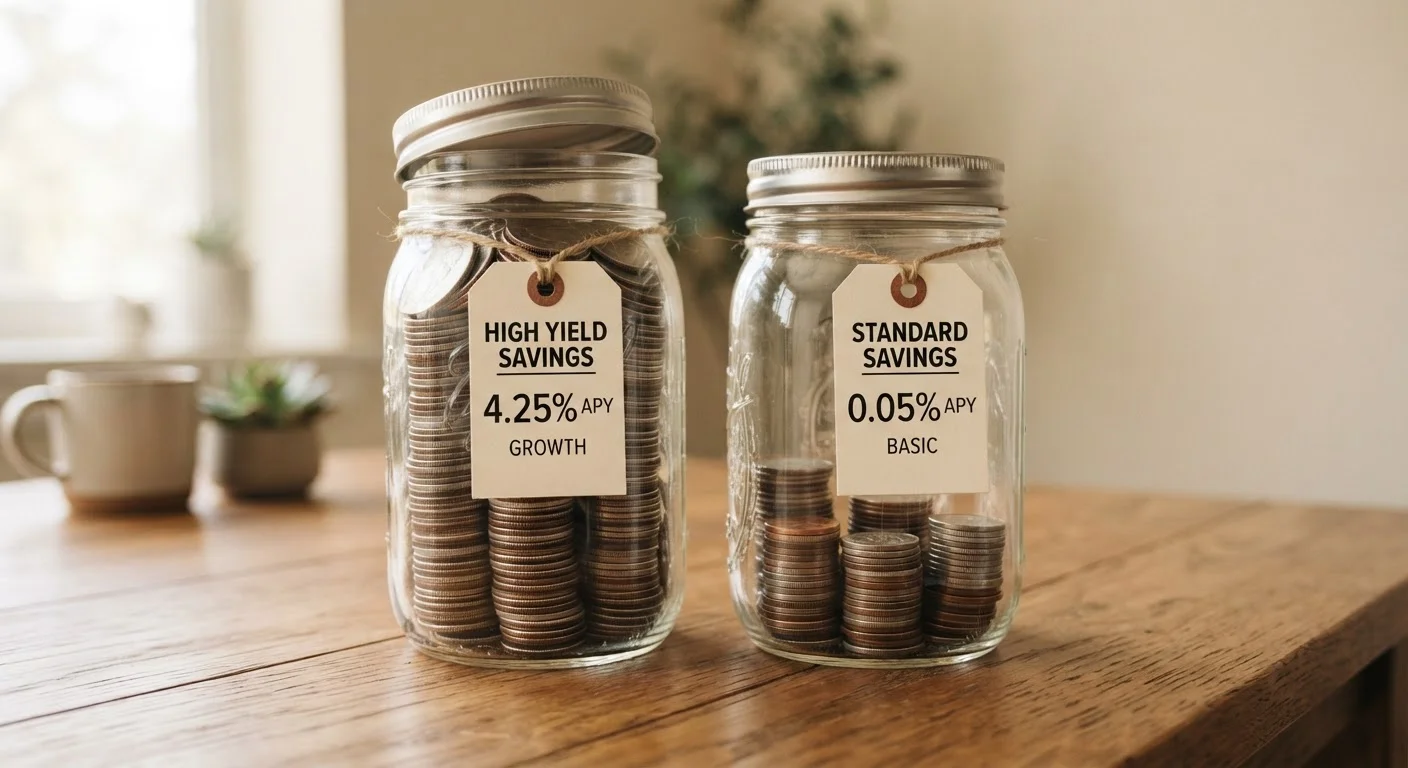
Option A
Standard Savings Account
The familiar, widely accessible baseline for personal saving.
Best for: Consumers who prioritize branch access, simplicity, and keeping savings alongside their everyday checking account.
Option B
High-Yield Savings Account
The higher-rate alternative designed to make idle cash work harder.
Best for: Savers comfortable with online banking who want meaningfully more interest on their emergency fund or short-term goals.
The Core Difference: Interest Rate
The most significant distinction between a high-yield savings account and a standard savings account is the annual percentage yield (APY) - the rate at which your deposited balance earns interest over a year, including compounding. Understanding how compounding amplifies earnings over time is foundational here; see our article on how compound interest works for savers for a deeper explanation.
Standard savings accounts, typically offered by large traditional banks and credit unions, have historically paid APYs well below 1%. High-yield savings accounts - most commonly offered by online banks - have offered APYs that are substantially higher, often several times the national average. The Federal Deposit Insurance Corporation (FDIC) publishes the national average savings rate regularly, and the gap between that average and what high-yield accounts offer can be considerable, particularly during periods of higher federal interest rates.
That rate advantage is the central reason consumers consider making a switch. For a deeper look at how these rates are set, our high-yield savings accounts explained article covers the mechanics in full.
| Criterion | Standard Savings Account | High-Yield Savings Account |
|---|---|---|
| Typical APY | Below national average (often under 0.5%) | Significantly above national average (varies) |
| FDIC/NCUA Insured | Yes, up to $250,000 | Yes, up to $250,000 |
| Access Type | Branch, ATM, online | Primarily online only |
| Transfer Speed | Instant if same-bank checking | 1-3 business days to external accounts |
| Rate Stability | Variable, typically slow to change | Variable, responsive to Fed rate changes |
| Principal Risk | None (not market-linked) | None (not market-linked) |
| Tax Treatment | Interest is taxable income | Interest is taxable income |
What Stays the Same: Protections and Structure
Despite the rate difference, several features are shared across both account types - and these matter for evaluating real-world risk.
$250,000
Federal deposit insurance limit per depositor
The FDIC insures deposits at member banks up to $250,000 per depositor, per institution, per ownership category - identical for both account types.
0.01%-5%+
Approximate APY range across savings accounts
APYs vary widely depending on account type, institution, and prevailing federal interest rates; always verify current rates directly with financial institutions.
- FDIC insurance: Both standard and high-yield savings accounts at FDIC-member institutions are federally insured up to $250,000 per depositor, per institution, per ownership category. The National Credit Union Administration (NCUA) provides equivalent protection at credit unions.
- Liquidity: Both account types keep your money accessible. Neither locks funds away the way a certificate of deposit (CD) does.
- No investment risk: Unlike stocks or mutual funds, savings accounts do not expose your principal to market fluctuations. The balance will not decrease due to market conditions.
- Tax treatment: Interest earned in both account types is generally considered taxable income in the year it is received and must be reported to the IRS.
It's also worth noting what both accounts are not designed for: long-term wealth building. For retirement-focused saving with tax advantages, a different structure is needed - our comparison of Roth IRA vs. Traditional IRA explains those options.
Trade-offs Worth Considering
High-yield accounts aren't universally superior. There are real trade-offs that affect whether the rate advantage translates into a better fit for every saver.
Access and convenience: High-yield accounts are predominantly offered by online-only banks. This means no branch visits, and some consumers find the absence of face-to-face service a genuine friction point - particularly for complex questions or large transactions.
Transfer timing: Moving money between an online high-yield account and an external checking account typically takes one to three business days. Standard savings accounts linked to a checking account at the same institution may allow faster or instant transfers.
Minimum balance and fee structures: Both account types vary widely here. Some high-yield accounts carry no minimum balance requirements or monthly fees; others do. Standard savings accounts at large banks may charge fees that erode interest earned if minimums aren't met.
Rate variability: High-yield savings account rates are variable, not fixed. When the Federal Reserve adjusts its benchmark rate, banks often adjust their savings rates in response - meaning the APY advantage can narrow or widen over time.
A Note on Withdrawal Rules
Federal Regulation D historically limited savings account withdrawals to six per month, but the Federal Reserve suspended that requirement in 2020, giving banks flexibility to set their own limits. Many online banks still enforce similar limits as a matter of policy, and exceeding them may trigger fees or account conversion. Always review the specific terms of any account before opening it.
Deciding where to keep your liquid savings also intersects with how you use that account - for instance, whether it doubles as an emergency fund. Our article on the difference between an emergency fund and a savings account helps clarify that distinction.
How to Use This Comparison Practically
The question isn't which account is objectively better - it's which one aligns with how you actually save and access money. A few practical considerations can guide that decision:
- Calculate the dollar difference: On a $5,000 balance, the gap between 0.5% APY and 4.5% APY is roughly $200 per year in additional interest. The math changes with balance size and the actual rates available at any given time.
- Assess how often you need fast access: If you're likely to need funds quickly and frequently, the transfer lag of an online account may matter more than the rate difference.
- Consider having both: Many households maintain a standard savings account linked to their checking for day-to-day flexibility, and a high-yield account for their longer-term liquid reserves, such as an emergency fund or a savings goal that won't be touched for months.
Tracking your overall savings rate - the share of income you consistently set aside - matters more than the account type alone. An account earning 4% APY on a $200 balance contributes far less than a standard account holding a $10,000 emergency fund built through consistent saving habits.
This article is for general informational and educational purposes only and does not constitute personalized financial advice. Consult a qualified financial professional before making decisions based on your specific circumstances.
The content on this site is for informational purposes only and is not a substitute for professional advice. Always consult a qualified professional for guidance specific to your situation.