

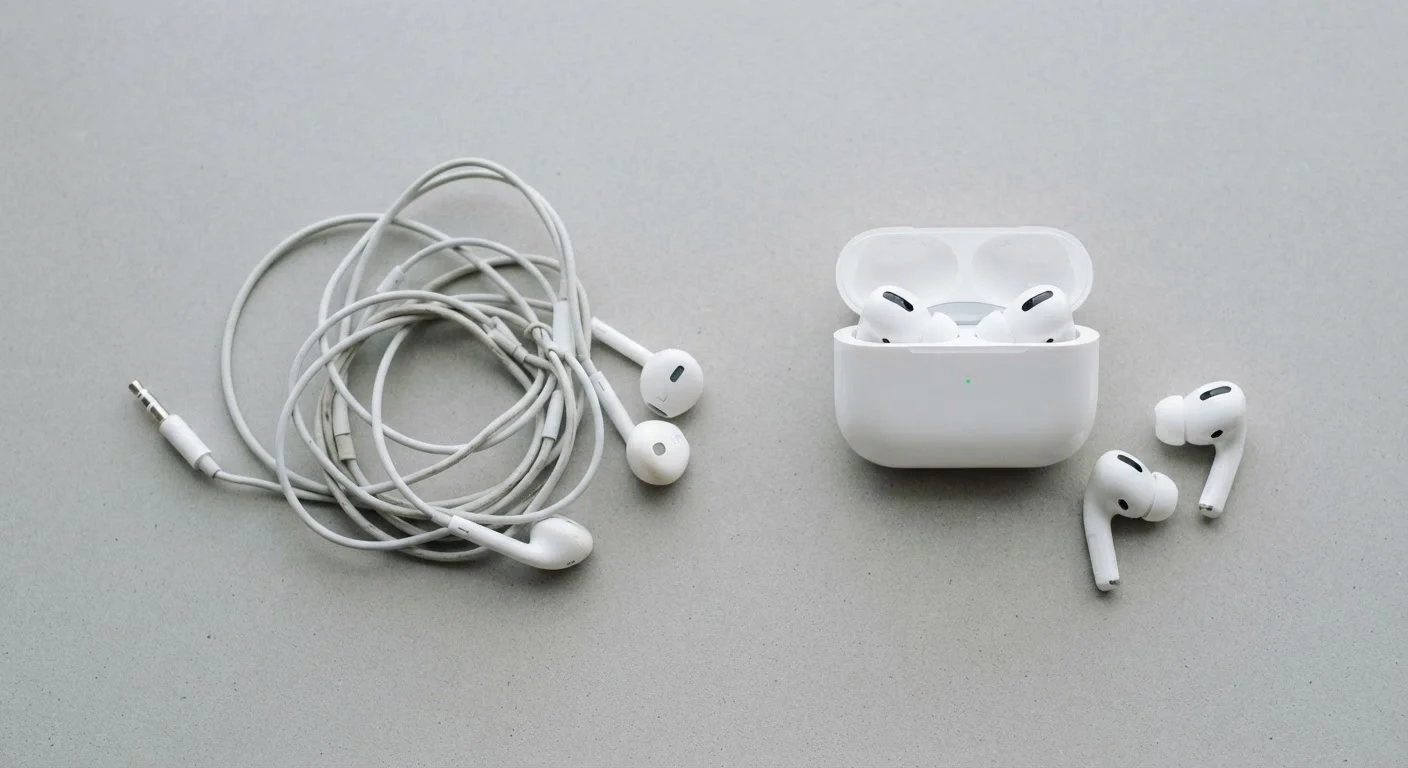
Option A
Wired Earbuds
The dependable, no-compromise audio classic.
Best for: Listeners who prioritize consistent audio quality, zero latency, and never worrying about battery life.
Option B
Wireless Earbuds
The cable-free, feature-rich modern option.
Best for: Active users who value freedom of movement, smart device integration, and on-the-go convenience.
What Actually Separates Wired from Wireless
At the most fundamental level, wired earbuds transmit audio as an analog electrical signal through a physical cable. Wireless earbuds receive audio as a digital signal over Bluetooth - a short-range radio protocol - and convert it inside the earbud itself. That difference in signal path has real downstream effects on latency, audio fidelity, battery dependence, and how each type fits into your daily life.
For a broader look at how wired and wireless trade-offs play out across all kinds of everyday devices, see how wired and wireless connections compare generally. The earbud context adds a few specific wrinkles worth understanding on their own.
| Criterion | Wired Earbuds | Wireless Earbuds |
|---|---|---|
| Latency | Negligible (near-zero delay) | Small delay; varies by codec |
| Audio fidelity ceiling | High; no compression required | Good to high; codec-dependent |
| Battery required | No | Yes; finite charge cycles |
| Freedom of movement | Limited by cable length | Unrestricted within Bluetooth range |
| Headphone jack needed | Yes (or adapter) | No |
| Active Noise Cancellation | Rarely available | Common on mid/high-tier models |
| Setup complexity | Plug in and play | Requires Bluetooth pairing |
| Long-term durability risk | Cable fraying | Battery capacity degradation |
Latency: Why It Matters More Than You Might Think
Latency refers to the delay between when audio is produced by your device and when you actually hear it. Wired earbuds have negligible latency - the signal travels almost instantaneously. Wireless earbuds, because they encode, transmit, and decode a digital signal, always introduce some delay.
Modern Bluetooth codecs - the compression formats used to send audio wirelessly - have reduced this gap considerably. Aptx Low Latency and similar formats can bring delay down to around 40 milliseconds, which is imperceptible during casual music listening. However, for video playback, video calls, or gaming, even modest delay can cause noticeable lip-sync issues or audio that feels slightly out of step with on-screen action.
~40ms
Minimum latency for low-latency Bluetooth codecs
Standard Bluetooth audio without a low-latency codec can produce delays of 100-200ms, while optimized codecs can reduce this to approximately 40ms or lower.
300-500
Typical full charge cycles before noticeable battery degradation
Lithium-ion batteries in wireless earbuds generally begin losing meaningful capacity after several hundred complete charge cycles, a pattern consistent across portable electronics.
If your use case involves timing-sensitive audio, the wired path remains the more predictable choice. If you primarily stream music, latency is unlikely to be noticeable in practice.
Audio Quality: The Honest Picture
Wired earbuds have traditionally held an advantage in audio fidelity because the analog signal path avoids the compression that Bluetooth requires. High-quality wired earbuds can take full advantage of lossless audio files and high-resolution streaming.
Wireless audio quality has improved substantially. Codecs like aptX HD and Sony's LDAC can transmit audio at high bit depths and sample rates, narrowing the gap for most listeners. However, the quality you actually hear depends on the codec supported by both your earbuds and your source device - and not all device combinations support the same codecs. Understanding how Bluetooth works as a technology helps clarify why these compatibility details matter - see this plain-language guide to Bluetooth and short-range connectivity for context.
For most everyday listening environments, the difference is subtle. Audiophiles using high-resolution source material are more likely to notice it than casual listeners.
Codec Compatibility Affects Wireless Audio Quality
Wireless audio quality is only as good as the codec both your earbuds and your source device mutually support. If your earbuds support LDAC but your phone does not, the connection defaults to a lower-quality shared codec. Before assuming wireless audio quality will match the spec sheet, verify codec compatibility between your specific device pairing. This is a commonly overlooked detail when evaluating wireless earbud performance.
Battery, Durability, and Practical Realities
Wired earbuds have no battery to charge, degrade, or run flat at an inconvenient moment. They also tend to be mechanically simpler, with fewer moving parts or electronic components that can fail. The main durability vulnerability is the cable itself, which can fray, kink, or break at stress points near the plug or ear pieces.
Wireless earbuds carry rechargeable lithium-ion batteries that have a finite lifespan. After several hundred charge cycles, battery capacity measurably declines - meaning earbuds that once lasted six hours may hold significantly less charge over time. Charging cases extend daily usability but add another item to manage. On the upside, wireless earbuds eliminate cable tangling entirely and typically offer features like touch controls, voice assistant integration, and automatic device switching.
The disappearance of the 3.5mm headphone jack from many current smartphones also changes the practical calculus: wired earbuds now often require a USB-C or Lightning adapter, which adds a step and an accessory to carry - a friction point that wireless avoids entirely.
The content on this site is for informational purposes only and is not a substitute for professional advice. Always consult a qualified professional for guidance specific to your situation.