

Option A
End-to-End Encryption (E2EE)
The gold standard for private messaging.
Best for: Anyone who needs their messages readable only by the sender and recipient - no exceptions.
Option B
Standard (Transport) Encryption
Widely used, but leaves gaps at the provider level.
Best for: General web browsing, account logins, and services where the provider legitimately needs to access your data.
How Each Type of Encryption Actually Works
Encryption is the process of scrambling data so only authorised parties can read it. But the word encryption covers several different approaches, and the distinctions matter enormously for privacy.
Standard encryption - more precisely called transport encryption - protects data as it moves between your device and a server. When you see https:// in a browser address bar, that's transport encryption at work. It prevents outsiders on the network from intercepting your data mid-transit. However, once the message arrives at the service provider's server, it is decrypted and stored in a form the provider can access.
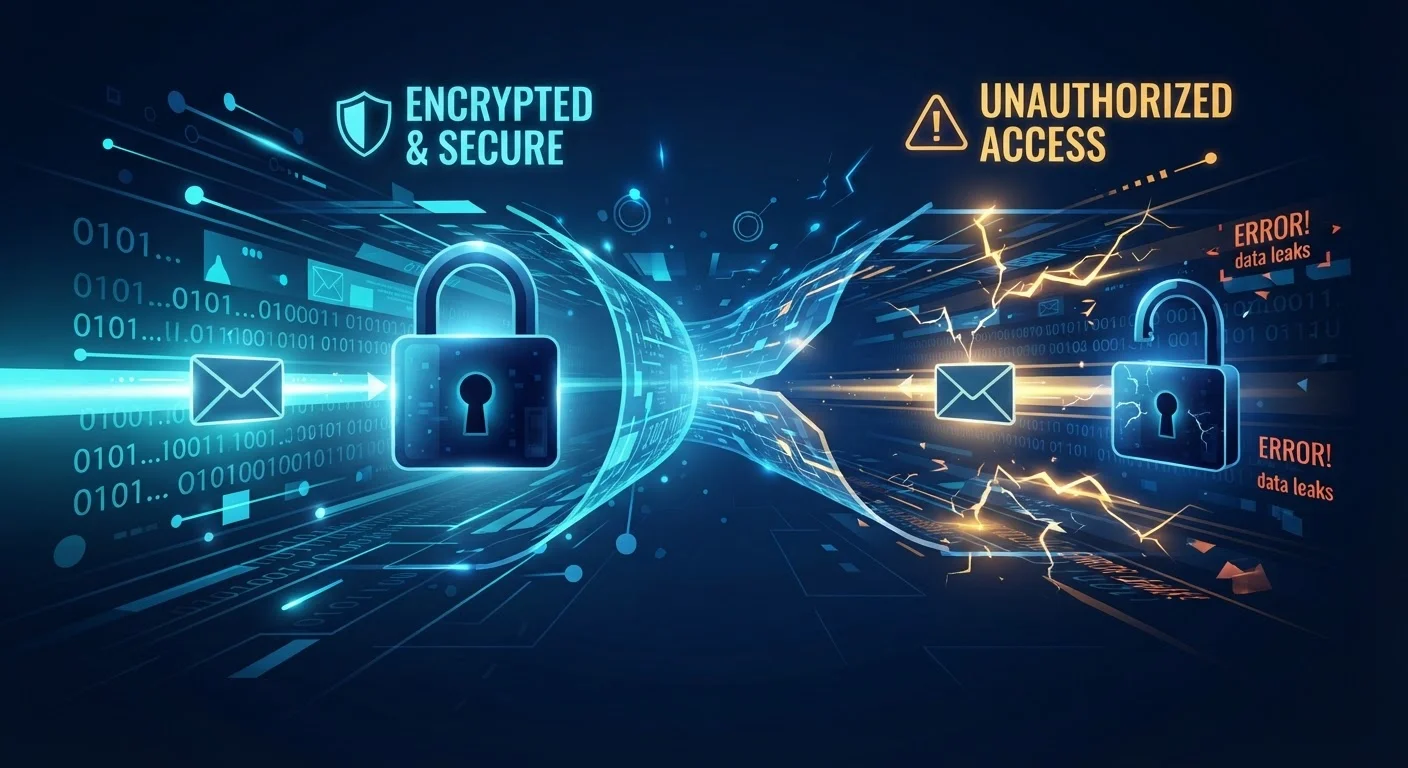
End-to-end encryption (E2EE) works differently. The message is encrypted on your device before it ever leaves, using a key that only the intended recipient holds. The service provider routes the encrypted data but never holds the key needed to read it. Even if the provider's servers are breached, attackers see only scrambled data.
| Criterion | End-to-End Encryption | Standard (Transport) Encryption |
|---|---|---|
| Who can read your message | Sender and recipient only | Service provider can access it |
| Where encryption happens | On your device, before sending | On the network between device and server |
| Provider access to content | No - provider holds no decryption key | Yes - decrypted on provider's server |
| Protects against network interception | Yes | Yes |
| Protects against server-side breach | Yes - data remains encrypted | No - stored data may be exposed |
| Common use cases | Private messaging, file sharing | Web browsing, login, email transit |
| Protects unlocked device screen | No | No |
Think of it this way: transport encryption is like sending a sealed letter through a courier - the courier can't read it during delivery, but the sorting facility can open it. E2EE is like a letter written in a personal code that only the recipient knows how to decode.
Where the Gaps Appear - and Why They Matter
For everyday consumers, the most important gap in standard encryption is at the provider level. A company that stores your decrypted messages can, in principle, be compelled by law enforcement to hand them over, could be breached by attackers, or could mine them for business purposes - depending on its policies and jurisdiction.
~80%
Share of global web traffic using HTTPS
Google's Transparency Report has consistently tracked HTTPS adoption across Chrome browsing, showing broad but not universal deployment of transport encryption.
Varies widely
Messaging apps with E2EE enabled by default
Adoption of default E2EE differs significantly across messaging platforms; some enable it for all chats, others only for specific conversation types or require manual setup.
This does not mean standard encryption is without value. HTTPS protects passwords, payment details, and login credentials from being intercepted on the network. That protection is essential and should not be dismissed. The concern arises specifically when message content privacy matters beyond the transit phase.
E2EE also has limitations worth understanding. It protects messages in transit and at rest on the provider's servers - but it cannot protect a message that is visible on an unlocked phone, screenshotted by the recipient, or backed up to a cloud service without encryption. The encryption boundary ends at the device.
For a broader look at protecting all aspects of your digital life - not just messaging - see our comprehensive digital security guide.
Cloud Backups Can Bypass E2EE
Even if your messages are end-to-end encrypted in transit, automatic cloud backups may store them in an unencrypted or separately encrypted format accessible to the cloud provider. This is a frequently overlooked gap. Check your messaging and cloud storage settings to understand what is and is not protected end-to-end.
Practical Steps: Applying This Knowledge
Understanding encryption types helps you make better choices without needing to become a security expert.
- Check your messaging apps. Review whether the apps you use offer E2EE and whether it is on by default or requires manual activation. Some services offer it only in specific chat modes.
- Use E2EE for sensitive conversations. Medical details, financial discussions, and personal matters warrant a messaging tool with E2EE enabled by default.
- Don't assume encryption protects stored backups. If you back up messages to a cloud service, check whether that backup is also encrypted end-to-end - many are not by default.
- Combine encryption with good account security. Encryption protects content in transit; a strong, unique password and a second authentication factor protect account access. These layers work together. If you're weighing authentication options, see the differences between SMS codes and authenticator apps.
No single security measure covers every risk. Encryption - whether end-to-end or transport-based - is one layer in a broader set of habits and tools. Knowing what each layer does, and where it stops, puts you in control of decisions that affect your own privacy.
The content on this site is for informational purposes only and is not a substitute for professional advice. Always consult a qualified professional for guidance specific to your situation.