

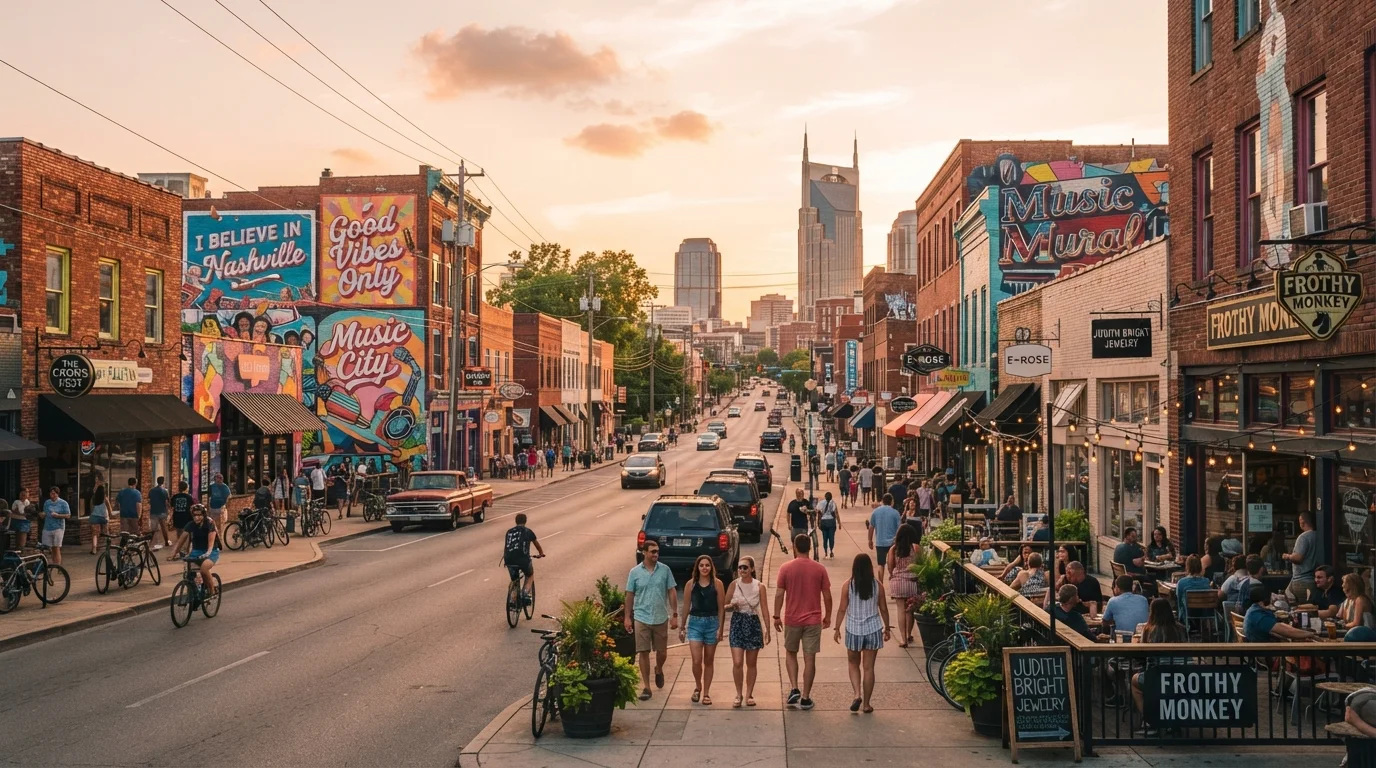
Why Nashville Rewards the Curious Traveler
Lower Broadway - the neon-soaked strip of honky-tonks, bachelorette parties, and daytime boot-scootin' - is what most people picture when they think of Nashville. It's loud, it's fun, and it's entirely optional. The city that exists beyond that two-block-wide corridor is genuinely surprising: walkable neighborhoods with real character, a restaurant culture that rivals cities twice its size, and a civil rights and arts history that rarely makes it into the travel brochures.
If you've avoided Nashville assuming it's a one-note destination, that assumption deserves a second look. And if you're visiting for a wedding or work trip and quietly dreading wall-to-wall country music, rest easy - this city has plenty of room for you. For a broader orientation to what lies past the honky-tonks, our guide for first-time Nashville visitors is a useful starting point.
2M+
Annual visitors to Nashville
Nashville consistently draws millions of visitors annually, making it one of the Southeast's most-visited urban destinations.
1960
Year of Nashville's landmark sit-in protests
The Nashville sit-ins are widely regarded as among the most organized and effective student-led civil rights actions of the era.
~20 min
Rideshare time between key neighborhoods
East Nashville, Germantown, 12 South, and The Gulch are all within a short rideshare ride of each other and downtown.
Neighborhoods Worth Exploring on Foot
East Nashville is the neighborhood most locals point to when visitors ask where they actually spend their time. It's a walkable stretch of bungalows, vintage shops, independent coffee roasters, and restaurants where the menus change with the seasons. Gallatin Avenue and Five Points are the two corridors worth anchoring your walk around.
12 South offers a tidier, slightly more polished version of the same impulse - boutiques, brunch spots, and the famous "I Believe in Nashville" mural, which remains one of the city's most photographed walls. It can get crowded on weekends, but the side streets are quieter and equally charming.
The Gulch sits closer to downtown and skews more urban, with converted warehouse spaces, independent art galleries, and a walkable street grid that feels more like a mid-size design district than the tourist zone a few blocks north.
Germantown, just north of downtown, is Nashville's oldest neighborhood and one of its most architecturally interesting. Restored 19th-century brick buildings house restaurants and coffee shops alongside a thriving farmers market on Saturdays.
Visit East Nashville on a weekday morning rather than a weekend afternoon - you'll find the coffee shops uncrowded and the residential streets quiet enough to actually take in the architecture.
Weekend foot traffic in popular Nashville neighborhoods has increased significantly with the city's tourism growth, making off-peak timing noticeably more pleasant.
Ask your hotel or rental host which neighborhood farmers market is happening during your visit - Nashville has several, and the smaller ones tend to be more local in character than the main Germantown market.
Secondary markets often reflect the immediate community more authentically and draw fewer tourists, giving visitors a more unmediated look at everyday Nashville.
A Food Scene That Goes Far Beyond Bar Food
Nashville's culinary identity extends well past the honky-tonk nachos served on Broadway. The city is the undisputed home of hot chicken - a cayenne-heavy fried chicken preparation that ranges from pleasantly spicy to genuinely punishing. Prince's Hot Chicken Shack, widely credited with originating the style, remains a pilgrimage for serious eaters.
Beyond the hot chicken conversation, Nashville has developed a serious fine-dining ecosystem. Several local chefs have earned national recognition, and the city now hosts a range of internationally influenced restaurants - Ethiopian, Vietnamese, Mexican, and Japanese among them - that reflect decades of demographic change and a growing professional population.
The Farmers Market near Germantown is worth a Saturday morning stop: produce vendors share space with permanent stalls serving everything from Korean soup to Indian street food. It's one of the more honest cross-sections of who actually lives in Nashville today.
Plan One Meal Outside a Tourist Corridor
Some of Nashville's most-praised restaurants are in residential neighborhoods that visitors rarely find by accident. A quick search of local food journalism - Nashville Scene publishes reliable, editorially independent restaurant coverage - will surface places that don't show up on generic travel lists. Reservations are strongly recommended for dinner at well-regarded spots, especially on weekends.
History and Culture You Won't Find on Broadway
Nashville's identity as "Music City" can obscure its equally significant place in American civil rights history. The Nashville sit-ins of 1960 - organized largely by students from Fisk University and American Baptist College - were among the most disciplined and strategically influential protests of the civil rights movement. The Civil Rights Room at the Nashville Public Library documents this history with photographs, oral histories, and primary documents that put the city's role in sharp relief.
Fisk University itself is worth a visit for its art collection alone. The Carl Van Vechten Gallery houses a significant collection that includes works by Georgia O'Keeffe and Alfred Stieglitz, donated to the university in the 1940s. Admission is modest and the campus is beautiful.
For a different kind of history, Carnton in nearby Franklin - about 20 miles south of downtown - is one of the most intact Civil War sites in the South. The plantation house served as a field hospital during the Battle of Franklin in 1864, and the adjacent Confederate cemetery remains a sobering and significant place.
The Parthenon in Centennial Park is a full-scale replica of the Greek original, completed in 1931, and houses a collection of 19th-century American paintings. It's free on certain days and genuinely unexpected - standing in a public park, surrounded by families and joggers, looking at a structurally faithful reproduction of one of the world's most famous buildings.
“Nashville is a city that has always been shaped by migration, conflict, and reinvention. The music is real, but so is everything else.”
— A Nashville historian and cultural commentator, Contributor to Tennessee historical preservation initiatives
Getting the Most from a Nashville Trip
Nashville's neighborhoods are walkable individually but spread out enough that getting between them requires a rideshare or rental car. Planning by neighborhood - spending a morning in Germantown, an afternoon in East Nashville - will serve you better than trying to hit everywhere in a day.
Spring and fall are the most comfortable seasons for walking the city; summer heat and humidity can be significant, and major events (including CMA Fest in June) drive up accommodation prices and crowds considerably. If your trip is flexible, shoulder season visits offer a notably quieter experience.
For travelers interested in layering in a natural escape, the region surrounding Nashville connects well to broader Tennessee geography. The Smoky Mountains beyond Gatlinburg are roughly four hours east - a reasonable addition if you're spending five or more days in the region.
Parking and Traffic Are Genuine Friction Points
Nashville's infrastructure has struggled to keep pace with its growth, and downtown parking on weekends can be expensive and scarce. If you're staying outside the core, rideshares are often the more practical option for evening outings. Build in extra time if you're driving to an event - the city's road grid, particularly around downtown, can back up significantly after 5 p.m.
The content on this site is for informational purposes only and is not a substitute for professional advice. Always consult a qualified professional for guidance specific to your situation.