

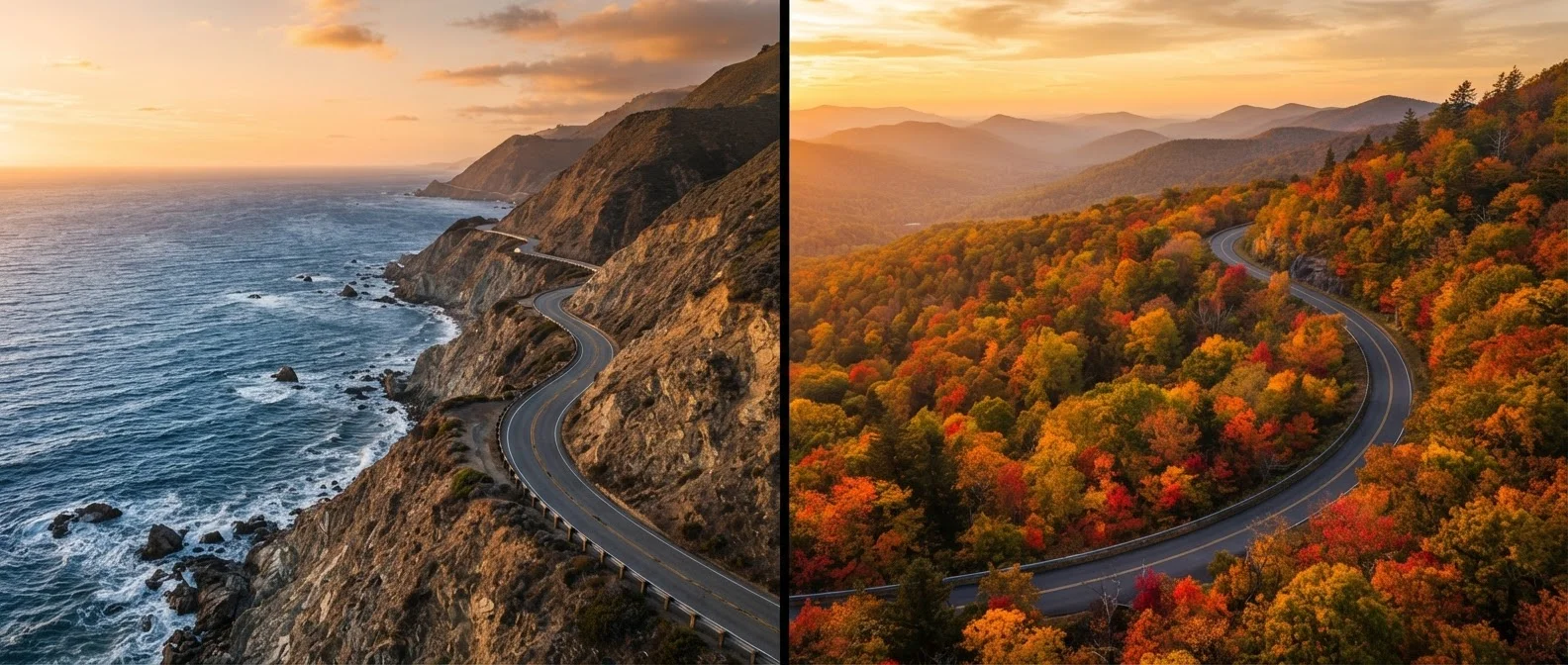
Option A
Pacific Coast Highway (PCH)
The dramatic, ocean-hugging coastal drive.
Best for: Travelers who want sweeping Pacific views, beach towns, and a vibrant West Coast culture along a single scenic corridor.
Option B
Blue Ridge Parkway
The unhurried, forested Appalachian escape.
Best for: Road trippers seeking immersive mountain scenery, fall foliage, Appalachian heritage, and a slower, quieter pace through the eastern US.
What Each Drive Actually Feels Like
The Pacific Coast Highway - typically understood as California State Route 1 and the connected US-101 corridor - is a sensory experience that announces itself immediately. You're rarely far from the sound of surf. The road tilts and curves along cliff edges, offers sudden pull-outs above crashing waves, and drops you into fishing harbors and surf towns with little warning. It's exhilarating, but it can also feel busy. Summer traffic near Big Sur and the Marin Headlands can test any road tripper's patience.
The Blue Ridge Parkway operates on a different register entirely. Designated as America's longest linear national park, it runs 469 miles from Shenandoah National Park in Virginia to the edge of Great Smoky Mountains National Park in North Carolina. The road was engineered specifically for pleasure driving - no commercial trucks, no billboards, no intersecting highways cutting across. What you get instead is a rolling canopy of hardwood forest, layered ridge views, and a pace that naturally slows you down. If you've visited the Smokies before, the Parkway offers a quieter continuation of that landscape - much like the lesser-seen corners of the Smokies that reward travelers willing to look beyond the most crowded areas.
Logistics, Cost, and Planning Realities
| Criterion | Pacific Coast Highway | Blue Ridge Parkway |
|---|---|---|
| Total length | ~650 miles (CA Route 1 + US-101) | 469 miles (VA to NC) |
| Entry / road fee | Free (state highway) | Free (NPS-administered) |
| Best season | Spring & fall (avoid summer fog) | Late September-early November |
| Speed limit | Varies; often 45-55 mph | 45 mph maximum throughout |
| Scenery type | Ocean cliffs, beaches, redwoods | Forested ridges, valley overlooks |
| Accommodation cost | High in peak season | Generally more affordable |
| Urban access | High - near SF, LA, Santa Barbara | Low - mostly small mountain towns |
| Traffic & crowds | Heavy in summer; some year-round | Busy in October; quieter otherwise |
Cost is one of the sharpest contrasts. Driving the Blue Ridge Parkway itself is free - the National Park Service administers it with no entry fee for the road. Accommodation in towns like Blowing Rock, NC, or Waynesboro, VA, tends to be more modestly priced than comparable California coastal lodging. On the PCH, nightly rates in places like Carmel-by-the-Sea or Santa Barbara can climb sharply in summer, and campground reservations at popular state parks often need to be secured months in advance.
Weather and seasonality shape both routes significantly. The PCH is driveable year-round, but coastal fog (common in June and July in California, sometimes called "June Gloom") can obscure the very views you came for. Winter storms can occasionally close sections of Highway 1 south of Monterey. The Blue Ridge Parkway closes certain sections - particularly higher-elevation stretches in Virginia - during winter ice and snow events. Fall, from late September through early November, is peak season and can bring weekend traffic that surprises first-timers expecting solitude.
For those who enjoy thinking through the broader philosophy of how to structure a trip, it's worth considering whether you're planning a focused point-to-point experience or a looser exploration - a question examined in depth in this look at slow travel vs. multi-destination trips.
Culture, Stops, and What You'll Remember
15 million+
Annual Blue Ridge Parkway visitors
The Blue Ridge Parkway consistently ranks among the most visited units of the National Park System, according to NPS visitor use statistics.
469 miles
Blue Ridge Parkway total length
The Parkway is administered by the National Park Service as America's longest linear national park, connecting two major park units.
~$0
Cost to drive the Blue Ridge Parkway
Unlike many national parks, the Blue Ridge Parkway charges no entry fee for the road itself, though some recreation areas within it may charge separately.
The PCH's cultural texture is distinctly Californian - surf culture, redwood groves, missions, farm stands, and seaside art galleries. Towns like Cambria, Mendocino, and Morro Bay feel genuinely local even as tourist infrastructure has grown around them. The drive also puts major museums, restaurants, and urban neighborhoods within easy reach, which suits travelers who want wilderness and city access in the same trip.
The Blue Ridge Parkway's character is rooted in Appalachian heritage. The Parkway was designed in part to showcase the craft traditions, farming practices, and mountain communities of the Southern Highlands. You'll encounter folk art centers, reconstructed homesteads, and overlooks named for the families who once farmed those ridgelines. It pairs naturally with a detour into the Great Smoky Mountains at its southern end, where the landscape and cultural history continue seamlessly.
Both drives reward spontaneity. The travelers who tend to remember them most vividly are rarely those who stuck to a rigid schedule - they're the ones who stopped at an unmarked overlook, wandered into a small harbor town, or lingered at a trail that turned out to be far more beautiful than the famous viewpoints.
Verify Closures Before You Go
Sections of both routes can close with little warning due to weather, landslides, or maintenance. The National Park Service maintains current Blue Ridge Parkway closure information at nps.gov/blri, and Caltrans tracks Highway 1 conditions at quickmap.dot.ca.gov. Always check official sources within a day or two of departure, particularly if traveling in winter or early spring.
The content on this site is for informational purposes only and is not a substitute for professional advice. Always consult a qualified professional for guidance specific to your situation.