

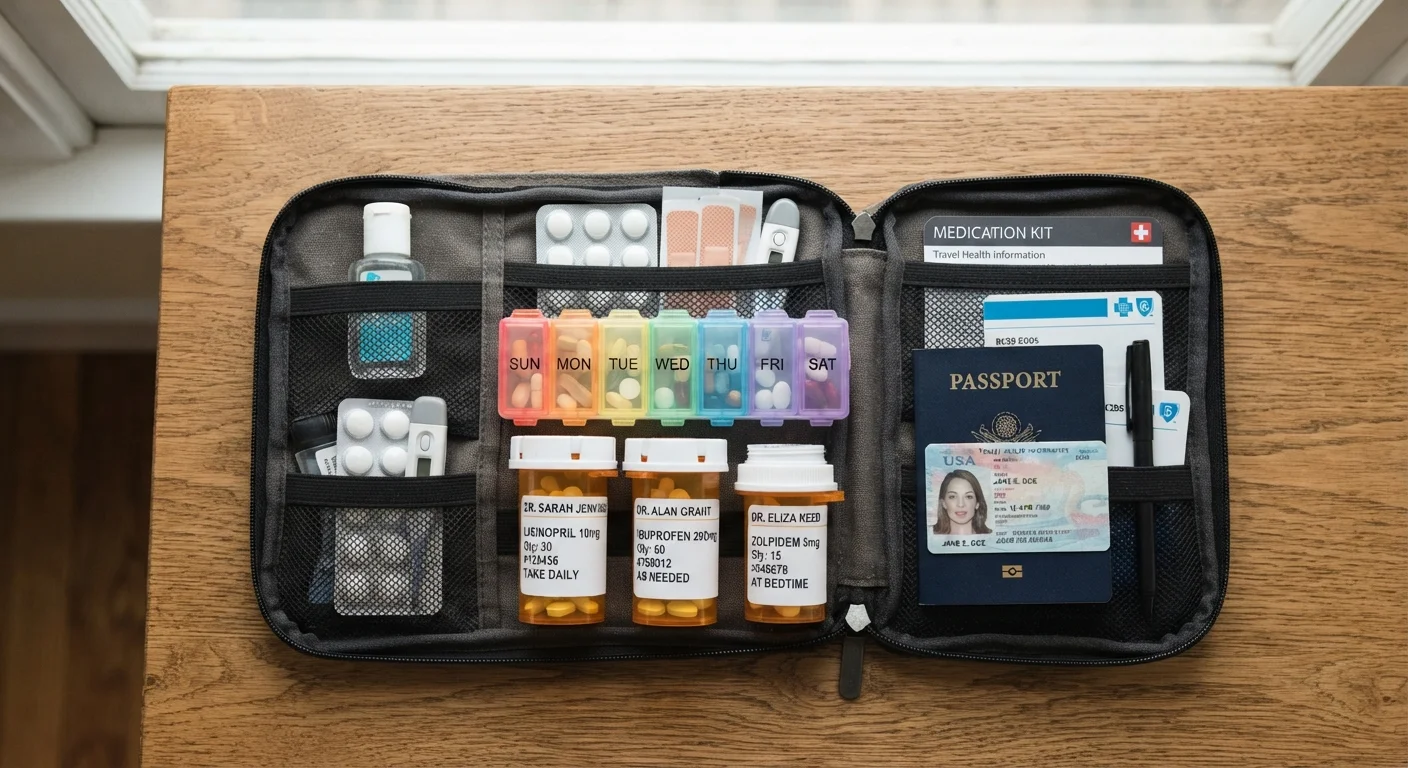
Why Medication Rules at the Border Matter
Carrying medication abroad sounds straightforward - until customs flags a bottle or a border agent asks for documentation you don't have. Regulations governing what medications travelers can bring across international borders vary widely by country, and what's legal at home isn't always permitted at your destination. Some countries classify common US prescription drugs as controlled substances; others restrict certain over-the-counter antihistamines or pain relievers. Getting ahead of these rules before you depart is far easier than troubleshooting at an airport checkpoint.
This reference guide is general educational information only. For decisions specific to your medications and travel destination, always consult your prescribing physician and verify current entry requirements with the destination country's embassy or official customs authority. Rules change, and no article can substitute for official, up-to-date sources.
| Carry-on recommendation | Keep all medications in carry-on luggage, not checked bags (General guidance from travel health authorities) |
| Original labeling | Pharmacy-labeled original containers are the most universally recognized documentation |
| Controlled substances | May require a destination-country import permit obtained weeks before travel (Requirements vary by country; verify with destination embassy) |
| Physician letter | A signed letter on letterhead stating medical necessity is widely recommended |
| Supply buffer | Carry extra supply beyond your trip duration to account for delays or loss (Consult your physician regarding early refill eligibility) |
| Official verification | Always confirm current rules with destination embassy and official customs sources before travel |
Documentation You Should Carry
Proper paperwork reduces the risk of delays, confiscation, or worse at customs. At a minimum, consider carrying the following for any prescription medication:
- Original pharmacy-labeled containers showing your full name, prescribing physician's name, pharmacy contact details, and exact drug name and dosage
- A letter from your prescribing physician on official letterhead, stating the medical necessity of the medication, its generic and brand name, and your dosage schedule
- A copy of the original prescription, ideally translated into the destination country's language if you're traveling somewhere with a different official language
For controlled substances - such as certain pain medications, sleep aids, stimulants, or anxiety medications - some countries require an official import permit obtained before travel. Check with that country's embassy well in advance; approval timelines can run weeks. The US Drug Enforcement Administration (DEA) and the US Department of State both publish general travel guidance that can serve as a starting point for research.
Keep copies of all documents in both your carry-on and a secure digital location. See our guide to essential travel documents for how to store and organize these before you leave.
Controlled substance
A drug regulated under a country's law due to potential for abuse or dependence. Classification varies by country - a medication legal in the US may be controlled or banned elsewhere.
Import permit
An official government document authorizing a traveler to bring a specific controlled medication into a country. Often must be obtained from the destination country's health ministry or embassy before travel.
Generic equivalent
A medication containing the same active ingredient as a brand-name drug, often available under a different name in other countries. Useful to know in case an emergency replacement is needed abroad.
Cold chain
An unbroken series of temperature-controlled storage and transport steps required for medications like insulin or certain biologics. Disruption can reduce a medication's effectiveness or safety.
Practical Storage and Packing Tips
How you pack medications matters as much as what papers you carry. A few widely recommended practices:
- Keep medications in carry-on luggage. Checked bags can be lost, delayed, or subjected to temperature extremes in cargo holds - conditions that can degrade some medications.
- Don't repack into unlabeled containers. Pill organizers are convenient, but bringing a full supply in original labeled bottles alongside any organizer makes customs verification smoother.
- Know your medication's temperature sensitivity. Insulin, certain biologics, and some liquid medications require refrigeration or specific temperature ranges. Ask your pharmacist about travel storage options before departure and research whether your accommodation can support those needs.
- Bring enough supply, plus a buffer. A general approach is to carry more than you need for the trip's duration - flight delays, itinerary changes, and loss can all create gaps. Ask your physician in advance whether an early refill is appropriate for your situation.
For a broader look at what to prioritize when space is tight, our guide to packing light covers practical strategies for making difficult packing decisions.
Special Populations: Extra Planning Required
Travelers managing chronic conditions, pregnancy, pediatric care, or complex medication regimens should consult their healthcare provider well before departure - not just days before. Some medications behave differently under heat, altitude, or time-zone shifts, and your physician may have specific guidance for your situation. This article is general educational information and is not a substitute for personalized medical advice.
Destination-Specific Research Is Non-Negotiable
No single list can capture every country's medication rules - and those rules shift. Some practical research steps before any international trip:
- Look up your destination's embassy website in the US for entry and import restrictions on medications
- Search the International Narcotics Control Board (INCB) traveler's guidelines, which outline controlled substance rules by country
- Contact your travel insurance provider to understand coverage for medication loss or medical emergencies abroad - this is especially relevant if your medication requires cold storage or is difficult to source internationally
- Ask your pharmacist whether your medication has a known generic equivalent abroad, in case an emergency replacement is needed
Staying healthy on the road involves more than just your medications. Our guide to staying healthy abroad covers vaccinations, food safety, and when to seek local medical care. And if you're building out your full pre-departure routine, the pre-departure checklist is a useful companion.
194+
Countries with distinct medication import rules
Each country sets its own regulations on what medications may enter - there is no single global standard for travelers to rely on.
Weeks
Typical lead time for some import permits
Certain destination countries require travelers to apply for controlled-substance import authorization well before their departure date.
The content on this site is for informational purposes only and is not a substitute for professional advice. Always consult a qualified professional for guidance specific to your situation.