

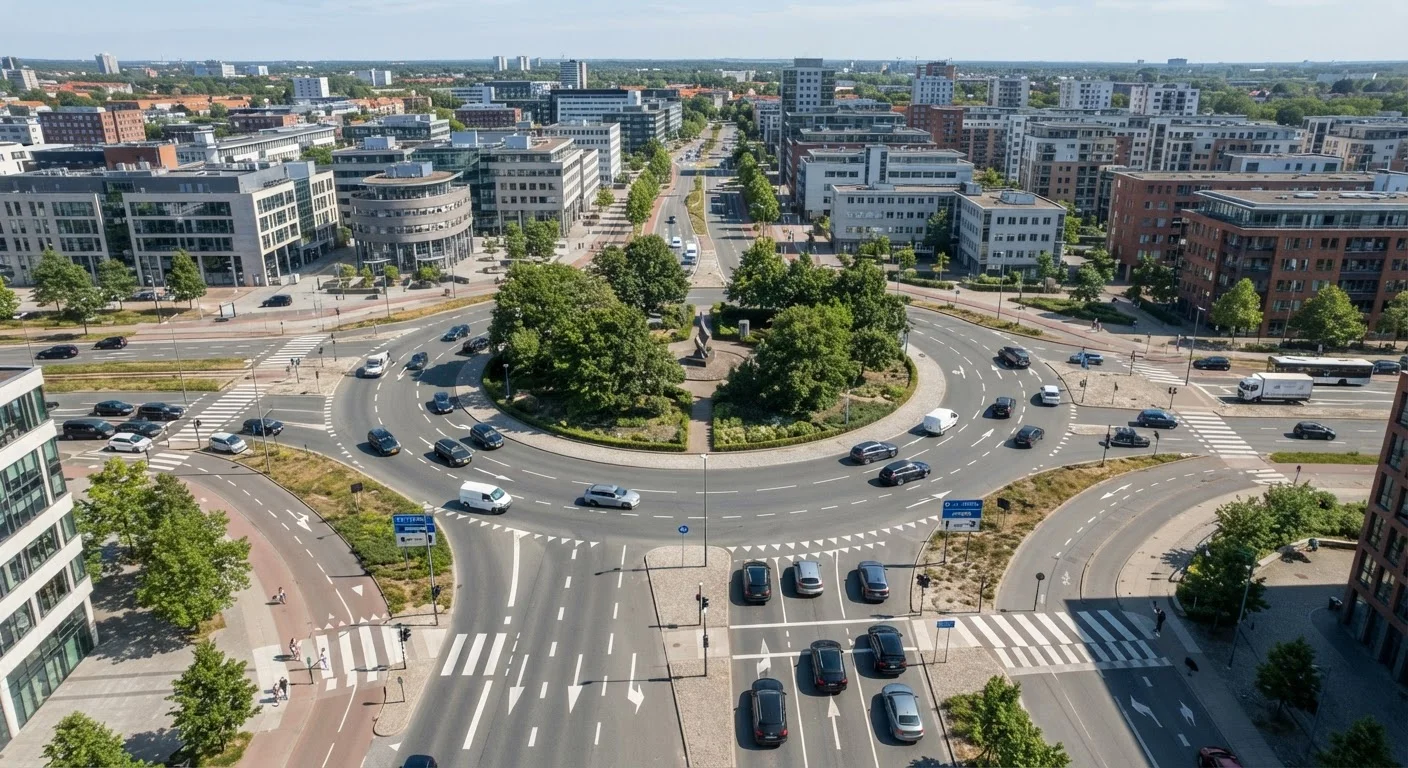
Why Roundabouts Still Trip Drivers Up
Roundabouts are designed to improve traffic flow and reduce the severity of collisions compared with signal-controlled junctions. Yet they remain a genuine source of confusion, even for drivers who have been on the road for decades. The rules around priority, lane selection, and signalling are widely misunderstood - and in some cases, what drivers think is correct is actually the opposite of what the law and highway codes specify.
This article works through the most persistent myths, paired with clear, accurate corrections. For related reading on junction navigation, see our guide on safe driving in urban areas.
Myth
You have priority when entering a roundabout because you are joining moving traffic.
Fact
Vehicles already on the roundabout have priority. Entering drivers must give way at the give-way line.
This is the most dangerous roundabout myth. Drivers who believe they have right of way when entering will pull out in front of circulating vehicles. The rule in the US varies by state and jurisdiction, but most roundabout designs explicitly mark a give-way (yield) line at each entry. Until you have confirmed the roundabout is clear, you must wait. Never assume that being in motion gives you priority.
Myth
If you're going straight ahead at a roundabout, you should always use the left lane.
Fact
Lane choice for going straight depends on the specific roundabout layout and any road markings present.
At a simple two-lane roundabout, the left lane is typically used for straight ahead and left turns, while the right lane is used for straight ahead when the roundabout is busy or for right turns and U-turns. However, road markings - arrows on the road surface and signs at the approach - always take precedence. Some roundabouts explicitly route straight-ahead traffic through the right lane. Always read the markings at each individual junction rather than applying a blanket rule.
Myth
You don't need to signal when going straight through a roundabout.
Fact
While no entry signal is needed for straight ahead, you should still signal left before your exit.
Signalling as you pass the exit before your own gives pedestrians, cyclists, and other drivers essential information about your intentions. Failing to signal is a courtesy issue at minimum and a safety issue in practice - it leaves vulnerable road users guessing whether you intend to exit or continue around. Consistent signalling at every roundabout, regardless of your direction, is considered best practice by road safety organisations.
Myth
A mini roundabout with a painted circle can be treated the same as a normal crossroads.
Fact
A painted mini roundabout island still carries the same give-way priority rules as a full roundabout.
The reduced physical size doesn't change the legal and safety rules. Circulating traffic - even on a tiny painted circle - has priority over entering traffic. Treating a mini roundabout as a crossroads leads to simultaneous entry by multiple vehicles, which is a common cause of low-speed but still damaging collisions in residential areas. Additionally, vehicles must pass to the right of the painted central circle where it is safe to do so.
Myth
You can change lanes inside a roundabout if you realise you're in the wrong one.
Fact
Changing lanes mid-roundabout is hazardous and should not be attempted. Exit and re-approach instead.
Once inside a roundabout, other drivers are anticipating you will stay in your lane and exit accordingly. An unexpected lane change removes that predictability and can force other vehicles to brake or swerve. If you miss your intended lane, the correct action is to complete the circuit in your current lane and exit safely, then re-approach the roundabout correctly. This is safer than a last-minute correction. See also our guidance on roundabout priority and confusion points for more on lane selection.
Lane Discipline and Signalling: Getting It Right
Many near-misses on roundabouts come down to two preventable mistakes: entering the wrong lane and failing to signal correctly. Lane choice must be made before you arrive at the give-way line, not while you are already on the roundabout. Changing lanes mid-roundabout without adequate space and observation is hazardous and can be treated as a lane-change offence.
Don't Choose Your Lane on the Roundabout
Deciding which lane to use while already navigating the roundabout forces you to divert attention from circulating traffic. Approach every roundabout at a speed that gives you time to read lane markings and position correctly before the give-way line. If you are unfamiliar with the junction, slowing on the approach - where it is safe to do so - is far better than making a rushed lane change inside.
On signalling: the standard approach is to signal left as you pass the exit before the one you intend to take. If you are going straight ahead at a two-exit roundabout, no entry signal is needed, but you should still signal left as you approach your exit. This consistency helps every other road user anticipate your path.
For a deeper look at how lane discipline applies on faster roads, our article on motorway lane discipline and exit timing covers the same underlying principles in a different context.
~40%
Reduction in serious injury crashes
The Federal Highway Administration has reported that converting traditional intersections to roundabouts can reduce serious injury crashes by approximately 40% or more.
~75%
Reduction in fatal crashes at converted intersections
Research compiled by the Insurance Institute for Highway Safety found roundabouts substantially reduce fatal crash rates compared with signal-controlled junctions.
Turbo and Mini Roundabouts: Additional Rules to Know
Turbo roundabouts - recognisable by their raised lane dividers or spiral road markings - do not allow lane changes once you have entered. Your lane selection at the entry point locks your exit. This is a deliberate safety feature, but drivers unfamiliar with the layout sometimes attempt to drift lanes mid-circuit, which the physical design and markings prohibit.
Mini roundabouts, common on residential streets, follow the same give-way priority rule: traffic on the roundabout has right of way. However, because the central island is sometimes just a painted circle, drivers occasionally treat them as standard crossroads and fail to yield - a significant error that causes avoidable collisions. When in doubt, treat the painted circle as a real island and apply the standard roundabout rules.
Cyclists and Pedestrians at Roundabouts
Cyclists may legally use the full lane on a roundabout rather than hugging the kerb, and they have the same priority as other circulating vehicles. Pedestrians cross at designated crossing points on each approach arm - not on the roundabout itself. Drivers exiting must give way to pedestrians crossing the exit road. These interactions catch many drivers off guard, particularly at busy urban roundabouts.
Understanding roundabout behaviour is part of broader situational awareness. The same observation skills that help you read a roundabout apply when merging onto a motorway - reading gaps, matching speed, and committing at the right moment.
The content on this site is for informational purposes only and is not a substitute for professional advice. Always consult a qualified professional for guidance specific to your situation.