

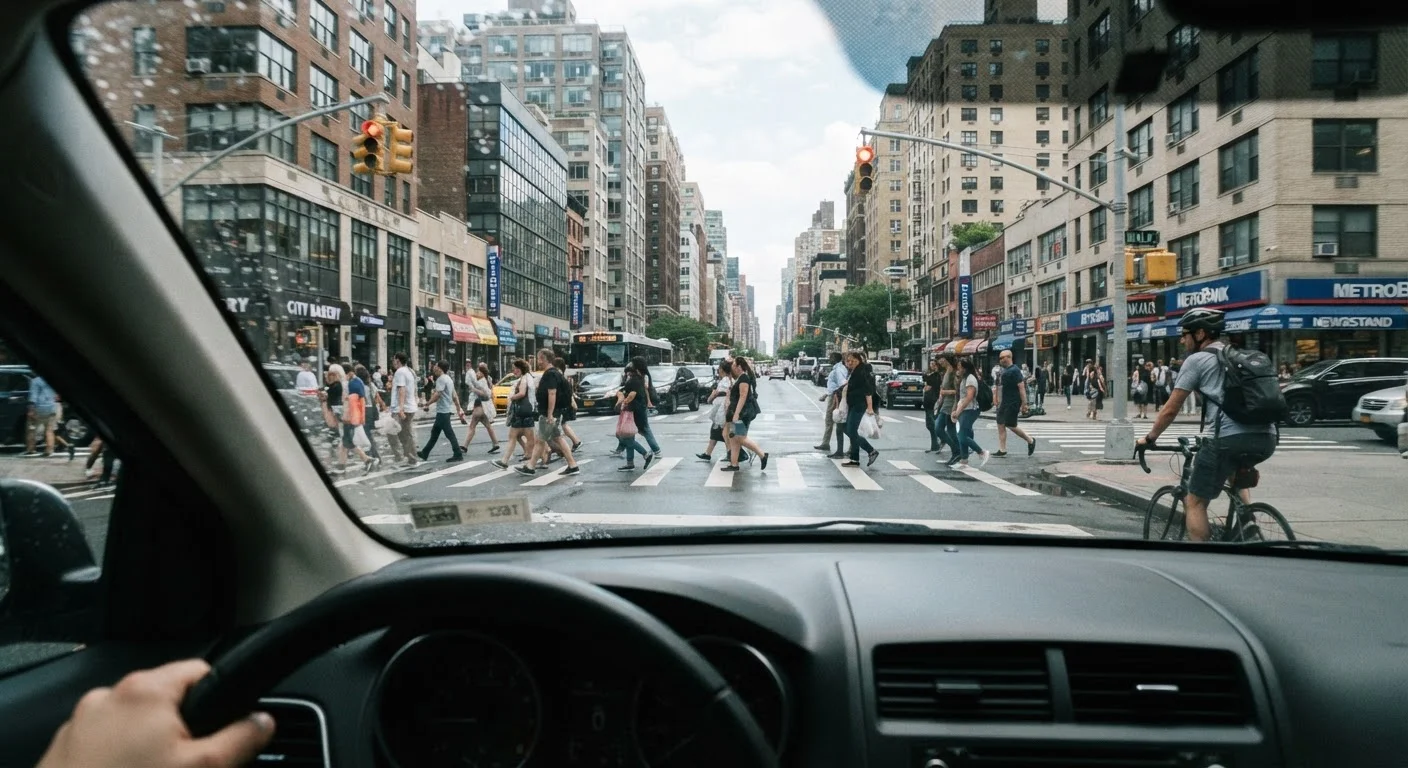
Why City Driving Demands a Different Mindset
Motorways are fast but, in many ways, predictable. Urban roads are the opposite. At any moment, a child may step off a curb, a delivery cyclist may swing wide to avoid a pothole, or a parked car's door may open into your lane. The hazard density in built-up areas is genuinely higher - and the margin for error is much smaller.
Research from road safety organizations consistently shows that the majority of serious collisions involving pedestrians and cyclists occur in urban environments, often at speeds well below 40 mph. Speed alone does not explain this; it's the combination of speed, proximity, and limited reaction time that creates risk.
If you find city driving tiring, that's actually a sign your brain is working correctly - sustained attention is exactly what's required. The goal is to make that attention more structured, so it's less exhausting and more effective. For a broader look at how risk profiles differ between town and country roads, see our guide to urban vs. rural driving hazards.
75%
Pedestrian fatalities occurring in urban areas
According to the U.S. National Highway Traffic Safety Administration (NHTSA), the majority of pedestrian traffic fatalities occur in urban settings rather than on rural roads.
~40%
Cyclist fatalities at or near intersections
NHTSA data indicates that a significant share of cyclist deaths in the US occur at or near road junctions, reflecting the concentrated hazard of urban intersection design.
Sharing the Road with Pedestrians and Cyclists
Pedestrians and cyclists behave differently from motor vehicles in ways that can catch even experienced drivers off guard. Understanding those differences is the starting point for sharing space safely.
Pedestrians don't always follow the rules, and expecting them to is a recipe for surprise. Children may run into the road without looking. Adults absorbed in their phones often step off the curb without checking. Older pedestrians may move more slowly than you anticipate. At crossings, always give full right-of-way as soon as a pedestrian steps out - don't inch forward hoping they'll hurry.
Cyclists are allowed to use the full lane in many situations and may move further into your path than you expect when avoiding drains, debris, or parked car doors. Give cyclists at least as much lateral space as you would another car when passing. If you can't pass with sufficient clearance, wait - a few extra seconds is an acceptable cost.
Watch for the 'Dooring' Zone
The area alongside parked cars is sometimes called the dooring zone - the space where a car door can swing open without warning. Cyclists are particularly vulnerable here. As a driver, staying aware of occupied parked cars (look for heads in windows, brake lights that just went off) helps you anticipate when a door might open. Give parked vehicles more space than feels necessary, especially on narrow streets.
Also look for signals that aren't obvious: a cyclist glancing over their shoulder often means they're about to change position; a pedestrian stepping to the edge of the curb is likely about to cross. These micro-signals are readable with practice. For more on how hazard recognition develops, see our guide on how risk awareness evolves.
Navigating Tight Junctions and Blind Spots
Tight urban junctions - T-junctions, crossroads, and narrow side-street exits - concentrate risk because sight lines are often blocked by parked vehicles, walls, or hedges. The fix is simple in principle: slow down before the junction, not at it.
Creeping forward slowly gives your eyes time to gather information progressively. Even if you can only see two feet into a junction initially, moving at walking pace means you can stop if something appears. Entering at speed removes that option entirely.
Approach every junction with a covered brake - foot hovering, not pressing.
Covered braking reduces reaction time by nearly a full second compared to moving your foot from accelerator to brake. In a tight junction, that second can be the difference between stopping and a collision.
Scan well ahead and to the sides, not just directly in front of the car.
Urban environments have multiple simultaneous hazard sources. Focusing only on the vehicle ahead means you miss pedestrians stepping off curbs or cyclists approaching from side streets.
Give parked vehicles extra clearance to avoid being caught by an opening door.
A car door opening unexpectedly can cause a serious collision with a cyclist or force a driver to swerve dangerously. Staying at least a metre from parked cars provides time and space to respond.
Reduce speed before, not during, a tight turn or narrow junction.
Braking mid-turn reduces tire grip and stability. Slowing before the junction keeps your vehicle stable and gives you more time to assess what's ahead before committing to the manoeuvre.
Make eye contact with pedestrians at crossings before moving off.
Visual confirmation that a pedestrian has seen you - and is waiting - removes ambiguity. A pedestrian who hasn't made eye contact may step out assuming you've stopped when you haven't.
Parked vehicles are one of the most overlooked hazard sources at junctions. A parked van can completely hide a cyclist or pedestrian who is about to emerge. Treat any gap between parked vehicles as a potential exit point for someone you cannot yet see.
For junctions involving roundabouts specifically, the rules around lane selection and priority add another layer - our guide on roundabout priority and confusion points covers those scenarios in detail.
Building Better Urban Driving Habits
Good urban driving isn't about nerves or aggression - it's about consistent habits applied calmly. A few structured practices make a measurable difference.
One underrated habit is managing your following distance in stop-start traffic. Leaving more space ahead doesn't just protect against rear-ending the car in front - it expands your view past the vehicle ahead, giving you earlier warning of hazards further down the road. This is especially valuable on bus routes, where buses stop frequently and obscure what's happening at the curb.
It's also worth being honest about habits that erode over time. Experienced drivers are not immune to complacency - familiarity with a route can reduce alertness just as surely as tiredness does. Our article on habits that quietly erode safe driving explores those patterns in more detail.
Finally, keep your vehicle in good working order. Responsive brakes, properly adjusted mirrors, and clean windows are not optional extras in city driving - they're the foundation. Visit our car maintenance hub for practical upkeep guidance.
The content on this site is for informational purposes only and is not a substitute for professional advice. Always consult a qualified professional for guidance specific to your situation.