

Start here
How Motorway Merging Actually Works
Next
Lane Discipline: What the Rules Say and Why It Matters
Then
Overtaking Safely Without Creating Risk
Finally
Timing Your Exit Correctly
How Motorway Merging Actually Works
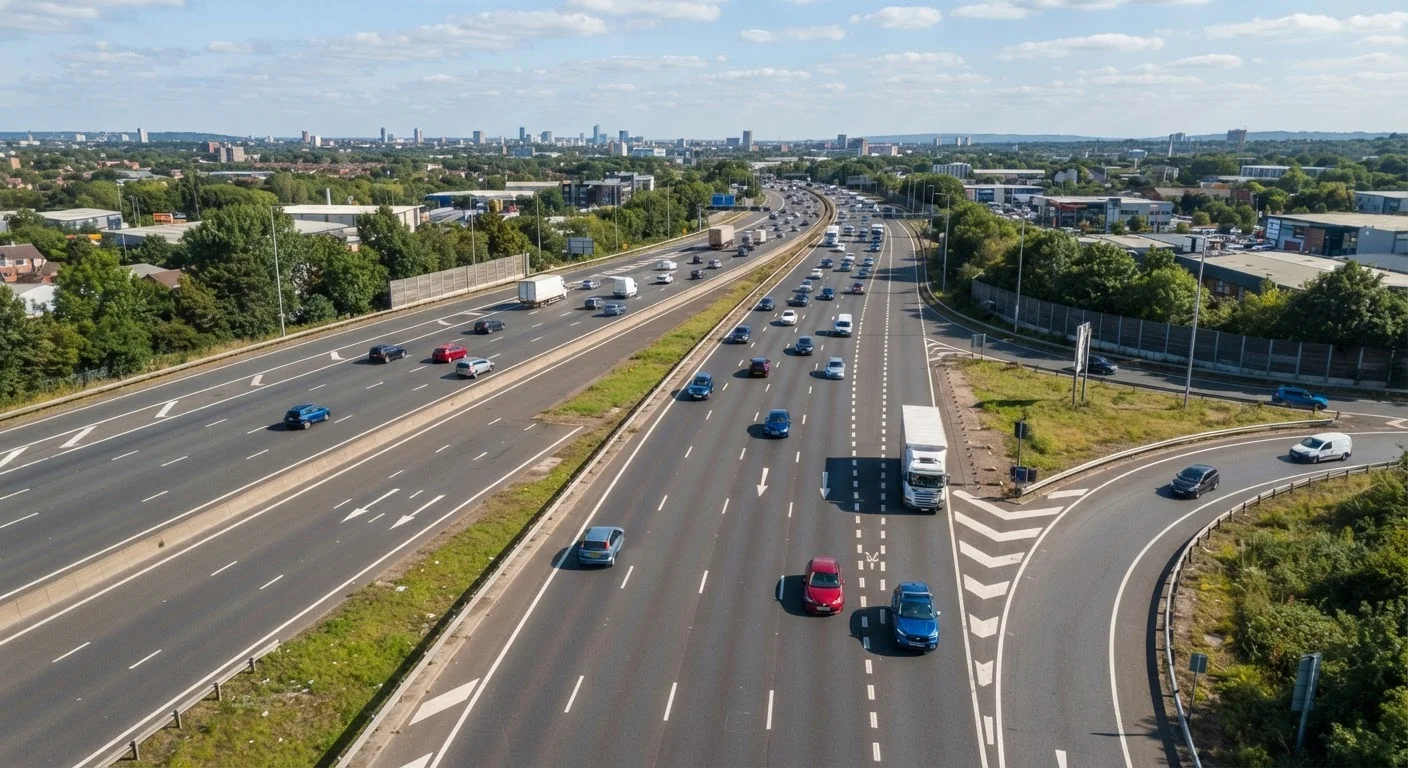
The acceleration lane - also called an on-ramp or slip road - exists for one purpose: to give you enough space to reach the speed of traffic already on the motorway before you join it. Many drivers misuse it by braking at the end, stopping entirely, or merging too slowly. All of these create hazards.
The correct approach is to accelerate smoothly through the lane, check your mirrors and blind spot early, signal, and identify a gap in the left lane. Aim to be travelling at roughly the same speed as mainline traffic by the time you reach the merge point. You're entering a fast-moving stream - match its pace.
Use the Acceleration Lane Fully
Don't leave yourself short of speed by braking or hesitating mid-ramp. Commit to accelerating throughout the slip road so you arrive at the merge point at traffic speed. A confident merge is a safer merge - hesitation forces the vehicles behind you to adapt too.
When traffic is dense and no obvious gap appears, the zipper merge is an accepted technique: stay in the closing lane until the marked merge point, then take turns alternating with mainline vehicles. This keeps traffic flowing more evenly than stopping early and queuing. For a deeper look at reading traffic flow and joining smoothly, see our guide to merging onto a fast-moving motorway.
Lane Discipline: What the Rules Say and Why It Matters
On a multi-lane motorway, the left lane is the default travel lane. The lanes to its right are for overtaking - nothing more. This is not merely a convention; in many jurisdictions lane hogging (sitting in the middle or right lane without overtaking) is an enforceable offence.
Poor lane discipline disrupts traffic flow and forces drivers behind you to either brake or make unnecessary lane changes. Both increase collision risk. The habit to build is simple: once you've completed an overtake, return to the left lane when it's safe.
Acceleration lane
The dedicated lane alongside a motorway on-ramp that allows merging drivers to build speed before joining main traffic flow.
Lane hogging
Staying in a middle or outer lane without actively overtaking, blocking the lane for drivers who need to pass.
Zipper merge
A merging technique where drivers in a closing lane stay in it to the merge point, then alternate one-for-one with mainline traffic.
Blind spot
The area alongside and slightly behind your vehicle that your mirrors don't fully cover - always check it with a brief head turn before changing lanes.
Slip road
The connecting road between a motorway and regular road network used for entering or exiting - called an on-ramp or off-ramp in US terminology.
Two-second rule
A following-distance guideline where you should stay at least two seconds behind the vehicle ahead - and more in poor weather conditions.
Lane discipline on motorways is different from the lane behaviour required at roundabouts, where positioning depends on your exit. If you find roundabout lane choices confusing, the roundabout rules guide breaks down the most common points of confusion.
Overtaking Safely Without Creating Risk
Safe overtaking follows a clear sequence: mirror, signal, manoeuvre. Check your centre mirror, then the door mirror on the side you're moving to, signal your intention, check your blind spot, and only then move if the lane is clear. Rushing any of these steps is where mistakes happen.
Avoid cutting back in too sharply after passing - the vehicle you've just overtaken needs space in front of them too. A good rule of thumb is to wait until you can see the overtaken vehicle's headlights in your interior mirror before pulling back left.
On a motorway, the speed differential between lanes can be significant. Before moving right to overtake, make sure you have enough speed and road ahead to complete the manoeuvre without holding up faster-approaching traffic from behind. Visibility matters too - wet weather, spray, and fading light all affect how early you can judge closing distances. Our wet-weather driving guide covers how to adjust for reduced visibility.
Timing Your Exit Correctly
Missing your junction because you left it too late is a common motorway mistake - and the attempted fix (braking suddenly or cutting across lanes) can be dangerous. The solution is early awareness.
Most motorways post advance direction signs at one mile and half a mile before junctions. Use the one-mile sign as your cue to check your position and begin moving left if you're not already there. Signal clearly and progressively transition into the left lane - not in a single sudden move.
Watch Your Speed After a Long Motorway Stretch
After extended high-speed driving, your perception of speed recalibrates. What feels like a slow crawl on the exit road may still be well above the local speed limit. Always check your speedometer rather than trusting your instincts when transitioning off a fast road.
Once you're on the exit slip road, reduce your speed gradually. Motorway speeds feel slower than they are after sustained high-speed driving - your speed perception adjusts, making 40 mph feel like 20 mph. Check your speedometer and actively manage your deceleration rather than relying on feel alone.
For drivers who also find bends and curves on exit roads challenging, understanding why drivers misjudge corners can help reinforce safe speed management as you transition off the motorway.
Frequently Asked Questions
The left lane is the default driving lane on a US highway or UK motorway. You should only move to a middle or right lane to overtake a slower vehicle, then return left once it's safe to do so. Staying in a non-left lane unnecessarily is known as lane hogging and can attract a penalty.
Traffic already on the motorway generally has priority. Drivers joining from an on-ramp or slip road must adjust their speed to find a safe gap rather than expecting existing traffic to move over. That said, courteous drivers on the main carriageway will often create space when it's safe.
In most jurisdictions, including the UK, overtaking on the left (undertaking) is illegal except in slow-moving queues where traffic in the left lane moves faster. In the US, rules vary by state, but passing on the right is generally discouraged on highways. Always check local rules.
Signal your intention to leave the motorway well before the exit - typically at the first advance direction sign for your junction. Move into the left lane progressively, not in a sudden swerve, and reduce speed once you're on the slip road rather than on the main carriageway.
A zipper merge is when drivers in a closing lane stay in it until the merge point, then alternate with mainline traffic one at a time, like a zip fastening. Research from several state transportation departments suggests it reduces overall congestion compared to early merging. Use it when lanes are clearly marked as ending ahead.
A common guideline is the two-second rule under good conditions - allow at least two seconds of gap between you and the vehicle ahead. In wet, foggy, or heavy traffic conditions, double that to four seconds minimum. Greater speed means longer stopping distances.
The content on this site is for informational purposes only and is not a substitute for professional advice. Always consult a qualified professional for guidance specific to your situation.