

The Core Rule: Who Has Priority?
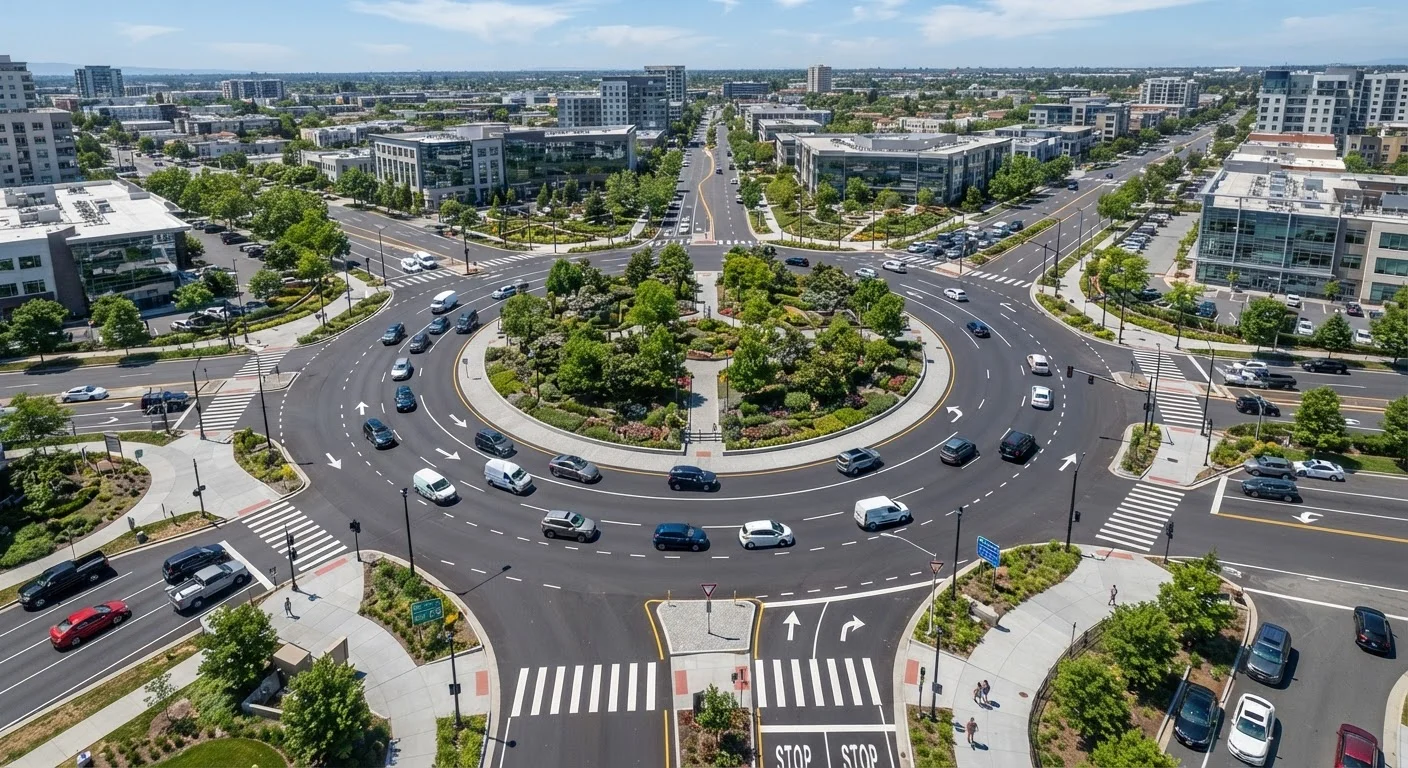
In the United States, roundabout rules are consistent at the federal guidance level but implemented at the state level - and the foundational rule is straightforward: traffic already circulating inside the roundabout has priority over entering traffic. Drivers approaching the entry point must yield, not stop unless traffic requires it.
This single rule resolves most confusion, yet drivers frequently hesitate, over-brake, or pull out prematurely. The yield line at the entry is the decision point. If the path inside is clear, you can enter without stopping. If vehicles are circulating, wait until there's a safe gap - don't rush and don't freeze.
One widespread misconception is that the vehicle to your right always has right-of-way at a roundabout, as it does at an uncontrolled intersection. That rule does not apply here. Inside the roundabout, circulating traffic holds priority regardless of direction. See also our guide on navigating tight urban junctions for similar priority scenarios in city settings.
Lane Selection: The Biggest Source of Errors
Single-lane roundabouts are forgiving. Multi-lane roundabouts are where lane discipline separates confident drivers from anxious ones. The general guidance used by most traffic engineers follows a simple principle:
- Right lane: Use when taking the first exit or turning right.
- Left lane: Use when going straight through or taking a later exit (past the 12 o'clock position).
In practice, always check posted lane-use signs before the entry - they override general guidance when specific markings are present. Look for directional arrows painted on the road surface.
The most common error is entering the left lane then needing to exit right, which forces a dangerous lane change inside the roundabout. Choose your lane before entering, not after. If you miss your exit, it is safer to continue around and exit on the next pass than to cut across lanes.
Yield line
The dashed or solid line at a roundabout entry where drivers must give way to circulating traffic before proceeding. It is not the same as a stop line.
Circulating traffic
Vehicles already inside the roundabout traveling around the central island. These vehicles hold priority over any vehicle attempting to enter.
Multi-lane roundabout
A roundabout with two or more lanes for both entry and circulation, requiring drivers to choose and maintain a lane based on their intended exit.
Lane discipline
Staying within your chosen lane throughout a maneuver. Inside a multi-lane roundabout, drifting between lanes is a leading cause of collisions.
Gap acceptance
The judgment call a driver makes about whether a space in circulating traffic is large enough to enter safely. Misjudging this is a primary cause of roundabout entry conflicts.
Drivers who struggle with merging scenarios in general may find it helpful to read our breakdown of motorway merging technique, which covers similar gap-judgment skills.
Signalling, Pedestrians, and Other Common Confusion Points
Signalling at roundabouts confuses many drivers because the timing isn't always obvious. Here's a practical approach used in most driver education programs:
- Right exit (first exit): Signal right on approach and maintain it through the exit.
- Straight ahead: No signal on approach; signal right as you pass the exit before yours.
- Left exit (later exit): Signal left on approach; switch to right signal as you pass the exit before yours.
Pedestrian crossings at roundabouts are another frequent confusion point. These crossings are typically set back from the yield line - drivers exiting the roundabout must give way to pedestrians on the crossing before completing the turn. Do not accelerate past the pedestrian crossing to clear the roundabout quickly.
Cyclists in Roundabouts: Give Extra Space
Cyclists are legally permitted to occupy a full lane inside a roundabout, even when the lane appears wide enough to share side by side. Treat a cyclist in the roundabout the same as you would any other circulating vehicle - maintain a safe following distance and do not attempt to pass them within the circle. When exiting, check for cyclists continuing around before turning.
Cyclists may take the full lane inside a roundabout even if a lane looks wide enough to share. Give them space and do not attempt to overtake within the circle. For a broader look at sharing space with vulnerable road users, see our guide to urban driving around pedestrians and cyclists.
For a deeper dive into the full range of roundabout rule nuances, the roundabout rules that confuse even experienced drivers article covers edge cases in detail.
The content on this site is for informational purposes only and is not a substitute for professional advice. Always consult a qualified professional for guidance specific to your situation.