

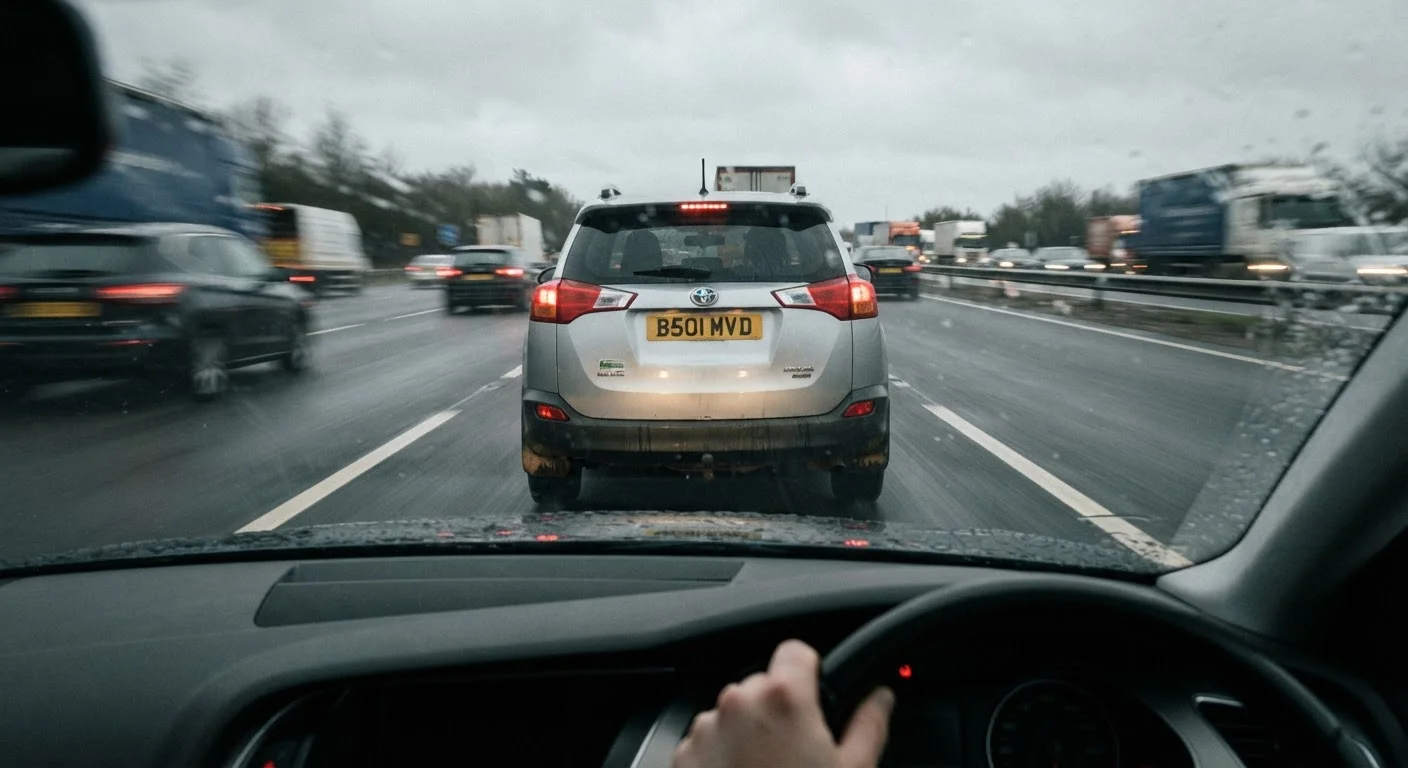
What Actually Happens When You Follow Too Closely
When a driver in front brakes hard, a chain of events begins immediately. The brake lights illuminate, your eyes register the signal, your brain processes it, your foot moves to the brake pedal, and the vehicle begins to slow. That entire sequence - from perception to the car actually decelerating - takes roughly 1.5 seconds under normal conditions. At 60 mph, that's about 132 feet traveled before your brakes even engage.
Add the actual braking distance on top, and the total stopping distance for an average vehicle at 60 mph is somewhere between 240 and 300 feet, depending on road conditions and tire quality. A driver following at 50 feet has already lost the calculation before anything goes wrong.
Rear-end collisions are not freak accidents. According to the National Highway Traffic Safety Administration, rear-end crashes consistently rank among the most frequent collision types on U.S. roads, accounting for a significant share of both injuries and fatalities each year. Following too closely is among the most commonly cited contributing factors.
~29%
Share of U.S. traffic injuries from rear-end crashes
According to NHTSA data, rear-end collisions are consistently among the most common crash types and injury sources on American roads.
1.5 sec
Average driver perception-reaction time
Traffic safety research commonly uses 1.5 seconds as the standard perception-reaction time before braking begins - equivalent to roughly 132 feet at 60 mph.
240-300 ft
Estimated stopping distance at 60 mph
This total includes both reaction time travel and braking distance for an average passenger vehicle under normal dry road conditions.
The Psychology Behind Tailgating
Most drivers who tailgate aren't thinking, I'm going to take a serious risk right now. The behavior usually emerges from a handful of well-documented thinking errors.
Speed Normalization
At highway speeds, gaps that are objectively dangerous start to feel normal. When everyone around you is maintaining a two-car-length following distance at 70 mph, the brain begins treating that as the baseline. This is a form of adaptation - the same cognitive process that makes a loud noise seem quieter after a few minutes.
Optimism Bias
Drivers consistently overestimate their own reaction time and driving ability. Research in traffic psychology has repeatedly found that most people rate themselves as above-average drivers - a statistical impossibility. This overconfidence leads to an underestimation of how close 'too close' actually is.
Frustration and Time Pressure
Running late, stuck behind a slow driver, or feeling general road frustration can push drivers to close the gap as a form of pressure - a nonverbal signal to the car ahead to move or speed up. This is the aggressive tailgating that most people recognize, and it's covered more directly in resources on defensive driving principles.
These patterns often develop gradually over time, reinforced by uneventful close-following experiences - a dynamic explored in our piece on habits that quietly erode safe driving.
Use a Fixed Landmark to Check Your Gap
Instead of guessing your following distance by eye, pick a stationary roadside object - a signpost, overpass, or lane marking - and use the two-to-three-second count as the vehicle ahead passes it. This takes the guesswork out of a judgment that speed naturally distorts. In rain or poor visibility, extend your count to at least four seconds.
How to Maintain a Safe Following Distance
The two-to-three-second rule is the most practical tool available to everyday drivers. Choose a stationary reference point - a sign, a bridge, a painted marking. When the vehicle ahead passes it, count: 'one-one-thousand, two-one-thousand.' If your front bumper clears that point before you finish the count, you're too close.
In adverse conditions - rain, fog, snow, or reduced visibility - extend this to at least four seconds. Heavy vehicles like trucks and SUVs with higher curb weights also need more stopping distance than a standard sedan.
If you're being tailgated, resist the urge to brake sharply or slow suddenly as a warning. That escalates risk for everyone. Gradually ease off your speed and, when safe, let the vehicle pass. Increasing your own following gap to the car ahead gives you room to slow progressively, which reduces the chance of an abrupt stop that could surprise the driver behind you.
Urban driving adds extra complexity - pedestrians, cyclists, and tight intersections all demand more buffer room. Our guide to safe driving in urban areas covers how to manage space in those environments.
Frequently Asked Questions
Most U.S. states have laws requiring drivers to maintain a 'reasonable and prudent' following distance, though exact definitions vary by state. Some states specify a minimum number of feet; others use the standard of whether the following distance is safe given speed, traffic, and road conditions. A ticket can be issued at an officer's discretion.
The widely recommended guideline is the two-to-three-second rule: pick a fixed point ahead, watch the vehicle in front pass it, then count. If you pass the same point in under two seconds, you're too close. In wet, foggy, or icy conditions, double that gap to at least four to six seconds.
Most drivers who tailgate aren't consciously deciding to take a risk. Speed normalization makes close gaps feel ordinary at highway speeds, and frustration or time pressure can override rational judgment. Some drivers also wrongly assume they have quicker reflexes than they actually do.
Avoid brake-checking, which dramatically escalates risk. Instead, gradually reduce your speed to encourage the driver behind to pass, or safely move to a different lane when possible. Maintaining a larger gap to the car ahead of you gives you more room to slow gently rather than braking sharply.
Both are serious, but highway tailgating tends to produce more severe crashes because stopping distances are far greater at speed. City tailgating, however, involves more unpredictable hazards like pedestrians and cyclists, making close following risky in different ways.
The content on this site is for informational purposes only and is not a substitute for professional advice. Always consult a qualified professional for guidance specific to your situation.