

Our Verdict
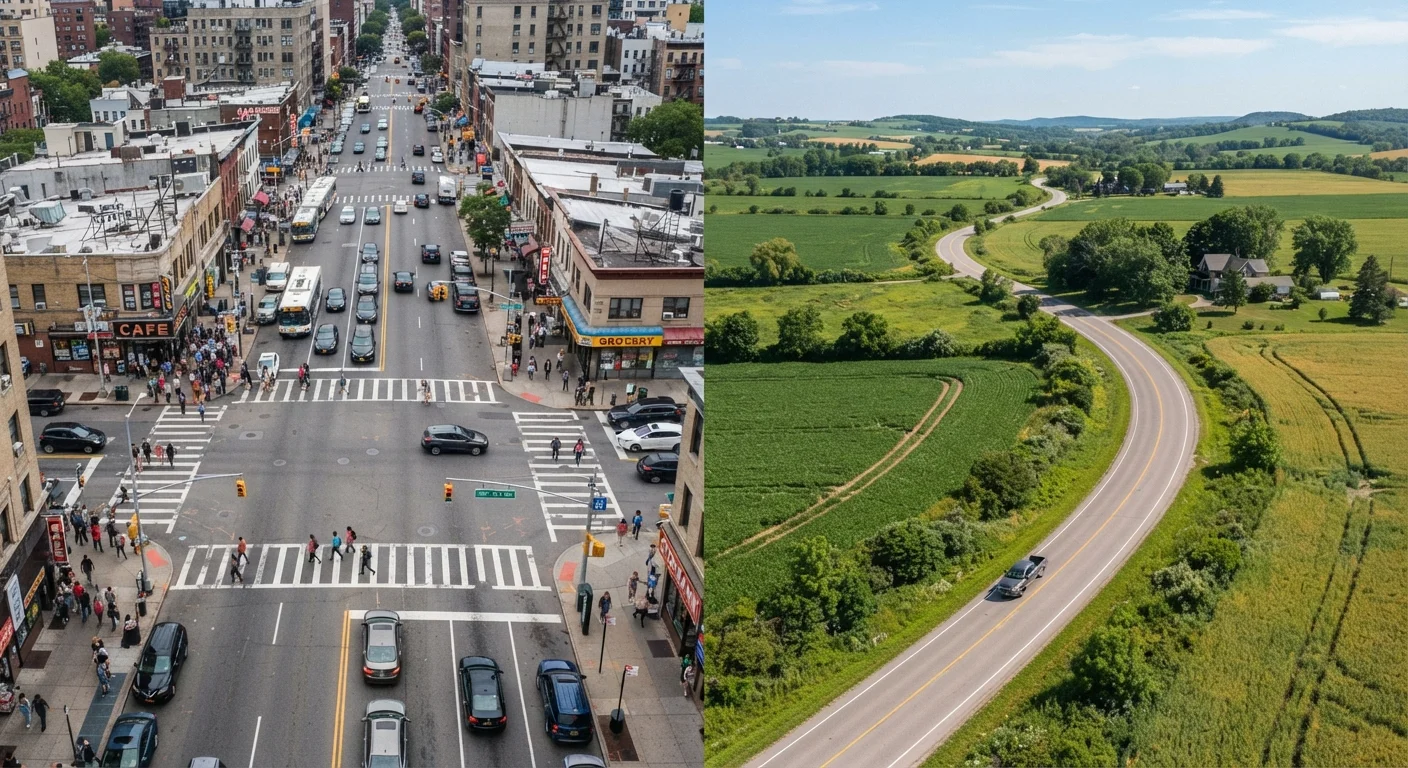
Neither urban nor rural driving is inherently safer overall - they carry distinct risk profiles that require different mental frameworks. Urban driving demands high-frequency hazard scanning at lower speeds; rural driving demands speed management and preparation for low-visibility, high-consequence situations.
| Best for | Recommended |
|---|---|
| Drivers navigating high-traffic city streets | Urban risk awareness strategies |
| Drivers traveling long distances on open country roads | Rural road risk management techniques |
The Core Difference: Frequency vs. Severity
Urban and rural roads don't just look different - they produce different kinds of crashes with different outcomes. Urban roads tend to generate more frequent incidents: fender-benders, intersection conflicts, and minor pedestrian near-misses. Rural roads, by contrast, see fewer total crashes, but those crashes are far more likely to be fatal.
According to the National Highway Traffic Safety Administration (NHTSA), rural roads consistently account for a large share of U.S. traffic fatalities despite carrying less than half of all vehicle miles traveled. The main reasons are higher speeds, fewer traffic controls, longer emergency response times, and less forgiving road geometry.
Understanding this distinction - frequency in cities, severity in the country - shapes how you should approach risk in each setting. For more on how your awareness evolves with experience, see how risk awareness develops over time.
~50%
Share of U.S. traffic fatalities on rural roads
NHTSA data shows rural roads account for roughly half of all U.S. traffic deaths despite lower total traffic volume.
2x
Rural fatality rate vs. urban per mile driven
Research from the Insurance Institute for Highway Safety indicates the death rate per mile traveled is approximately twice as high on rural roads compared to urban ones.
Urban Driving: High-Density, High-Frequency Hazards
City roads compress many hazards into a small space. Pedestrians step off curbs between parked cars. Cyclists ride in and out of traffic. Delivery vehicles double-park and block sight lines. Intersections - whether signalized or not - are constant decision points where the actions of multiple road users must be tracked simultaneously.
Speed is relatively low in urban environments, which limits the kinetic energy involved in most collisions. However, distraction and complacency are serious threats. Stop-and-go traffic can lull drivers into a passive state just when active scanning is most needed.
Key urban risk factors include:
- Vulnerable road users - pedestrians and cyclists are everywhere and often unpredictable
- Tight junctions and blind corners - limited sight distance at many intersections
- Door zones - parked car doors opening into moving traffic
- Congestion-driven frustration - which can push drivers toward aggressive behavior
For a detailed breakdown of city-specific hazards, see navigating pedestrians, cyclists, and tight junctions.
| Risk Factor | Urban Roads | Rural Roads | |
|---|---|---|---|
| Crash frequency | Higher | Lower | |
| Crash severity/fatality rate | Lower | Significantly higher | |
| Typical speed | 25-45 mph | 55-70+ mph | |
| Vulnerable road users | Frequent (pedestrians, cyclists) | Rare (farm equipment, animals) | |
| Road lighting | Generally well-lit | Often unlit | |
| Emergency response time | Fast (minutes) | Slow (can be 20-30 min) | |
| Primary driver risk | Distraction, complacency | Speed, fatigue, poor sight lines |
Rural Roads: Open Space, Serious Consequences
Rural roads may feel relaxed - open space, less traffic, fewer stops - but that perception can be misleading. Higher speed limits, sharp curves, unmarked intersections, and narrow lanes all raise the stakes considerably. A single mistake at 60 mph on a two-lane county road leaves little margin for recovery.
Hazards specific to rural driving include:
- Animals and farm equipment - unexpected obstacles that appear with little warning
- Limited lighting - most rural roads have no streetlights, making night driving especially demanding
- Poor road surface conditions - gravel edges, potholes, and debris are common on less-maintained routes
- Delayed emergency response - help may be 20-30 minutes away, making seatbelt use and crash avoidance even more critical
Rural roads also demand more from drivers in adverse weather. Rain, fog, and ice are harder to manage when roads lack markings or barriers. Wet road driving strategies become especially relevant in these conditions.
Rural Night Driving: Slow Down Before the Curve
On unlit rural roads, your headlights typically illuminate only 200-250 feet ahead - less than your stopping distance at highway speed. A practical rule: you should be able to stop within the distance you can see. Reduce speed before crests and curves where your sight line shortens, and stay alert for animals at the roadside.
Adjusting Your Driving Mindset for Each Environment
Safe driving in either environment means matching your mental approach to the actual hazard landscape - not just following posted speed limits.
In urban areas, slow down your decision-making. Scan farther ahead, check crosswalks early, and maintain generous gaps so you're never forced into a reactive stop. Expect the unexpected from every direction.
On rural roads, raise your vigilance around curves and crests where sight lines disappear. Reduce speed before corners, not during them. Keep your headlights clean and use high beams where appropriate on unlit roads. Fatigue is also a larger factor on long rural routes - plan rest stops before tiredness sets in.
Whether you drive mostly in cities or frequently take long rural trips, adjusting your style to the environment is a core part of responsible driving. For a broader look at how driving style affects safety outcomes, see defensive vs. aggressive driving approaches.
The content on this site is for informational purposes only and is not a substitute for professional advice. Always consult a qualified professional for guidance specific to your situation.