

Why Risk Awareness Isn't Fixed
Most drivers assume that with more time behind the wheel comes proportionally better judgment. The reality is more complicated. Risk awareness doesn't improve in a straight line - it shifts in shape and character as drivers move through different stages of experience.
A learner driver and a 20-year veteran face genuinely different risk profiles. The new driver lacks perceptual fluency; the veteran may have accumulated subtle bad habits. Understanding where you are on that curve is itself a safety advantage.
This guide traces how hazard recognition, confidence, and decision-making evolve from the first lesson to years of independent driving - and what every driver can do to stay sharp at each stage. For a broader look at how environment shapes risk, see how urban and rural roads differ in their risk profiles.
~50%
Crash reduction after first year of driving
Studies consistently show crash rates drop substantially for most drivers after the first 1-2 years of independent driving, reflecting accumulated experience.
3x
Elevated crash risk for drivers aged 16-19
According to the CDC, teen drivers are roughly three times more likely per mile driven to be in a fatal crash than drivers aged 20 and older.
The Learner Stage: High Caution, Limited Perception
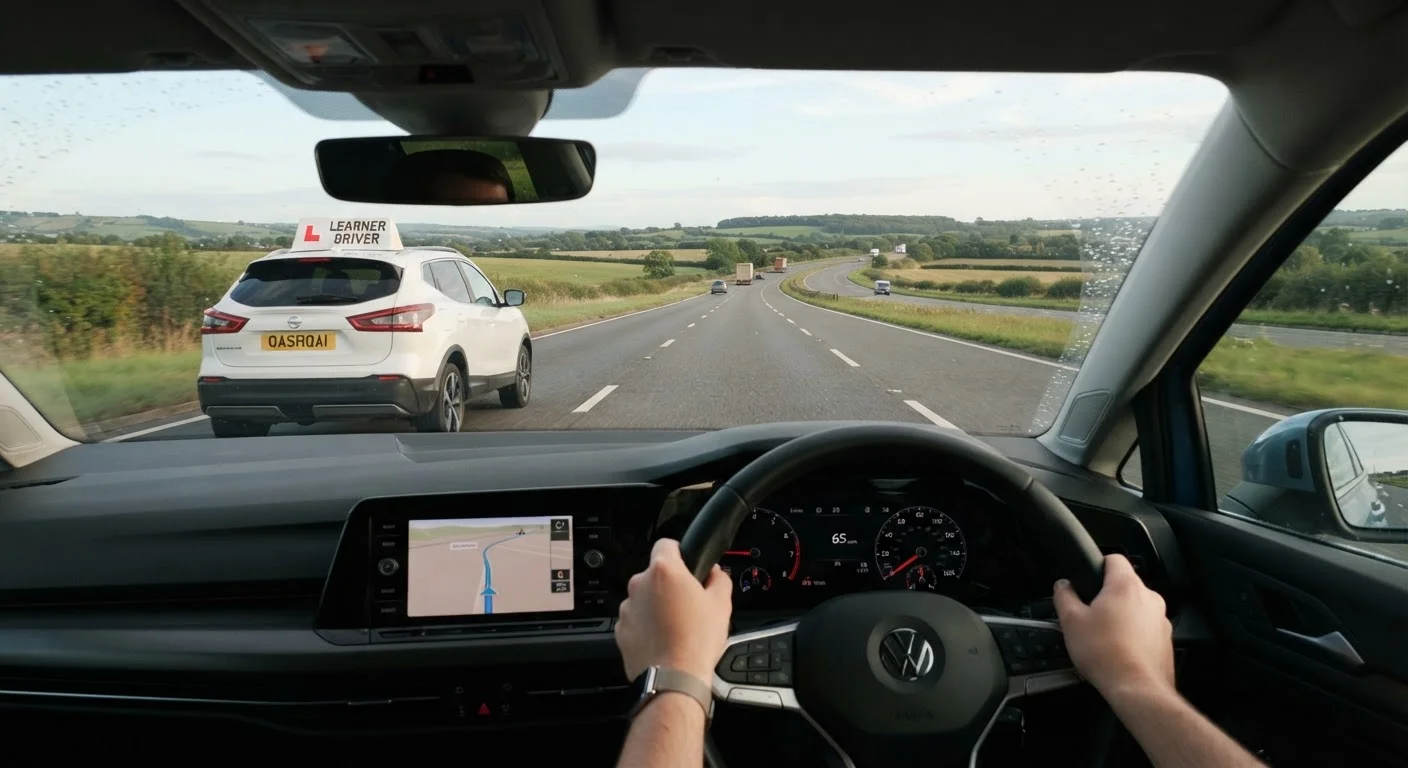
Learner drivers tend to be highly rule-conscious. They've studied the Highway Code, they know what yield signs mean, and they're acutely aware of being watched. That conscious caution is genuinely protective - but it has a ceiling.
What learners typically lack is hazard perception depth: the ability to read developing situations before they become emergencies. Spotting a child near a parked car, anticipating that a cyclist may swerve, or reading the body language of a vehicle about to pull out - these skills depend on pattern recognition that only accumulates through exposure.
Research on novice drivers consistently shows that they scan a narrower field of view and fixate longer on individual hazards rather than reading the whole scene. This isn't a character flaw - it's a neurological reality of learning any complex skill.
Vary Your Practice Routes Early
Learner drivers who practice exclusively on familiar roads build narrow pattern libraries. Deliberately seek out new road types - dual carriageways, roundabouts, residential streets, and night driving - under supervised conditions. Each new environment adds to your hazard recognition vocabulary.
For learners, the key focus should be building foundational habits that will serve them for decades. That includes maintaining appropriate following distances, resisting distraction, and getting varied driving experience - not just on familiar routes.
The Newly Licensed Driver: The Dangerous Confidence Gap
The period immediately after passing a driving test is one of the highest-risk windows in a driver's life. Crash rates among drivers in their first year of independent driving are significantly elevated compared to those with just a few more years of experience.
The core issue is a mismatch: formal testing creates a minimum competence threshold, but confidence often rises faster than actual skill. Without an instructor in the passenger seat, new drivers make different - sometimes riskier - choices. Late-night driving, carrying passengers, unfamiliar roads, and adverse weather all present challenges the test environment rarely replicates.
Passengers Affect New Driver Risk
Multiple road safety studies have found that newly licensed drivers carrying peer-age passengers face meaningfully higher crash risk. Social dynamics can subtly - or not so subtly - shift driving behavior. Being aware of this pressure is the first step to resisting it.
This stage is also where peer influence plays a measurable role. Drivers with passengers of similar age are statistically more likely to be involved in crashes, a pattern well-documented in road safety research.
The fix isn't to avoid driving - it's deliberate exposure. Gradually extend into more demanding conditions while maintaining the structured habits built during lessons. Defensive driving principles are especially valuable here, offering a mental framework that compensates for the experience gap.
The Experienced Driver: Skills Gained, New Risks Introduced
After several years of driving, genuine competence develops. Route reading improves, vehicle control becomes intuitive, and hazard spotting happens faster. These are real gains - but they come with a shadow side.
Experienced drivers are more susceptible to automation bias: over-relying on routine to the point where attention drifts. Familiar routes are particular traps. When the brain expects nothing unusual, it stops actively scanning for the unexpected.
Complacency shows up in subtler ways too - slightly reduced following distances, slow creep in speed on roads where enforcement is rare, or habitual phone use in traffic. These small erosions rarely cause an immediate incident, which reinforces the behavior. For a closer look at how these patterns develop, see habits that quietly erode safe driving over time.
After any near-miss or moment of surprise on the road, pause and ask yourself: what could I have spotted earlier? Replaying the sequence in your mind builds the pattern recognition that makes hazards visible sooner next time.
Post-event reflection is a core technique in advanced driver training programs because it converts reactive incidents into proactive learning, helping recalibrate attention over time.
If you find yourself predicting nothing unusual on a route you drive every day, that's a signal to deliberately raise your scanning effort - not lower it.
Familiarity breeds reduced alertness, a well-documented phenomenon in human factors research. Actively counteracting routine is how experienced drivers maintain the attentional standards of a novice without the novice's perceptual gaps.
The antidote is treating attention as a skill to be maintained, not a trait that's either present or absent. Periodic honest self-assessment - or formal advanced driver training - can recalibrate habits before they compound into risk.
Building Awareness That Lasts
Regardless of experience level, situational awareness is the common denominator of safe driving. It means actively reading the road ahead, monitoring traffic around you, and anticipating what other road users are likely to do next - not just reacting to what they've already done.
For newer drivers, navigating urban environments with pedestrians and cyclists is a practical place to build that skill in a controlled way. For experienced drivers, situational awareness as a learnable habit reframes attention as something you can actively practice rather than passively assume you have.
A few principles hold true across every stage:
- Scan broadly. Don't fixate on the vehicle directly ahead - keep your eyes moving across the full scene.
- Manage your margins. Following distance, lane position, and speed all determine how much time you have to react.
- Question your own confidence. Feeling certain you know what's coming is often when risk is highest.
Road safety isn't a destination you reach after passing a test. It's an ongoing practice - and understanding where your risk awareness currently sits is the first step in strengthening it.
Defensive Driving Explained
A practical breakdown of defensive driving principles - what they are, why they matter, and how to apply them at any experience level.
Situational Awareness on the Road
How to build and maintain active road awareness as a learnable, everyday skill - not just a reaction to emergencies.
Habits That Quietly Erode Safe Driving
An honest look at the small patterns experienced drivers slip into - and how to catch them before they become serious risks.
The content on this site is for informational purposes only and is not a substitute for professional advice. Always consult a qualified professional for guidance specific to your situation.