

Our Verdict
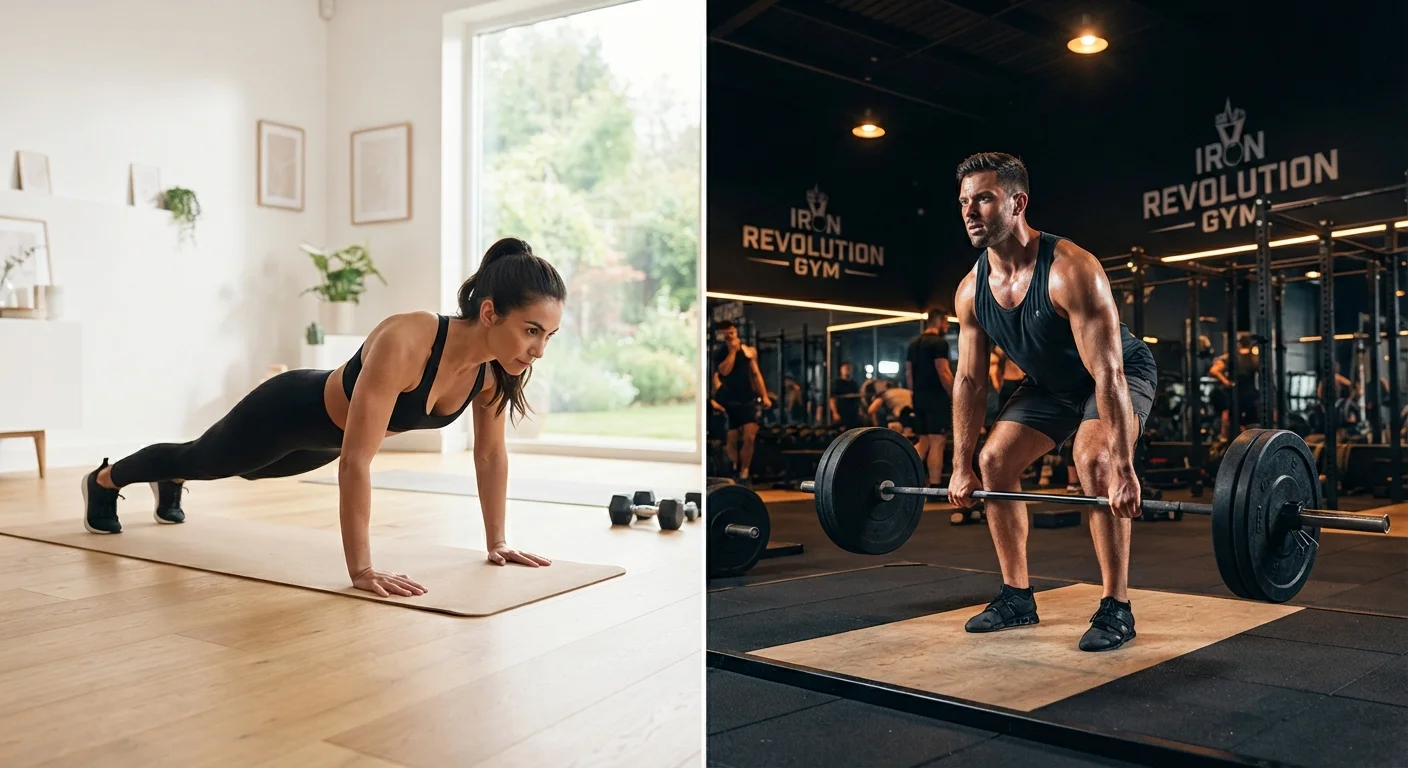
Neither home nor gym training is objectively superior - each supports genuine fitness progress under the right conditions. The deciding factors are personal: your goals, schedule, budget, and what environment actually keeps you coming back. Consistency over time remains the single strongest predictor of results, regardless of where you train.
| Best for | Recommended |
|---|---|
| Those working within strict time or cost constraints | Home Workouts |
| Those seeking progressive strength training with heavy loads or specialized equipment | Gym Training |
| People who thrive on social energy and structured classes | Gym Training |
| Those who want maximum scheduling flexibility with minimal barriers | Home Workouts |
Why the Environment You Train In Actually Matters
The debate between home and gym training is less about which is "better" and more about which is better for you. Both environments can support meaningful improvements in strength, cardiovascular fitness, and overall health - but they create genuinely different conditions that suit different people and goals.
Understanding those differences clearly helps you make a sustainable choice, rather than defaulting to whatever seems most popular or most convenient in the moment. This article maps the real trade-offs across the factors that matter most: cost, equipment access, social environment, consistency, and adaptability to specific fitness goals.
It's also worth noting that many people don't commit to one setting permanently. A hybrid approach - home training on busy weekdays, a gym visit on weekends - is practical and increasingly common. The goal is to find what keeps you moving consistently over months and years, not just weeks.
Cost, Convenience, and Access
Home workouts carry a significant cost advantage upfront. Beyond a modest investment in basics - a mat, resistance bands, or a set of adjustable dumbbells - there are no recurring membership fees. Gym memberships vary widely by location and facility type, but the ongoing cost is a real consideration over time.
Convenience, however, is where home training shines most clearly. Removing the commute, the locker room, and the scheduling constraint eliminates many of the friction points that cause people to skip sessions. Research consistently shows that reducing barriers to exercise - even small ones like travel time - improves adherence. For people with irregular schedules, young children, or limited transportation, home training can be the option that actually happens.
Gyms, in turn, offer access to equipment that is impractical to replicate at home: cable machines, squat racks, leg press stations, rowing machines, and a wide range of free weights. For goals that specifically require heavy progressive loading - building maximal strength or significant muscle mass - this equipment access is a genuine, not trivial, advantage. Bodyweight and equipment-based training build strength through different mechanisms, and understanding that distinction helps set realistic expectations for what each environment can deliver.
| Home Workouts | Gym Training | |
|---|---|---|
| Upfront cost | Low to moderate (equipment optional) | Membership fee plus potential setup costs |
| Ongoing cost | Minimal after initial setup | Monthly or annual membership fees |
| Equipment variety | Limited without investment | Extensive, including heavy weights and machines |
| Scheduling flexibility | Maximum - available anytime | Dependent on facility hours and commute |
| Social motivation | Low - self-directed only | High - classes, partners, community |
| Barrier to entry | Low - no travel required | Higher - commute and time commitment |
| Suitability for heavy strength training | Limited without significant investment | Strong - full progressive loading available |
| Privacy and comfort | High - no social pressure | Variable - can feel exposed for beginners |
Motivation, Social Environment, and Habit Formation
The psychological dimension of training is often underestimated. For some people, the gym environment - other people working hard, a dedicated space, group energy - is a powerful motivator. For others, it creates anxiety or self-consciousness that undermines the experience entirely.
Home training removes social pressure, which is genuinely freeing for many beginners or those returning after a gap. There's no performance anxiety, no waiting for equipment, and no sense of being observed. That psychological safety can make it easier to start and maintain a habit.
On the other hand, some people need external accountability. A gym class, a training partner, or even just leaving the house creates commitment cues that are hard to replicate at home. Research on group versus solo training environments suggests that social context meaningfully affects long-term adherence - though the direction of the effect depends on the individual.
Design Your Home Space Intentionally
Even a small, designated workout area at home - a cleared corner, a mat, a set of resistance bands - signals to your brain that this space is for training. Treating your home sessions with the same structure and scheduling you'd apply to a gym visit significantly improves consistency. Set a specific time, wear workout clothes, and minimize distractions during that window.
Home environments can also carry distractions - household tasks, other people, or simply the pull of the couch - that gyms don't. Creating a dedicated training space at home, even a small one, and treating scheduled sessions as non-negotiable appointments helps counteract this.
Matching Your Setting to Your Goals
Your specific fitness goals should weigh heavily in this decision. General health maintenance, cardiovascular fitness, flexibility, and moderate strength building are all achievable at home with bodyweight exercises and minimal equipment. A well-designed home movement routine requires no equipment at all and can address most everyday fitness needs.
Goals oriented toward competitive strength sports, significant hypertrophy (muscle growth), or sport-specific conditioning typically benefit from gym access. The ability to incrementally increase resistance in small, precise steps - a cornerstone of progressive overload, the primary driver of strength and muscle adaptation - is substantially easier with a full range of weights and machines.
For cardio specifically, both settings work well. Running, cycling outdoors, or following high-intensity bodyweight circuits at home can match or exceed what a treadmill provides, depending on your approach. How you sequence cardio and strength work within a session also affects your outcomes, regardless of where you train.
It's also worth separating common assumptions from evidence. Many people believe home workouts are inherently less effective, or that gyms automatically produce better results. A number of widely held fitness beliefs don't hold up to scrutiny - and the idea that location determines outcomes is one of them. Consistency, effort, and appropriate programming drive results far more than the address where you train.
This article provides general health and fitness information for educational purposes only. It is not a substitute for advice from a qualified healthcare or fitness professional. Consult a professional before beginning any new exercise program, particularly if you have existing health conditions or injuries.
The content on this site is for informational purposes only and is not a substitute for professional advice. Always consult a qualified professional for guidance specific to your situation.