

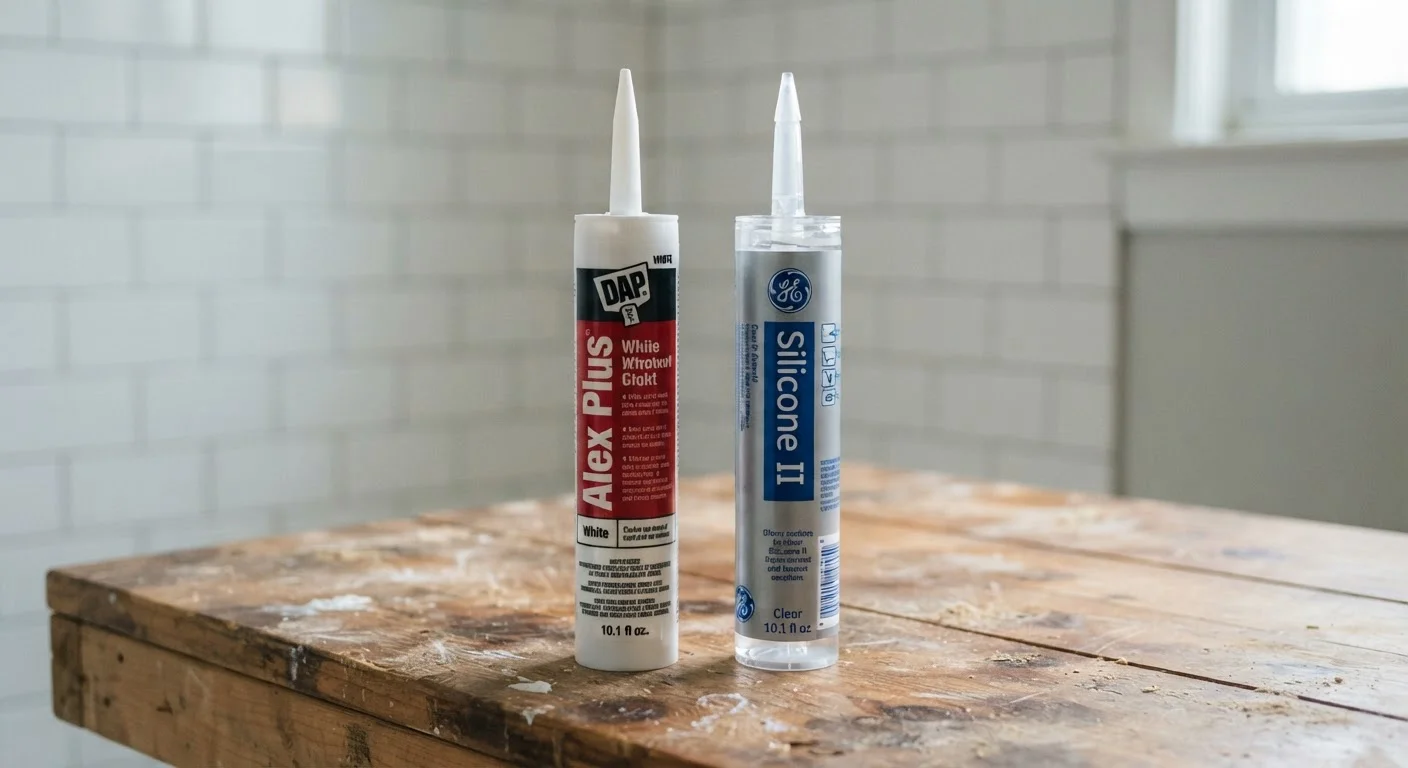
Option A
Caulk
The rigid, paintable gap-filler for stable joints.
Best for: Filling stationary gaps along baseboards, window trim, and interior wall junctions where movement is minimal.
Option B
Sealant
The flexible, moisture-resistant barrier for high-movement zones.
Best for: Sealing joints in wet areas like showers, bathtubs, and exterior penetrations where expansion, contraction, or water exposure is ongoing.
Why the Mix-Up Matters
Walk into any hardware store and you'll find shelves lined with tubes that look nearly identical. The labels say things like "kitchen and bath caulk," "silicone sealant," or "acrylic caulk-sealant." It's understandable that homeowners treat these terms as synonyms - but they describe products with fundamentally different properties, and picking the wrong one can mean peeling joints, mold behind tiles, or water damage inside your walls.
The confusion has real consequences. If you've ever seen a bathtub seam crack within a year or paint peeling off a window frame seal, there's a good chance the wrong product was used. Understanding the chemistry behind each helps you make the right call before the tube is ever opened.
| Criterion | Caulk | Sealant |
|---|---|---|
| Primary base material | Acrylic latex | Silicone or polyurethane |
| Curing method | Dries (water evaporation) | Cures chemically (moisture reaction) |
| Flexibility after curing | Rigid; low elasticity | Rubber-like; high elasticity |
| Paintable | Yes, once fully dry | No (standard silicone); some hybrids are |
| Water resistance | Low to moderate | High |
| Mold resistance | Low | High (fungicide-grade formulas) |
| Ideal locations | Interior trim, baseboards, crown molding | Bathrooms, kitchens, exterior joints |
| Lifespan in wet zones | Months (then cracks) | Several years with proper prep |
What Caulk Actually Is
Traditional caulk is most commonly acrylic latex-based. It cures by drying - water evaporates from the compound and it hardens into a relatively rigid bead. This rigidity is actually a feature in the right setting: acrylic caulk bonds firmly to painted surfaces, drywall, wood trim, and masonry, and once dry it can be sanded and painted over without any adhesion problems.
The key limitation is movement. Acrylic caulk has low elasticity, meaning it tolerates very little expansion or contraction before it cracks. For a joint between a baseboard and drywall - which essentially doesn't move - that's perfectly fine. For a joint between a cast iron tub and a tile surround - which shifts slightly every time someone gets in - it's a recipe for failure.
For a deeper look at where caulk belongs and where it doesn't, see our guide on correct caulk application.
What Sealant Actually Is
The term "sealant" most often refers to silicone-based products, though polyurethane and hybrid formulations also fall under this category. Unlike caulk, silicone sealant cures through a chemical reaction with atmospheric moisture rather than by drying out. The result is a rubber-like, highly elastic bead that can stretch and compress repeatedly without breaking its bond.
This flexibility makes sealant indispensable in wet zones. A shower corner joint or the perimeter of a bathtub moves every single day - from temperature change, from weight, from the building settling. Sealant accommodates that movement. It also resists water absorption and, when formulated with fungicide additives, resists mold growth far better than acrylic caulk.
The trade-off: standard silicone sealants are notoriously difficult to paint. The silicone surface repels paint adhesion. If the joint needs to blend into a painted wall, you'll need either a paintable hybrid product or acrylic caulk - not a standard silicone sealant.
Hybrid Products: A Middle Ground
Some products are marketed as "siliconized acrylic" or "caulk-sealant." These hybrids offer better flexibility than standard acrylic caulk and are often paintable, making them a useful compromise for low-moisture areas where some movement is expected. However, they still fall short of pure silicone sealant in high-moisture environments like showers - check the label carefully and look for explicit "waterproof" or "bathroom-grade" language before using any hybrid in a wet area.
Where Each Product Belongs
Location and exposure conditions should drive your choice every time. Here's a practical breakdown:
- Interior trim joints (baseboards, crown molding, window casings): Use acrylic caulk. These joints are stable, paint is expected, and moisture is not a primary concern.
- Bathtubs, shower surrounds, and kitchen sinks: Use silicone sealant. Water resistance and flexibility are non-negotiable here. If you're also working with tile in these areas, see what most homeowners get wrong about grout - the two products serve very different roles.
- Exterior gaps around pipes, vents, and window frames: Use sealant, ideally one rated for UV exposure. Temperature swings require elasticity.
- Damp walls or areas with suspected moisture infiltration: Address the underlying cause first. Sealing over active damp is counterproductive - the product will fail and moisture will continue spreading. Learn to distinguish damp walls from condensation before sealing anything.
~20%
Elasticity of typical acrylic caulk
Standard acrylic caulk can stretch or compress roughly 10-25% of its width before cracking, compared to silicone sealants which can manage 25-50% or more depending on formulation.
25+ years
Potential lifespan of quality silicone sealant
When applied to properly prepared, clean surfaces, high-grade silicone sealants are widely reported by manufacturers and building professionals to remain effective for two decades or longer.
The content on this site is for informational purposes only and is not a substitute for professional advice. Always consult a qualified professional for guidance specific to your situation.