

Why Good Intentions Lead to Poor Watering Habits
Most lawn watering mistakes don't come from neglect - they come from misplaced care. Homeowners often water daily because it feels attentive, or soak the lawn at the same time every evening because it fits their schedule. These routines seem logical, but they can quietly weaken a lawn over months and years.
Understanding why grass behaves the way it does underground changes how you think about watering entirely. Grass roots follow moisture. If water is always shallow and always available at the surface, roots have little reason to extend deeper into the soil. That leaves your lawn dependent on you for every drop - and vulnerable the moment conditions change.
For a broader look at building a genuinely resilient lawn from the ground up, see our complete lawn care guide.
Watering every day in small amounts rather than deeply and infrequently.
Why it happens: Daily watering feels thorough and attentive, and many people assume more frequent watering equals better care.
Watering late in the evening, leaving grass wet through the night.
Why it happens: Evening is often the most convenient time after a workday, and it avoids peak heat - which feels like a reasonable trade-off.
Running sprinklers on a fixed timer regardless of recent rainfall.
Why it happens: Automated systems are set once and forgotten, and many homeowners don't adjust them seasonally or after rain events.
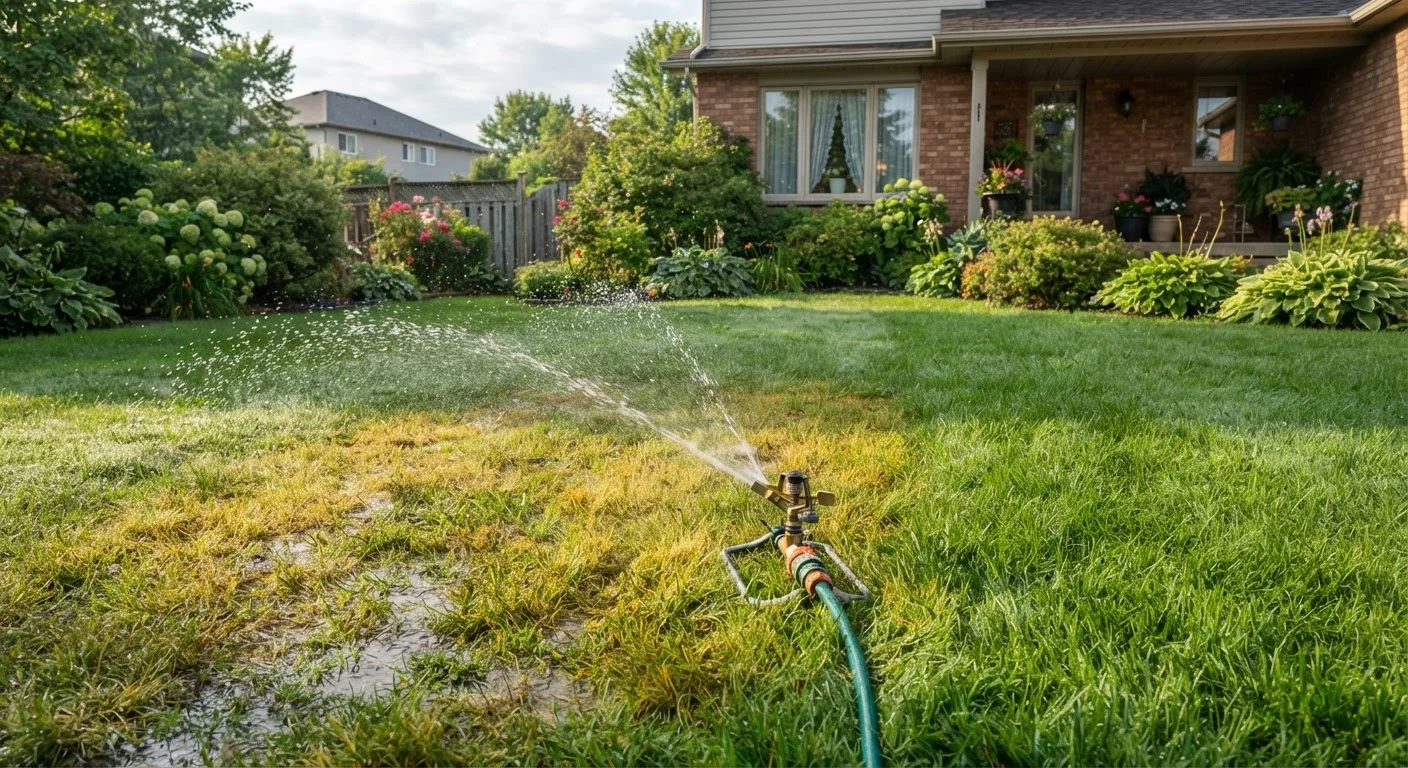
Applying water faster than the soil can absorb it, causing runoff.
Why it happens: High-flow sprinklers on compacted or clay-heavy soil saturate the surface quickly, and the excess water simply runs off before penetrating.
Treating all lawn areas with the same watering schedule despite different conditions.
Why it happens: It's easier to set one schedule for the whole yard, and differences in sun exposure or soil type aren't always visible.
What Healthier Watering Actually Looks Like
The goal of a sound watering routine is to encourage deep root development while avoiding the conditions that invite disease or waste water. In practice, this usually means watering thoroughly but infrequently - typically two to three times per week during active growing season, adjusted for rainfall.
~1 inch
Weekly water most lawns need
Cooperative Extension programs across the US consistently cite one inch per week - including rainfall - as the general benchmark for most cool- and warm-season grasses.
50%
Outdoor water lost to inefficiency
The U.S. Environmental Protection Agency (EPA) estimates that roughly half of outdoor residential water use is lost to evaporation, wind, or runoff due to inefficient application methods.
Watering in the early morning, between roughly 6 a.m. and 10 a.m., gives the grass time to absorb moisture before the heat of the day accelerates evaporation. It also allows the blades to dry out by midday, reducing fungal pressure. A simple soil screwdriver test - if a six-inch screwdriver pushes into the ground with moderate resistance, moisture levels are likely adequate - can replace guesswork entirely.
Soil composition matters, too. Sandy soils drain quickly and may need slightly more frequent watering, while clay soils retain moisture longer and are especially prone to overwatering. If you're unsure how your lawn compares, common gardening myths explores several mistaken assumptions about soil and water that are worth revisiting.
Overwatering Can Mimic Drought Stress
Yellowing, wilting, or thinning grass isn't always a sign that your lawn needs more water - it can equally signal that it's getting too much. Waterlogged soil deprives roots of oxygen, causing symptoms that look remarkably like drought stress. Before increasing your watering frequency, check that the soil isn't already saturated a few inches below the surface.
Adding a layer of mulch around garden beds adjacent to your lawn can also reduce overall irrigation needs by slowing surface evaporation. Our article on what mulch does beneath the surface explains how this works in practice. And if compacted soil is limiting how well water penetrates, lawn aeration may be worth considering before adjusting your watering schedule.
The content on this site is for informational purposes only and is not a substitute for professional advice. Always consult a qualified professional for guidance specific to your situation.