

Option A
Zero-Based Budgeting
The meticulous, dollar-by-dollar planning method.
Best for: People who want complete control over every spending decision and are willing to rebuild their budget from scratch each month.
Option B
Percentage-Based Budgeting
The flexible, proportional framework for consistent allocation.
Best for: People who prefer a simpler, repeatable system that scales automatically as income rises or falls.
How Each Method Works
Understanding these two approaches starts with their core mechanics - how they instruct you to handle each dollar that comes in.
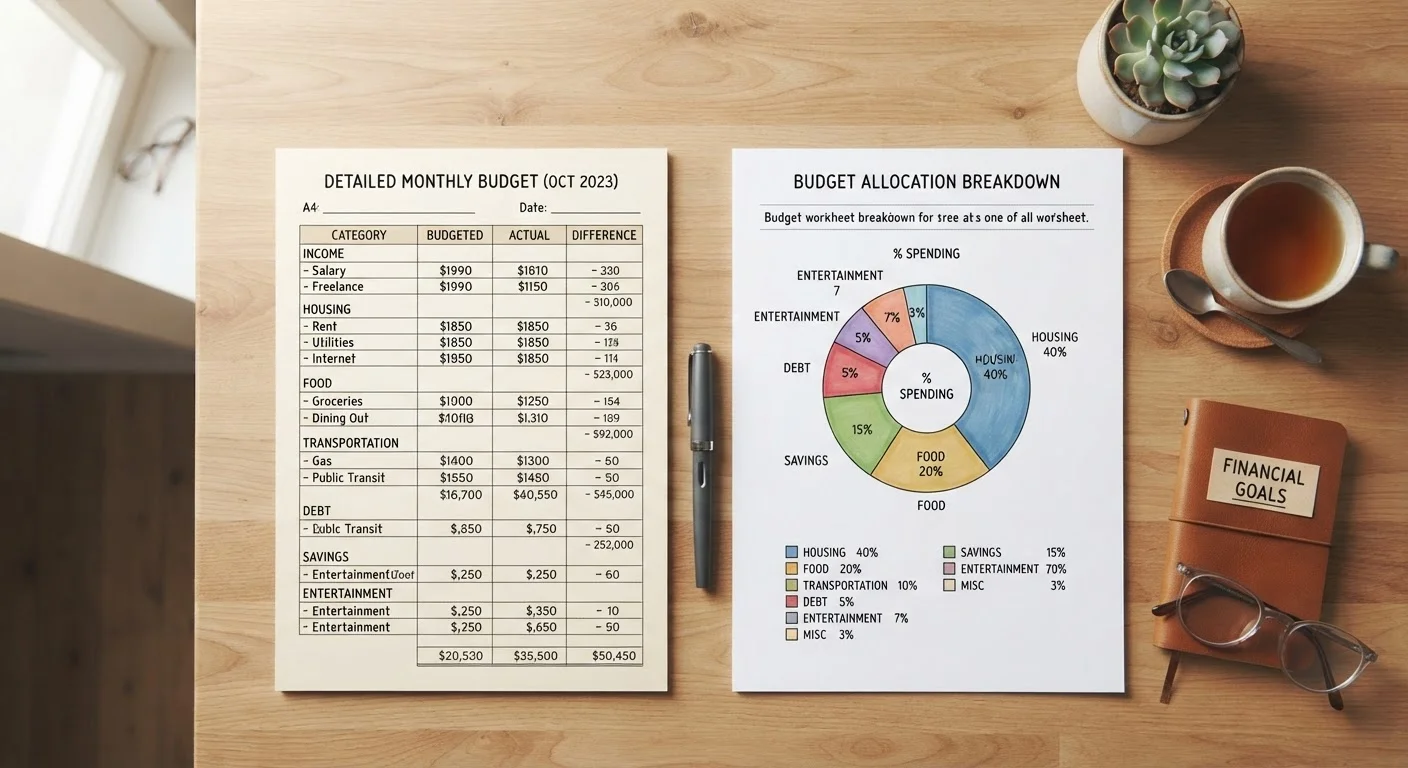
Zero-based budgeting (ZBB) means you start each month with your total expected income and assign every dollar to a category - rent, groceries, savings, debt payments, entertainment - until the remaining balance reaches zero. As our Zero-Based Budgeting Explained guide details, that zero doesn't mean you've spent everything; it means every dollar has a named purpose, including dollars allocated to savings or an emergency fund.
Percentage-based budgeting works differently: you divide income into broad categories by proportion. The widely known 50/30/20 rule, for example, directs 50% to needs, 30% to wants, and 20% to savings and debt repayment. The categories stay constant; only the dollar amounts shift as your income changes. For a broader comparison of structured frameworks, see The 50/30/20 Rule, Zero-Based Budgeting, and the Envelope Method.
| Criterion | Zero-Based Budgeting | Percentage-Based Budgeting |
|---|---|---|
| Core logic | Every dollar assigned a job; balance = zero | Income split into fixed percentage categories |
| Monthly setup time | High - rebuilt from scratch each month | Low - proportions stay constant |
| Handles irregular income | Yes - flexible month-to-month allocation | Yes - percentages self-adjust with income |
| Handles irregular expenses | Yes - can assign specific line items | Requires proactive sinking fund planning |
| Spending visibility | Very granular - every category tracked | Broad - category-level only |
| Best for beginners | Steeper learning curve | Simpler entry point |
| Savings automation | Built in - savings assigned first or as a category | Built in - savings is a fixed percentage |
Handling Irregular Income and Variable Expenses
One of the clearest differences between these methods emerges when income isn't predictable - a common reality for freelancers, contractors, and gig workers.
With zero-based budgeting, you rebuild the budget each month around whatever you expect to earn. That flexibility is an advantage: in a lean month, you allocate less to discretionary categories first and protect essentials. In a strong month, you can direct surplus dollars to debt or savings intentionally. The Budgeting on an Irregular Income article outlines strategies that pair well with this approach.
Percentage-based budgeting is naturally self-adjusting for income swings because each category is a proportion - 50% of $3,000 is $1,500, and 50% of $4,500 is $2,250. However, it can struggle with irregular expenses: a one-time car repair or annual insurance premium doesn't fit neatly into a percentage slice unless you proactively set aside a sinking fund. Understanding which of your costs are fixed versus variable - explored in our Fixed vs. Variable Expenses guide - helps you apply either method more accurately.
~34%
Americans with a detailed monthly budget
Gallup polling has consistently found that fewer than four in ten U.S. adults maintain a detailed household budget, highlighting how much room exists for improvement.
20%
Savings allocation in the 50/30/20 rule
The 50/30/20 framework, popularized in personal finance literature, recommends directing 20% of after-tax income to savings and debt repayment.
$0
Unassigned dollars in zero-based budget
By design, a correctly completed zero-based budget leaves no dollar without a designated category, including savings, investments, or debt payoff.
Time Commitment and Practical Sustainability
Neither budgeting system works if you abandon it after two weeks. The effort each method demands is a real factor in which one you'll actually maintain.
Zero-based budgeting is more time-intensive. Because you're rebuilding allocations from scratch each month and tracking every category closely, it requires regular check-ins - ideally weekly - and honest accounting of where money went. That accountability is its strength and its friction point.
Percentage-based budgeting, once set up, requires far less ongoing effort. You confirm your income, apply your percentages, and check that spending stays within bounds. This lower maintenance threshold makes it more sustainable for people with busy schedules or those just beginning to budget.
A practical middle path: use a percentage framework as a baseline structure, then apply zero-based thinking inside each category during months when spending feels out of control. Both methods support long-term saving when used consistently - for more on that, see Budgeting Methods That Actually Support Long-Term Saving.
Hybrid Approaches Are Common
Many personal finance practitioners use elements of both systems - applying broad percentage targets for major categories while using detailed line-item tracking for problem spending areas like dining out or entertainment. There's no rule requiring you to follow one method exclusively. The goal is an accurate, honest picture of where your money goes and intentional decisions about where it should go.
This article is for general informational and educational purposes only and does not constitute personalized financial advice. Consult a qualified financial professional regarding decisions specific to your situation.
The content on this site is for informational purposes only and is not a substitute for professional advice. Always consult a qualified professional for guidance specific to your situation.