

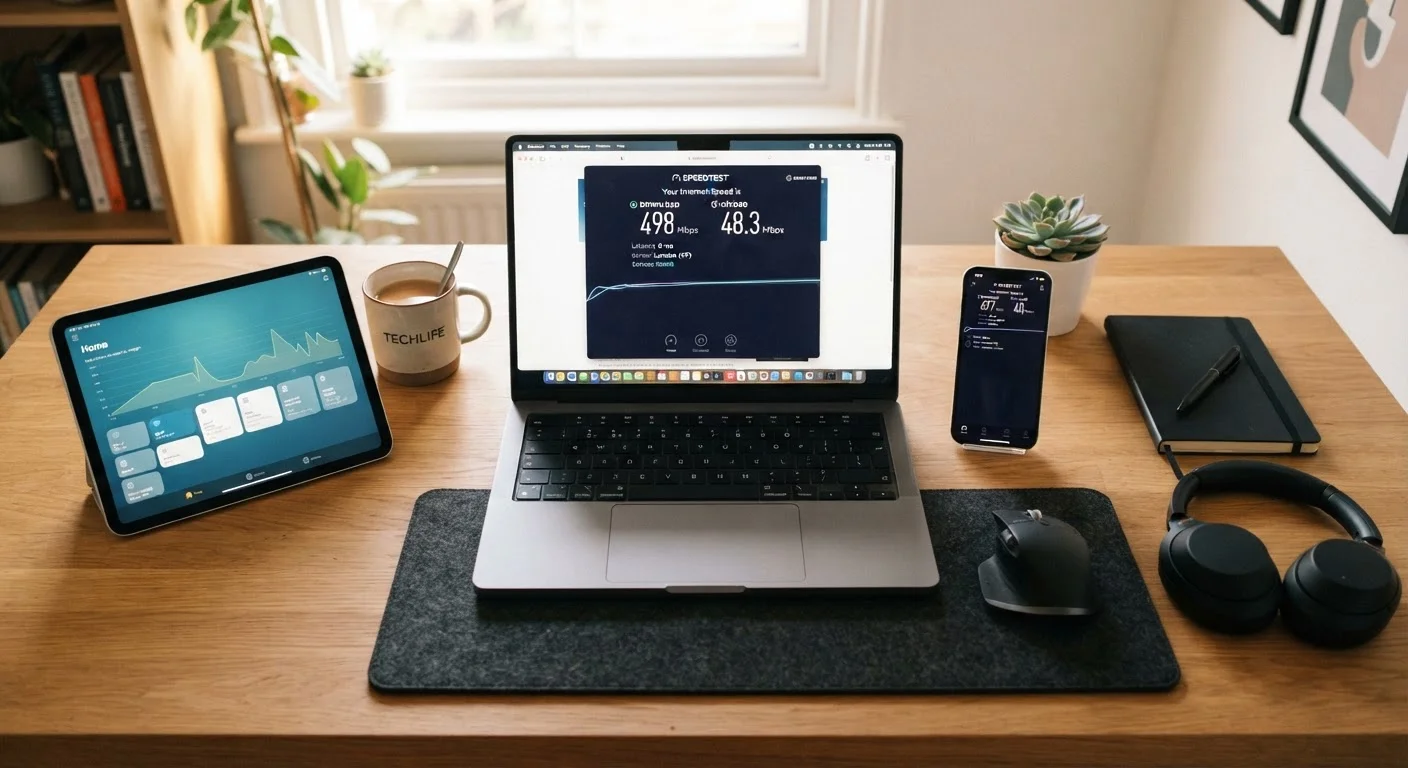
What Mbps Actually Means Day to Day
Internet speed is measured in megabits per second (Mbps) - a unit that describes how quickly data travels between the internet and your devices. Higher Mbps means more data can move at once, which matters most when multiple people or devices are active simultaneously.
Download speed (data coming to your home) affects streaming, browsing, and loading files. Upload speed (data going from your home) matters for video calls, sending large files, and cloud backups. Most households use far more download bandwidth than upload, which is why ISP plans are typically asymmetric - offering higher download than upload figures.
Speed alone does not tell the whole story. Latency - or ping - also plays a critical role, particularly for video calls and real-time gaming, where even a fast connection can feel sluggish if response times are high.
| FCC minimum broadband definition | 25 Mbps download / 3 Mbps upload (Federal Communications Commission (FCC)) |
| Typical 4K stream requirement | 15-25 Mbps per stream (Major streaming platform guidelines) |
| Average US household download speed | Approximately 200+ Mbps (Ookla Speedtest Global Index) |
| Upload-to-download ratio (typical plan) | 1:10 or lower (asymmetric) (Standard ISP plan structure) |
| Gigabit internet threshold | 1,000 Mbps (1 Gbps) |
Speed Benchmarks by Common Activity
Different tasks place very different demands on your connection. Here is a general breakdown of the minimum and comfortable download speeds for typical household activities:
- Basic web browsing and email: 1-5 Mbps is sufficient for one person loading pages and checking messages.
- Standard-definition (SD) video streaming: Around 3-5 Mbps per stream keeps playback smooth.
- HD video streaming (1080p): Typically 5-10 Mbps per stream, depending on the platform.
- 4K Ultra HD streaming: Most services recommend 15-25 Mbps per stream to avoid buffering.
- Video calls (standard quality): 1-4 Mbps upload and download per participant is generally workable.
- HD video conferencing: 3-8 Mbps in each direction provides reliable quality.
- Online gaming: Raw speed requirements are modest (3-10 Mbps), but low latency is far more important than bandwidth.
- Large file downloads or cloud backups: Faster plans (100 Mbps+) reduce wait times significantly, though they are not strictly necessary for light users.
These figures are per stream or per device. A household with several simultaneous users should add them together to estimate realistic peak demand.
Mbps
Megabits per second - the standard unit for measuring internet speed. One megabit equals one million bits of data. Higher Mbps means more data can transfer in a given second.
Download speed
The rate at which data moves from the internet to your device. This affects streaming, web browsing, and receiving files.
Upload speed
The rate at which data moves from your device to the internet. Critical for video calls, live streaming, and sending large files to cloud storage.
Bandwidth
The maximum capacity of your internet connection - essentially its ceiling. More bandwidth allows more simultaneous data transfers without slowdown.
Latency
The time delay, measured in milliseconds (ms), between sending a request and receiving a response. Low latency is crucial for gaming and video conferencing, independent of raw speed.
Asymmetric connection
An internet plan where download and upload speeds differ - typically download is much faster than upload. Most home broadband plans are asymmetric.
How Many Devices Change the Calculation
The number of actively connected devices is as important as any single activity. A useful rule of thumb: count the devices that are simultaneously active during your busiest period - not every device in the house.
A two-person household where one person streams 4K video (25 Mbps) while the other joins a video call (5 Mbps upload/download) needs at least 30 Mbps download and 5-8 Mbps upload at that moment. Add a smart TV running in another room and a tablet downloading an update in the background, and 50-100 Mbps starts to feel more comfortable than excessive.
For larger households with four or more simultaneous users, plans in the 200-500 Mbps range typically provide ample headroom. Plans marketed above 500 Mbps or at 1 Gbps (gigabit) are most relevant to heavy users - those working from home with large file transfers, running home servers, or sharing a connection across many simultaneous 4K streams.
25 Mbps
FCC minimum broadband threshold
The FCC defines broadband as a connection delivering at least 25 Mbps download and 3 Mbps upload, though many households need significantly more.
4-6
Average number of connected devices per US adult
Research from Deloitte and similar consumer surveys consistently shows US adults manage multiple connected devices, increasing household bandwidth demand.
15-25 Mbps
Recommended speed per 4K stream
Most major streaming platforms publish bandwidth guidelines recommending 15-25 Mbps to sustain stable 4K Ultra HD playback.
Understanding your connection type also shapes what speeds are realistically available to you. Fibre, cable, DSL, and fixed wireless each have different ceiling speeds and consistency profiles, so what is advertised on a plan may differ from what reaches your devices.
Several widespread beliefs about speed - including the idea that advertised speeds are guaranteed - are worth questioning before choosing or upgrading a plan. And for a complete picture of what shapes your day-to-day experience beyond just the plan itself, see everything that shapes your home internet experience.
The content on this site is for informational purposes only and is not a substitute for professional advice. Always consult a qualified professional for guidance specific to your situation.