

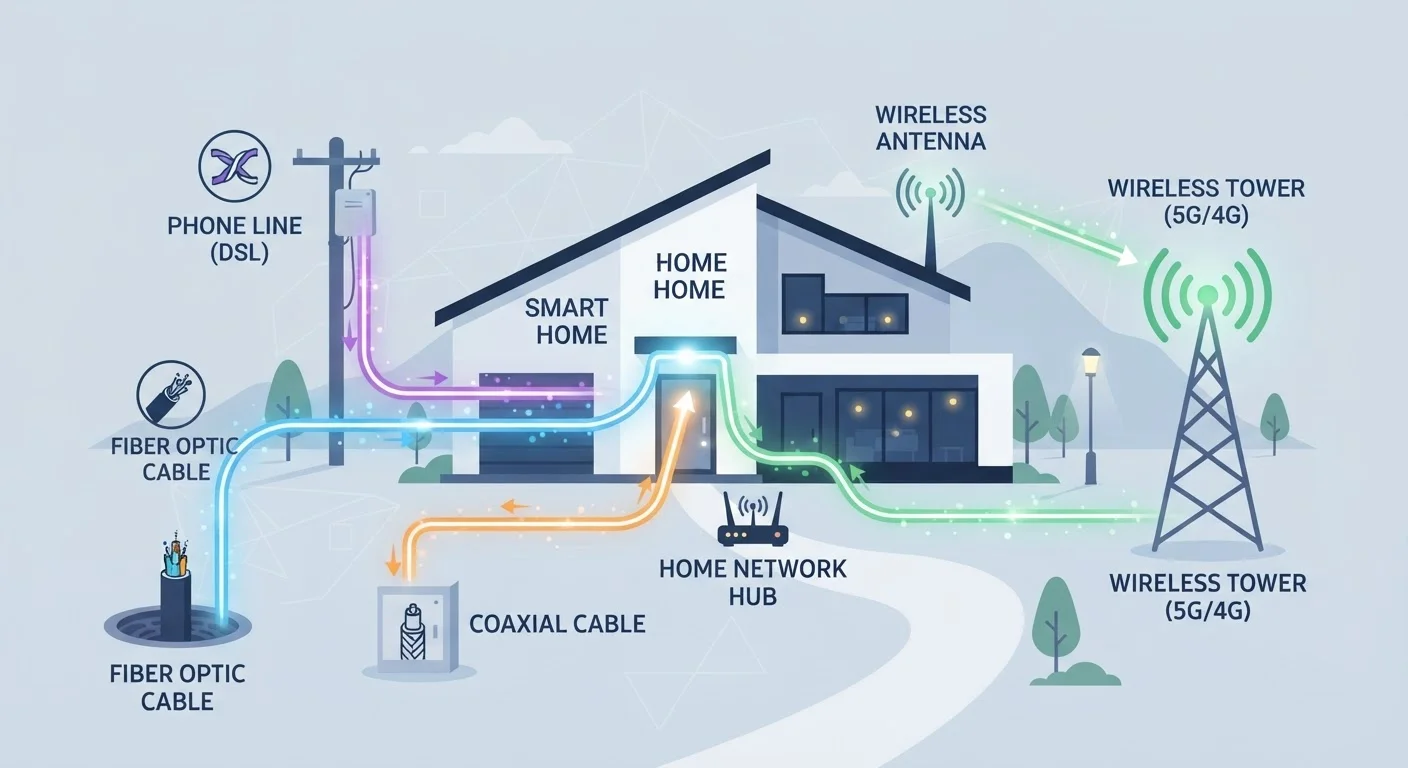
The Five Main Connection Types at a Glance
Most US households can access internet service through one of five underlying technologies: fibre optic, cable, DSL, satellite, or fixed wireless. Each works differently at a physical level, and those differences shape the speed, reliability, and latency you experience every day. Understanding the basics helps you evaluate what is actually available at your address - and what the tradeoffs are.
For a deeper look at how these technologies fit into the broader broadband picture, see our comprehensive home broadband guide.
~25%
US households with fibre internet access
According to FCC broadband deployment data, fibre availability continues to expand but remains well below cable and DSL reach nationwide.
500-700ms
Typical latency for geostationary satellite
Geostationary satellites orbit at roughly 22,000 miles, creating round-trip signal delays that affect real-time applications like video calls and gaming.
~87%
US homes with fixed broadband access
The FCC's National Broadband Map tracks deployment data reported by providers across all fixed connection technologies.
Fibre Optic Internet
Fibre optic internet transmits data as pulses of light through thin glass or plastic cables. Because light travels with virtually no signal degradation over distance, fibre delivers consistently high speeds and very low latency - often under 10 milliseconds.
A key advantage is symmetrical bandwidth: upload and download speeds are typically equal, which benefits households that video conference, back up data to the cloud, or work from home. Fibre is the least susceptible to congestion during peak usage hours.
The main limitation is infrastructure: fibre requires entirely new cabling to be laid, so availability is concentrated in cities and growing suburbs. Rural areas are often underserved. If fibre reaches your address, it is generally considered the premium option for home connectivity.
For a side-by-side comparison of fibre and its closest competitor, see Fibre vs Cable Internet: Understanding the Key Differences.
Check Actual Address Availability First
Advertised service areas do not always reflect what is available at a specific address. Before making assumptions based on a provider's coverage map, enter your exact address on the provider's website or use the FCC's broadband map at broadbandmap.fcc.gov. Contacting providers directly can also surface options that online tools miss.
Cable and DSL Internet
Cable internet travels over the same coaxial copper cables originally built for cable television. It is widely available across urban and suburban America and capable of fast download speeds - frequently 100 Mbps to 1 Gbps on modern networks. However, upload speeds lag considerably behind downloads, and because neighbourhood customers share network capacity, speeds can dip during busy evening hours.
DSL (Digital Subscriber Line) uses existing telephone copper wiring to carry internet signals. It is broadly available because phone lines reach most addresses, but speeds are modest - typically between 1 and 100 Mbps - and performance degrades with distance from the provider's central office. DSL is often the only wired option for homes in older suburban or rural areas without cable or fibre infrastructure.
Understanding what speed numbers mean for your household tasks is just as important as knowing the connection type - see What Internet Speed Do You Actually Need at Home? for practical guidance.
Satellite and Fixed Wireless Internet
Satellite internet sends data between your home and satellites orbiting Earth. Traditional geostationary satellites orbit at around 22,000 miles altitude, resulting in latency of 500-700 milliseconds - noticeable during video calls and online gaming. Low Earth orbit (LEO) satellite systems operate at much lower altitudes, reducing latency significantly, though speeds and reliability can still vary with weather and sky obstructions.
Satellite's defining advantage is near-universal coverage: if you have a clear view of the sky, it can work almost anywhere in the country. It is often the only viable option in remote rural locations.
Fixed wireless internet delivers a radio signal from a nearby ground-based tower to a receiver installed on your home. Speeds vary widely by provider and distance from the tower, but modern fixed wireless services can reach 25-300 Mbps in favourable conditions. Obstacles like trees or hills between your home and the tower can affect signal quality.
If you encounter unfamiliar terms while researching plans, our plain-language broadband glossary explains common jargon in straightforward terms.
Connection Type Affects More Than Speed
The technology delivering your internet also influences latency, upload performance, and reliability during bad weather or network congestion. Two plans advertised at the same download speed can feel very different in daily use if they rely on different underlying technologies. When evaluating options, consider the full picture - not just the headline Mbps figure.
Frequently Asked Questions
Fibre optic internet currently offers the highest speeds, with many plans delivering symmetrical speeds of 500 Mbps to 1 Gbps or more. Cable internet can also reach high speeds, though it is generally asymmetrical - download speeds outpace upload speeds significantly.
In areas without fibre or cable infrastructure, fixed wireless and satellite internet are the most common options. Satellite reaches almost anywhere with a clear view of the sky, while fixed wireless requires proximity to a provider's transmission tower.
DSL can be a practical option if no other wired technology is available at your address, especially for light internet use like browsing and email. However, speeds are significantly lower than fibre or cable, and performance degrades the farther your home is from the telephone exchange.
Download speed measures how quickly data travels from the internet to your device - relevant for streaming, browsing, and loading pages. Upload speed measures the reverse - important for video calls, sending large files, and cloud backups. Fibre connections often offer equal speeds in both directions.
Latency is the time it takes for a data signal to travel between your device and a remote server, measured in milliseconds. Lower latency means more responsive connections - important for video calls, online gaming, and real-time applications. Satellite internet has noticeably higher latency than ground-based connections.
You can check availability by entering your address on internet provider websites or using the FCC's broadband map at broadbandmap.fcc.gov, which shows reported coverage by technology type. Actual availability may differ from what is mapped, so contacting providers directly is always worthwhile.
The content on this site is for informational purposes only and is not a substitute for professional advice. Always consult a qualified professional for guidance specific to your situation.