

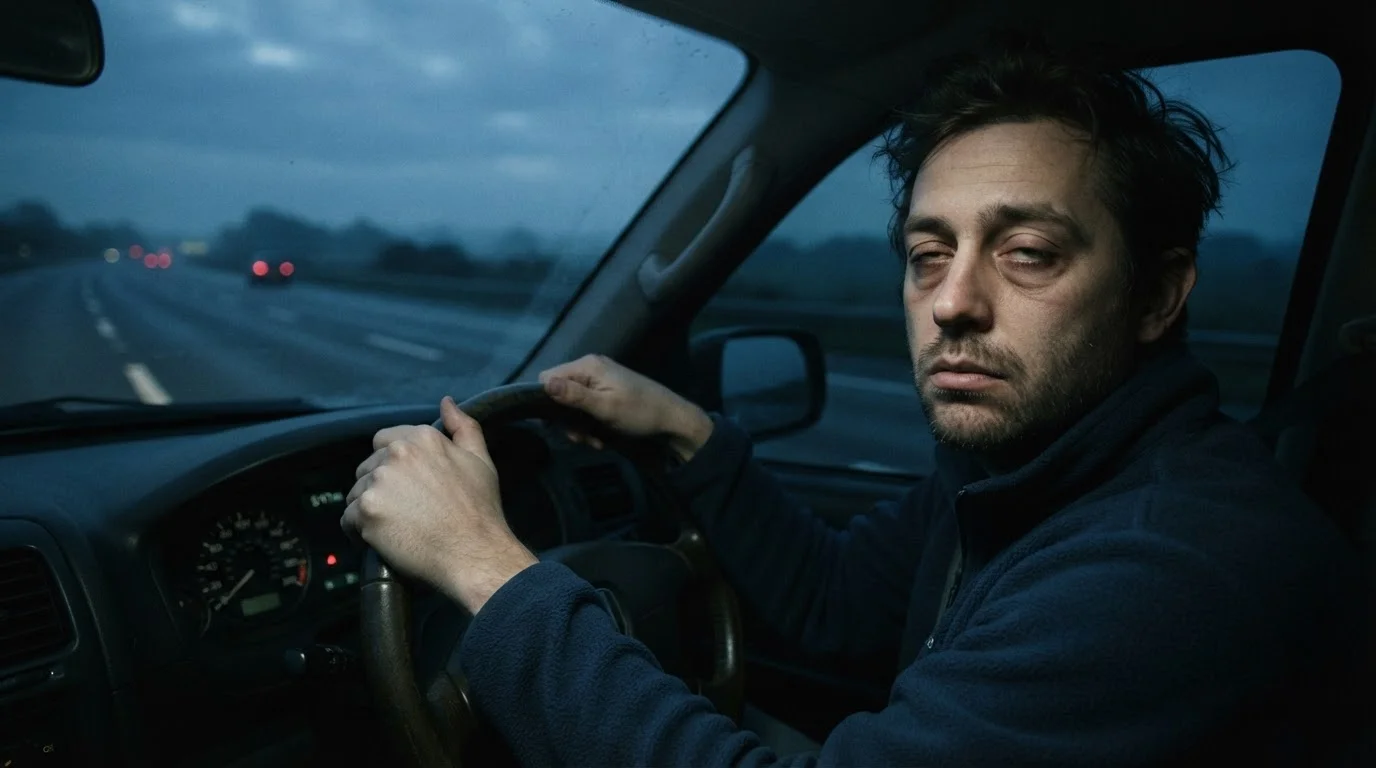
What Fatigue Actually Does Inside Your Brain
Fatigue is not simply a feeling - it is a measurable change in how your brain functions. When you are sleep-deprived, the prefrontal cortex, the region responsible for planning, attention, and impulse control, becomes markedly less active. Neurons fire more slowly, and your brain's ability to filter relevant information from background noise deteriorates.
The most direct consequence for driving is a significant increase in reaction time. A rested driver typically reacts to a sudden hazard in about 1.5 seconds. Fatigue can stretch that to 2.5 seconds or longer - and at 60 mph, each additional second of delay translates to roughly 88 feet of uncontrolled travel. The car ahead brakes; your foot has not moved yet.
Beyond raw reaction speed, fatigue also degrades peripheral vision awareness and the ability to accurately judge the speed and distance of other vehicles. You may be looking ahead but genuinely not processing what you see.
Fatigue vs. Drowsiness: A Useful Distinction
Drowsiness refers specifically to the urge to sleep - a subjective feeling you can sometimes recognize and act on. Fatigue is broader: it includes cognitive slowing, reduced coordination, and impaired judgment that can be present even when you do not feel particularly sleepy. This is why drivers can be dangerously impaired by fatigue while genuinely believing they are alert enough to drive safely.
Microsleeps: The Gaps You Never Notice
One of the most dangerous features of severe fatigue is the microsleep - a brief, involuntary transition into sleep that the driver is not aware of and cannot remember. Microsleeps can last anywhere from a fraction of a second to thirty seconds. During that window, the driver's eyes may remain open, but the brain is not receiving or processing visual information.
At 65 mph, a three-second microsleep means the vehicle covers nearly 300 feet - roughly the length of a football field - with no driver input. If that stretch includes a curve, a slowing car, or a pedestrian, the consequences can be catastrophic.
The unsettling reality is that people in a fatigued state are poor judges of their own impairment. Research suggests that the worse someone's fatigue, the more confident they tend to feel about their ability to keep driving safely - a pattern also seen with alcohol intoxication.
“People are notoriously bad at assessing their own level of impairment from sleep deprivation. The more sleep-deprived they are, the more they tend to underestimate their deficits.”
— William Dement, Sleep researcher and co-founder of sleep medicine as a clinical field
When Risk Peaks: The Body Clock Factor
Your risk of a fatigue-related crash is not constant throughout the day. The body's circadian rhythm - its internal 24-hour clock - creates two predictable troughs in alertness. The first runs from roughly 2 a.m. to 6 a.m., when the drive to sleep is at its strongest. The second is a shorter dip between approximately 1 p.m. and 3 p.m., a post-lunch window that is more pronounced in sleep-deprived individuals.
Crash data from the National Highway Traffic Safety Administration (NHTSA) reflects these patterns, with drowsy-driving incidents clustering heavily in overnight and early-morning hours, and a secondary peak in the early afternoon. Night-shift workers finishing a shift and long-haul drivers on overnight routes are among the highest-risk groups.
Pairing fatigue with other demanding conditions multiplies risk further. Driving in heavy rain already taxes attention and extends stopping distances - adding fatigue to that equation compounds the danger significantly. Similarly, the challenges covered in our guide on how darkness changes the physics of the road are substantially worse when a driver is also tired.
~100,000
Police-reported drowsy-driving crashes annually
The National Highway Traffic Safety Administration (NHTSA) estimates around 100,000 police-reported crashes each year involve drowsy driving, though the true number is considered higher due to underreporting.
0.05% BAC
Equivalent impairment after 18 hours awake
Research published in peer-reviewed sleep science literature has found that 18 hours without sleep produces cognitive and motor impairment roughly comparable to a blood alcohol concentration of 0.05%.
3-30 sec
Duration range of a single microsleep episode
Sleep researchers have documented microsleep episodes ranging from under a second to roughly 30 seconds, during which the driver has no awareness of the lapse.
What Actually Helps - and What Doesn't
The only genuine remedy for fatigue-impaired driving is sleep. A 20-minute nap in a safe rest area has been shown in multiple studies to produce a meaningful short-term improvement in alertness - far more reliably than caffeine alone. Combining a short nap with a caffeinated drink immediately before the nap (the caffeine takes about 20 minutes to peak) is a strategy some researchers have described as temporarily effective for alertness recovery.
What does not reliably help: opening windows, turning up the radio, splashing cold water on your face, or talking on the phone. These approaches address how tired you feel without restoring the cognitive speed and hazard-detection accuracy that fatigue has degraded.
Fatigue also interacts with other common driving risks. The cognitive load of distractions that a rested driver might handle becomes far more dangerous when the brain is already resource-depleted. And fatigue is one of the habits that quietly erode safe driving - drivers who routinely push through tiredness often underestimate how normalized their impairment has become.
Plan Rest Stops Before You Need Them
On any drive expected to exceed two hours, identify rest-area locations in advance and commit to stopping every 90 to 120 minutes regardless of how you feel. Waiting until fatigue becomes obvious means you may already be significantly impaired. Building stops into your itinerary removes the temptation to push through.
For a full breakdown of the warning signs that indicate you should pull over now rather than push on, see our guide on recognising the warning signs of driver fatigue.
Frequently Asked Questions
Studies show that being awake for 18 consecutive hours produces impairment roughly equivalent to a blood alcohol concentration of 0.05%, and 24 hours awake approaches impairment similar to 0.10% - above the US legal driving limit. Both conditions slow reaction time, reduce hazard perception, and impair judgment. Unlike alcohol, there is no roadside test to detect fatigue, which makes it a largely invisible but serious risk.
A microsleep is an involuntary episode where the brain briefly transitions into a sleep state, typically lasting between one and thirty seconds, while the person appears awake. During a microsleep, the driver receives no sensory information and takes no corrective action. At highway speeds, even a two-second microsleep means the vehicle travels roughly 180 feet completely unguided.
Caffeine can temporarily reduce subjective feelings of sleepiness for an hour or two, but it does not restore the cognitive processing speed or hazard-detection accuracy that fatigue impairs. It is at best a short-term bridge to find a safe place to stop. Relying on caffeine to push through long-distance fatigue is not a reliable safety strategy.
Crash data consistently points to two windows: roughly 2 a.m. to 6 a.m., when the body's circadian rhythm strongly promotes sleep, and 1 p.m. to 3 p.m., an afternoon dip that is especially pronounced in people who are already sleep-deprived. Night-shift workers and early-morning commuters face elevated risk during these periods.
Early signs include difficulty keeping eyes focused, frequent blinking, missing exits or road signs you expected to see, drifting within your lane, and struggling to remember the last few miles of driving. If you notice any of these, treat them as a signal to pull off safely as soon as possible. See our companion article on <a href="/cars-driving/safe-driving/driver-fatigue-recognising-the-warning-signs-before-they-cost-you">recognising fatigue warning signs</a> for a fuller breakdown.
These are common strategies but the evidence that they extend safe driving time is weak. Cool air and loud music may briefly raise alertness, but like caffeine they address the feeling of tiredness rather than the underlying neurological impairment. They should not be used as substitutes for stopping to rest.
The content on this site is for informational purposes only and is not a substitute for professional advice. Always consult a qualified professional for guidance specific to your situation.