

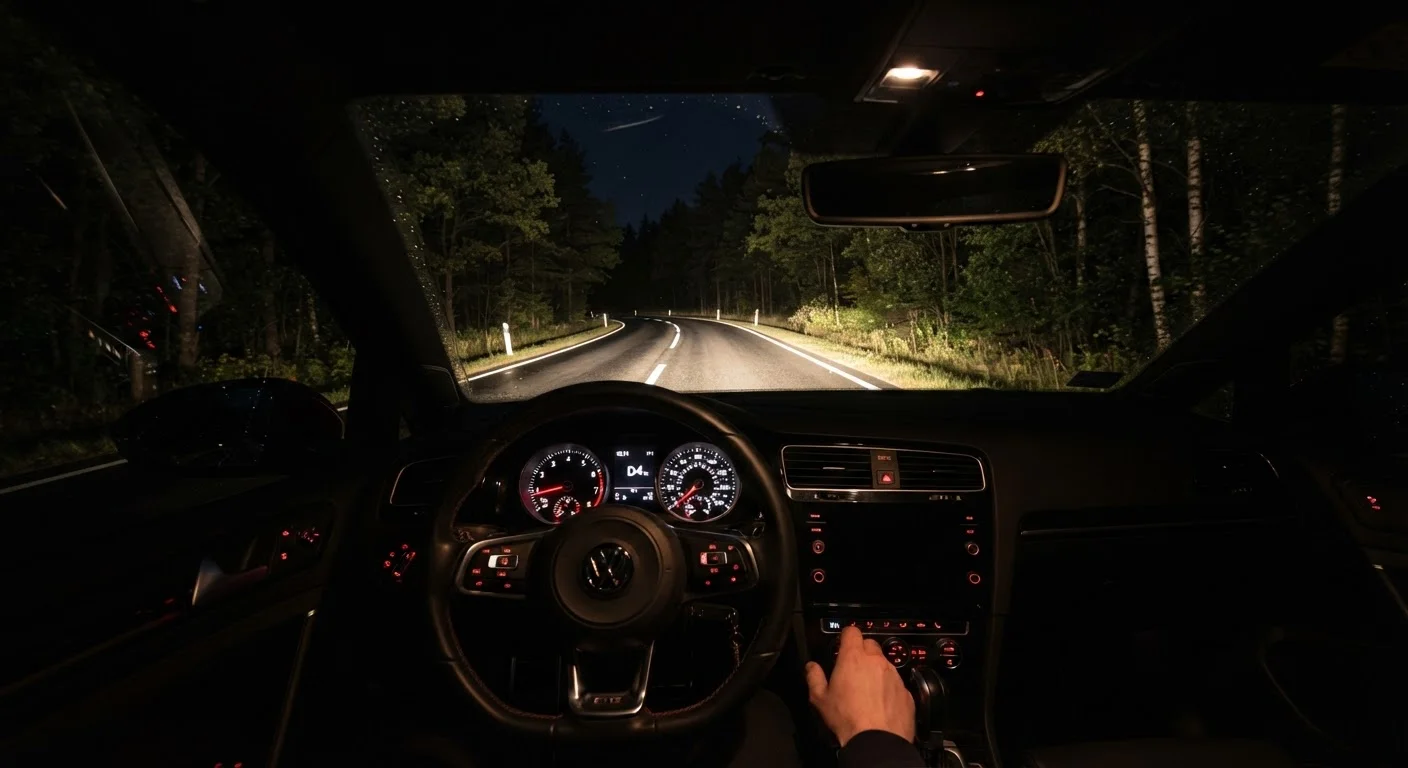
What Darkness Actually Does to Your Vision
Most drivers know night driving feels harder. Fewer understand exactly why - and that gap in awareness is itself part of the problem.
The human eye relies on two sets of photoreceptors: cones, which handle color and fine detail in daylight, and rods, which take over in low light but can't process color or sharp edges. The transition between the two - called dark adaptation - takes up to 30 minutes. Drive straight from a bright parking structure onto a dark highway and your eyes are still catching up for nearly half an hour.
More immediately disruptive: a single blast of oncoming high-beam light resets your dark adaptation almost instantly. Your vision recovers, but it takes time - time during which you're moving at highway speed with degraded visual input.
Peripheral Vision Narrows After Dark
In low-light conditions, the eye's peripheral field - where rod photoreceptors are concentrated - becomes more sensitive to motion but less reliable for detail. This means a fast-moving hazard at the edge of your vision may register as a blur rather than an identifiable object. Scanning the full road width actively, rather than focusing straight ahead, helps compensate for this limitation.
Peripheral vision also narrows in darkness. Hazards at the edge of your visual field - a pedestrian stepping off a curb, a deer at the road's shoulder - are much easier to miss after dark than in daylight.
The Stopping Distance Problem
Here's the physics most drivers don't think about: your headlights have a fixed range, but your stopping distance changes with speed.
Standard low-beam headlights illuminate roughly 160 feet ahead. At 60 mph, your total stopping distance - perception time, reaction time, and actual braking - can exceed 300 feet under normal conditions. That means at highway speeds on low beams, you may not be able to stop in time for a hazard you can just barely see.
This gap is sometimes called overdriving your headlights, and it's a structural feature of nighttime driving that can't be fully eliminated - only managed. High beams help when there's no oncoming traffic, extending visibility to 350-400 feet. But on busy roads or in fog, they often create more glare than they solve.
~50%
Traffic fatalities that occur at night
The National Safety Council estimates roughly half of all traffic deaths happen in darkness, despite significantly lower nighttime traffic volume.
160 ft
Typical low-beam headlight range
Standard low beams illuminate approximately 160 feet ahead - often less than the distance needed to stop at highway speeds.
30 min
Time for full dark adaptation
Ophthalmological research indicates the human eye can take up to 30 minutes to fully adapt to darkness after bright light exposure.
The practical fix is the same one that helps in other low-visibility conditions: slow down. Rain demands a similar adjustment - reduced visibility means reduced margin, and speed is the most direct way to rebuild that margin.
Depth Perception, Glare, and the Hidden Hazards
Night driving degrades more than just your forward sight line. Depth perception - the ability to judge how far away another vehicle or object is - relies heavily on contrast, shadow, and detail cues that disappear in darkness. Judging whether a car ahead is 200 feet or 400 feet away becomes significantly harder after dark.
Glare from oncoming headlights, especially with the growing prevalence of bright LED and HID (high-intensity discharge) headlights, compounds this. The contrast between a dark road and a bright oncoming beam temporarily overwhelms the eye's ability to see anything outside that beam.
Wildlife is another underappreciated hazard. Deer and other animals are most active at dawn and dusk but remain a serious risk throughout the night, particularly in rural and suburban areas. Eyes at the road's edge reflecting your headlights are a warning sign - slow down before you can identify what's there.
Clean Your Windshield Before Night Trips
Interior windshield haze - caused by off-gassing from plastic trim - scatters oncoming headlight beams and creates a diffuse glare that significantly reduces contrast. Wiping the inside of your windshield with a clean microfiber cloth before a night drive is a quick, free improvement most drivers overlook.
Fatigue layers on top of all of this. The nighttime hours align with the body's natural circadian dip in alertness, meaning drivers are simultaneously dealing with reduced visibility and degraded cognitive function. Our explainer on what fatigue does to reaction time covers this in detail.
Simple Adjustments That Make a Real Difference
Understanding the physics of night driving points directly to the adjustments that help most:
- Slow down. Even 5-10 mph less gives your stopping distance room to fit inside your headlight range.
- Keep your windshield clean - inside and out. Internal haze from off-gassing plastics scatters light and creates glare that's often worse than a dirty exterior.
- Use high beams when you can. On unlit rural roads with no oncoming traffic, high beams nearly double your sight line. Dim them promptly for oncoming vehicles and when following closely.
- Increase following distance. The same logic that applies in rain applies here - more space means more reaction time. Managing reduced visibility in heavy rain follows the same principles.
- Watch your own fatigue. If you're tired, darkness will make everything harder. Pull over, rest, and recognize that pushing through drowsiness at night is a meaningful risk.
For drivers looking to build on these fundamentals, evidence-backed night driving habits can help turn awareness into routine.
Frequently Asked Questions
Darkness reduces how far and how clearly drivers can see, compresses peripheral vision, and impairs depth perception. According to the National Safety Council, roughly half of all traffic fatalities occur at night despite far less traffic volume. Fatigue also peaks during typical nighttime hours, adding another layer of risk.
Standard low-beam headlights illuminate roughly 160 feet ahead. High beams extend that to around 350-400 feet. At highway speeds, your stopping distance can easily exceed your low-beam visibility range - a phenomenon sometimes called 'overdriving your headlights.'
Avoid staring directly at oncoming lights. Shift your gaze to the right edge of your lane and use road markings to track your path. Slow down slightly until your vision recovers. Never flash your high beams at an oncoming driver - it temporarily blinds them too.
Yes, significantly. Lower speeds give you more time to react to hazards that appear at the edge of your headlight range. Even dropping from 65 mph to 55 mph meaningfully reduces your stopping distance and expands the margin between what you can see and what you need to respond to.
Fatigue is one of the most serious co-factors in night driving crashes. Drowsiness slows reaction time, reduces hazard awareness, and impairs judgment - effects that compound the visibility challenges of darkness. See our <a href="/cars-driving/safe-driving/driver-fatigue-recognising-the-warning-signs-before-they-cost-you">guide to recognising driver fatigue</a> for warning signs to watch for.
Absolutely. A dirty or hazy windshield scatters oncoming light and creates glare that can dramatically reduce contrast and clarity. Cleaning both the inside and outside of your windshield regularly is one of the simplest and most overlooked night driving improvements.
The content on this site is for informational purposes only and is not a substitute for professional advice. Always consult a qualified professional for guidance specific to your situation.