

Our Verdict
Standard encryption is widely used and protects data from outside attackers, but it leaves a gap: the service provider holds the keys. End-to-end encryption closes that gap by ensuring only communicating parties can decrypt content. For everyday messaging and sensitive communications, end-to-end encryption offers meaningfully stronger privacy.
| Best for | Recommended |
|---|---|
| Users who want maximum privacy in personal messaging | End-to-End Encryption |
| Business platforms requiring admin oversight or content moderation | Standard Encryption |
| Cloud storage where account recovery and sharing features matter | Standard Encryption |
| Sharing sensitive personal or professional information digitally | End-to-End Encryption |
What Each Type of Encryption Actually Does
Encryption is the process of scrambling data so that only authorized parties can read it. But how and where that scrambling happens - and who holds the keys - is where the two approaches diverge significantly.
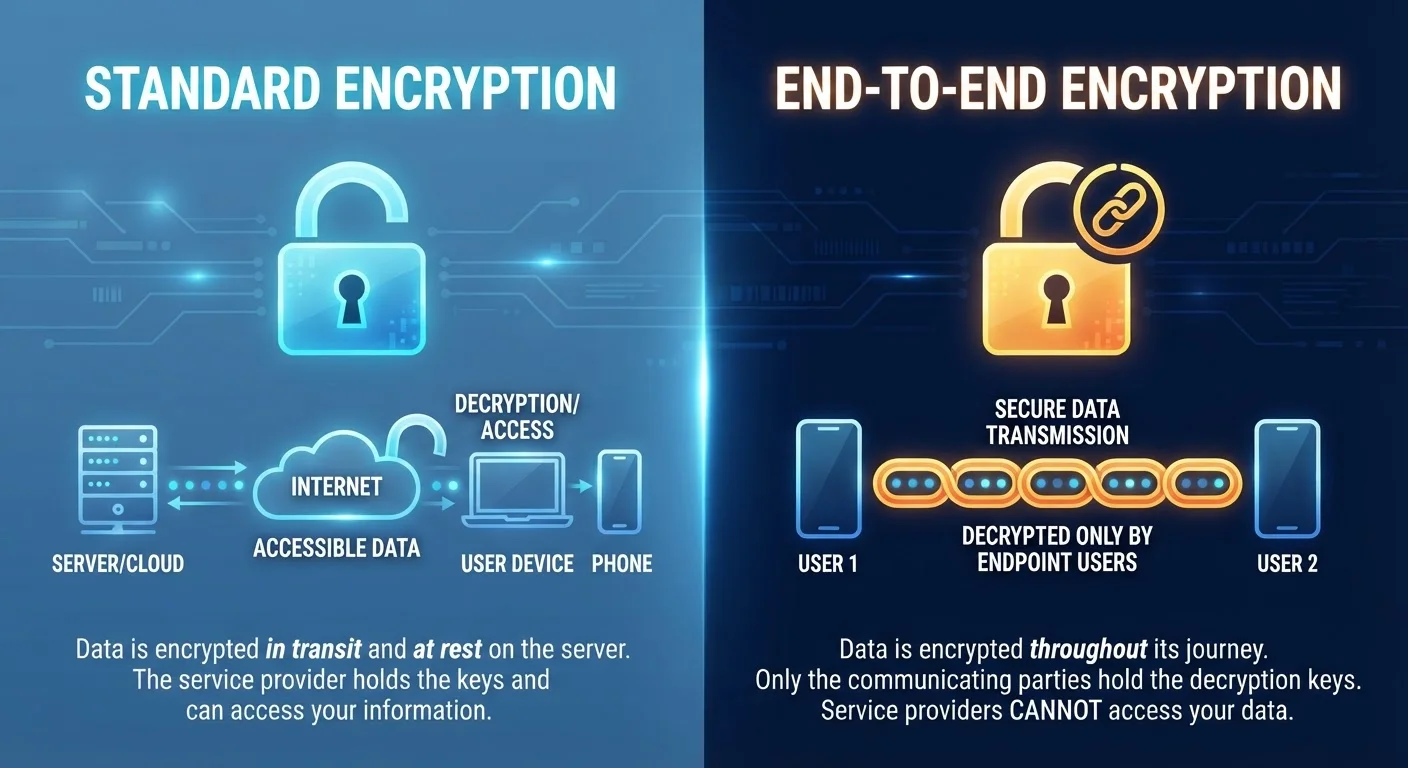
Standard encryption (often called encryption in transit or transport-layer encryption) protects your data as it travels between your device and a server. The connection is secured, so outside attackers cannot intercept the data mid-journey. However, once it arrives at the server, the service provider can decrypt it. They hold the encryption keys. This is how most email services, many cloud platforms, and typical web browsing (HTTPS) work.
End-to-end encryption (E2EE) goes further. The data is encrypted on your device before it leaves, and it can only be decrypted by the intended recipient's device. No one in between - not hackers, not internet service providers, and not the platform itself - can read the content. Only the sender and recipient hold the keys.
Think of standard encryption as a locked delivery van: safe on the road, but the depot can open the package. End-to-end encryption is more like a sealed envelope where only you and your recipient have the only two copies of the key.
How This Plays Out in Real Scenarios
Understanding the practical difference helps you make smarter choices about which tools to use for which situations.
Messaging
A messaging app using standard encryption protects your conversation from eavesdroppers on public Wi-Fi, but the company running the service can read your messages - and may be required to share them with authorities under a legal order. An app using E2EE means the company itself has no readable version of your conversations to hand over, even if compelled. This is why E2EE matters specifically for private messaging.
Cloud Storage
Most cloud storage services use standard encryption. This allows them to offer features like thumbnail previews, search indexing, and account recovery if you forget your password. With E2EE-based cloud storage, those features often become impossible - because the provider genuinely cannot see your files.
Standard email protocols use transport encryption, but the email provider can still access stored messages. True E2EE email requires both parties to use compatible encryption tools, which is why it remains less common in everyday use.
| Standard Encryption | End-to-End Encryption | |
|---|---|---|
| Who can read your data | You and the service provider | Only sender and recipient |
| Protection from hackers in transit | Yes | Yes |
| Protection from the platform itself | No | Yes |
| Account/data recovery if locked out | Usually available | Often not possible |
| Platform features (search, backup, sharing) | Fully supported | Often limited |
| Common use cases | Email, most cloud storage, HTTPS browsing | Select messaging apps, some storage tools |
If you travel and connect to unfamiliar networks, layering your choice of encryption with other security habits is important. See our guide to digital security while travelling for complementary steps.
Trade-Offs You Should Know About
Neither approach is universally superior - each involves real trade-offs.
Check Before You Assume
Not every app that mentions 'encryption' uses end-to-end encryption. Look for explicit statements in a service's privacy policy or security documentation specifying that the provider cannot read your content. If it only says 'encrypted in transit,' that is standard encryption. The distinction is usually stated clearly when E2EE is genuinely in place.
Standard encryption trade-offs:
- Provider can assist with account recovery if you lose access
- Supports features like search, moderation, and shared access
- Your data is accessible to the provider - and potentially to third parties under legal process
E2EE trade-offs:
- If you lose your encryption keys or device access, recovery may be impossible
- Platform features like cloud search or message backup can be limited
- Provides the strongest protection against both external attackers and the platform itself
For a broader view of how encryption fits into your overall security posture, the full guide to protecting your digital life covers passwords, networks, and device habits together. You might also consider how two-factor authentication options compare - another area where the details matter as much as the feature itself.
Encryption is one layer of security, not the whole answer. Device-level security principles - including strong authentication and keeping software updated - work alongside encryption to protect your digital life.
The content on this site is for informational purposes only and is not a substitute for professional advice. Always consult a qualified professional for guidance specific to your situation.